
AAhrefs
Ahrefs is an SEO and search-marketing platform for researching keywords, backlinks, competitors, rankings, website health, and visibility in AI-generated answers. It also provides content optimization, web analytics, paid-search intelligence, social publishing, and reporting modules.
Why people leave Ahrefs
Someone may seek an Ahrefs alternative when the platform’s expanding scope exceeds the job they need to accomplish. Ahrefs now spans conventional SEO research, AI-search visibility, content optimization, web analytics, paid-search analysis, social publishing, local SEO, and reporting. A smaller team that only needs rank tracking, keyword research, backlink analysis, or site auditing may prefer a narrower tool with fewer modules and a workflow centered on that specific task. Conversely, an organization with specialized teams may want separate products whose interfaces and data models are designed more deeply around each discipline.
Ahrefs bases much of its differentiation on a proprietary web index, keyword databases, estimated traffic metrics, and its own SEO measures. These are useful for comparative research, but organizations may want an alternative data source, different metric definitions, or the ability to compare estimates across multiple providers. Teams that rely primarily on first-party information from Google Search Console or their own analytics infrastructure may also prefer a lighter intelligence layer. Ahrefs states that GSC Insights enhances Search Console data rather than replacing Search Console, so some teams may decide that another reporting workflow better fits their existing stack.
The breadth and scale of the available reports can also create a learning and operational burden. Ahrefs supports detailed competitor research, keyword clustering, SERP analysis, backlink prospecting, global rank tracking, AI-answer monitoring, and customizable reporting. Users with simpler requirements may find a more guided product easier to adopt, while advanced teams may prefer tools that expose more control over collection, transformation, and automation. Agencies or organizations with unusual reporting requirements might also look for alternatives that align more closely with their preferred dashboards, APIs, deployment model, or internal processes.
Finally, teams interested in open-source software may prioritize inspectable code, self-hosting, data residency, extensibility, or reduced dependence on one vendor’s proprietary index and metrics. Replacing Ahrefs with open-source software would not automatically reproduce its large search and web datasets, however; crawling infrastructure, keyword data, backlink indexes, and ranking collection can be costly and technically demanding to operate. An alternative is therefore most plausible when the organization values control and customization enough to accept narrower datasets, integrate several data sources, or maintain more of the underlying infrastructure itself.
2 Best Open Source Ahrefs Alternatives (Ranked)
Each alternative is evaluated for core feature coverage, deployment options, licensing, project health, and overall fit. The ranking prioritizes how closely a tool matches Ahrefs's primary workflows, using popularity only as a secondary signal.
OOpen-seo12,059
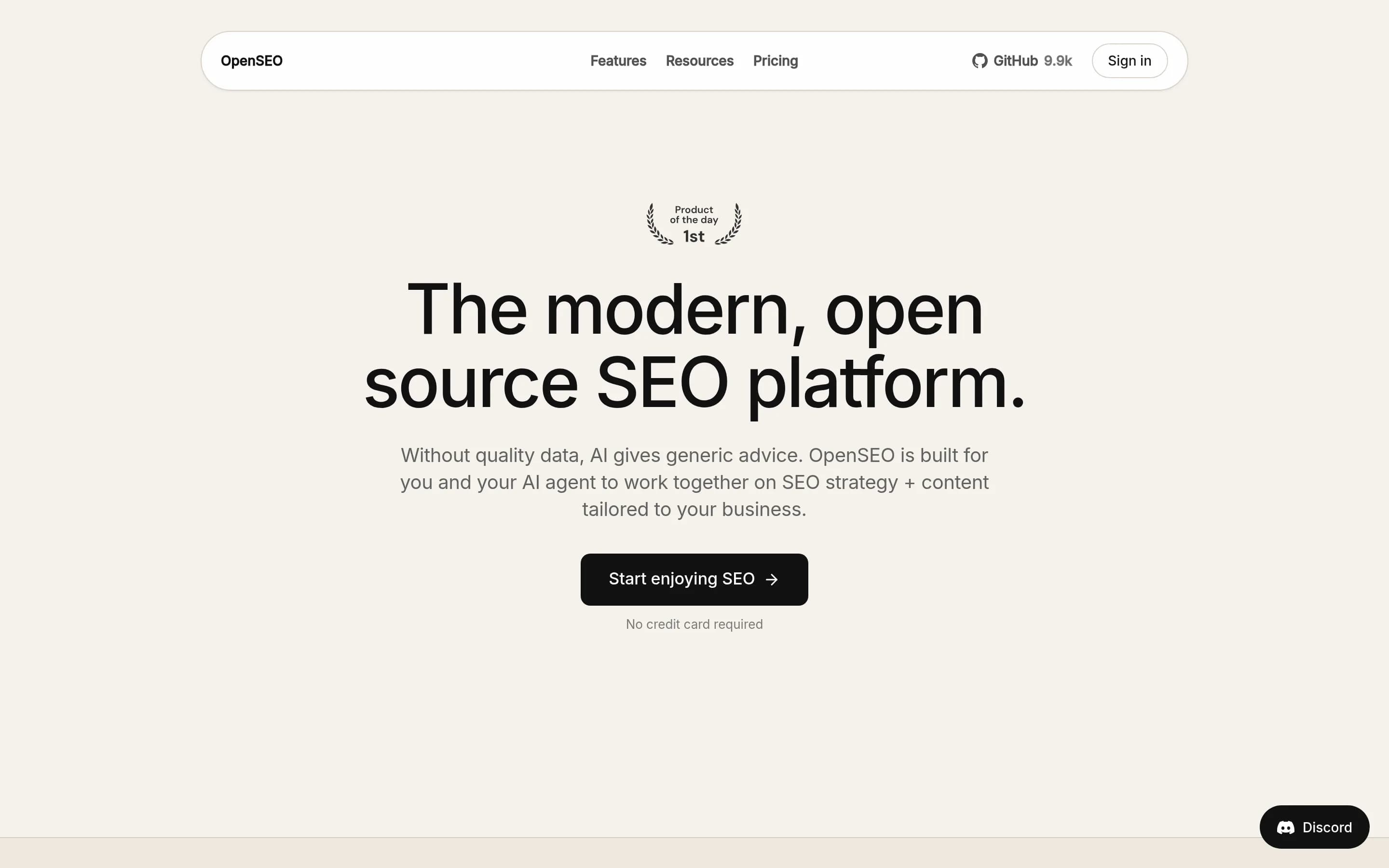
OpenSEO is a plausible narrower replacement for teams whose Ahrefs usage centers on keyword research, competitor/domain research, backlinks, rank tracking, site audits, AI visibility, and Search Console data. Its main tradeoff is control versus breadth: OpenSEO is MIT-licensed and self-hostable, but relies on a separately billed DataForSEO API and the supplied evidence does not document Ahrefs-like custom reporting,1
What it does
OpenSEO is an open-source, pay-as-you-go SEO platform covering keyword research, rank tracking, competitor insights, backlink analysis, site audits, and AI visibility. It presents focused workflows through a modern UI and can connect SEO data to AI agents such as Claude Code, OpenClaw, and Hermes through MCP and reusable agent skills.
The project supports a hosted version as well as self-hosting with Docker for personal use or Cloudflare for internet-facing deployments. Users supply their own DataForSEO API key and pay the underlying provider directly for SEO data. The repository also documents local development and customization through forking.
What it covers
- Keyword research and intent metrics
- Keyword organization and topical grouping
- Competitor domain research
- Backlink and referring-domain analysis
- Desktop and mobile rank tracking
- Technical site auditing
- AI-search mention and citation research
- Google Search Console metrics access
What’s different
- Custom dashboards and portfolio reports
- Content optimization workflows
- Real-time web and bot analytics
Crawlseo538
CrawlSEO is a narrower, self-hosted alternative for teams centered on Google Search Console, site crawling, Core Web Vitals, basic rank tracking, and optional third-party keyword/backlink data. Choose it when infrastructure control and inspectable MIT-licensed code matter more than breadth. Keep Ahrefs when you need its broader proprietary research datasets, competitor intelligence, global rank coverage, AI-answer監視,
What it does
CrawlSEO is an open-source SEO monitoring dashboard for founders and site owners. It connects Google Search Console with site crawling and Core Web Vitals, presenting keywords, pages, clicks, impressions, CTR, position changes, health scores, technical issues, content scoring, and remediation guidance.
The application also documents DataForSEO-powered keyword ideas and backlink analysis, historical rank snapshots, SEO opportunity detection, CSV export, and alerts through email, Slack, Telegram, or webhooks. An included MCP server exposes ten tools for querying SEO data, running crawls, and finding opportunities through supported AI-agent clients.
CrawlSEO is self-hosted under the MIT license. The README documents Docker Compose deployment with PostgreSQL, Google OAuth, and prebuilt multi-architecture images, plus a manual Node.js and PostgreSQL installation path.
What it covers
- Google Search Console integration
- Site crawling and SEO audits
- Keyword research with optional provider key
- Backlink profile analysis
- Historical keyword-position tracking
What’s different
- No documented keyword clustering or parent-topic analysis
- No documented comprehensive competitor or paid-search intelligence
- No documented 190+ location rank tracking
- No documented AI-answer brand visibility monitoring
- No documented AI-assisted content optimization workflow
- No documented customizable portfolio reporting