
CClay
Clay is a go-to-market sales intelligence platform for sourcing, researching, and enriching prospect and account data. It combines data from more than 200 providers with AI research, signals, automated workflows, and execution tools for outreach and advertising.
Why people leave Clay
Teams might seek an alternative if they need a narrower prospecting product rather than a broad system for building custom go-to-market workflows. Clay brings together a data marketplace, waterfall enrichment, AI agents, signals, orchestration, advertising audiences, and sequencing. That breadth can be useful, but organizations with a straightforward requirement—such as finding contacts, enriching a CRM, or sending outbound messages—may prefer a tool centered on one predefined workflow with fewer components to configure and maintain.
Clay’s approach also depends on combining first- and third-party sources, including more than 200 data providers. A team may instead want a product with its own unified dataset, a smaller set of standardized sources, or a different model for purchasing and governing external data. Organizations that already have preferred enrichment vendors could look for an alternative that connects those vendors without introducing another marketplace. Others may need coverage in particular regions, industries, or data fields and should compare the relevant sources directly rather than assume that a large provider catalog guarantees the required records.
Some buyers may not need Clay’s emerging category of GTM engineering. Building, testing, and scaling custom plays through agents, functions, formatting, integrations, and real-time workflows can require operational ownership and process design. A sales team without dedicated operations or technical resources might favor an application with fixed prospecting steps, managed campaign templates, or a more conventional user experience. Conversely, highly technical teams may prefer general-purpose integration infrastructure or code-first tooling that is not specifically organized around revenue workflows.
Finally, companies may want execution and relationship management to live in a single specialized system. Clay offers a native sequencer, automated messaging, ad-audience synchronization, CRM enrichment, and reverse ETL, but the crawled page presents these as parts of a wider GTM platform rather than a full CRM, dedicated email-marketing suite, or advertising platform. Teams whose central need is deal management, sophisticated campaign administration, or paid-media optimization may therefore evaluate category-specific alternatives. Requirements around deployment, governance, integrations, support, and total cost should also be checked against current product documentation and pricing before making a decision.
1 Best Open Source Clay Alternatives (Ranked)
Each alternative is evaluated for core feature coverage, deployment options, licensing, project health, and overall fit. The ranking prioritizes how closely a tool matches Clay's primary workflows, using popularity only as a secondary signal.
CCrm8,650
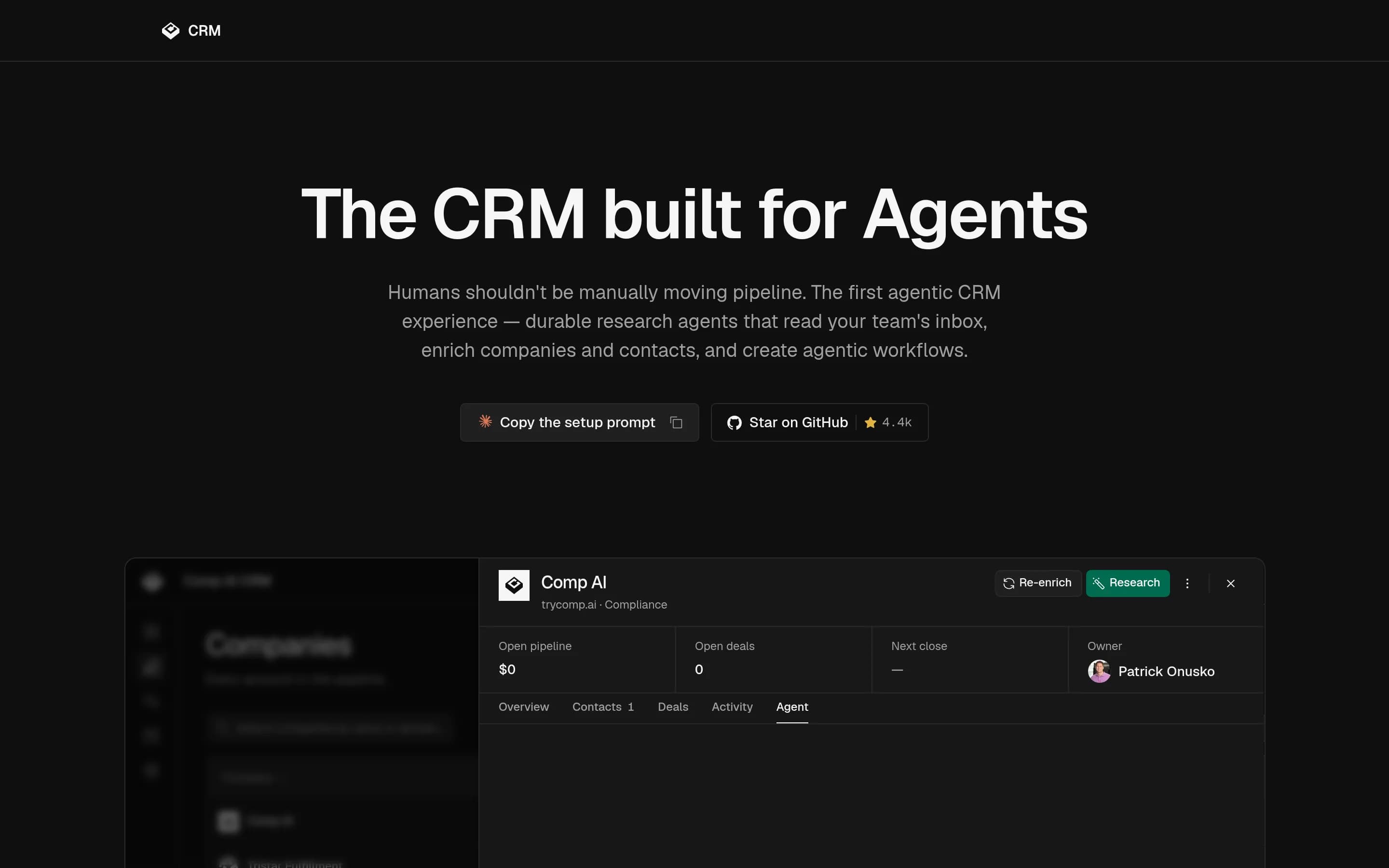
Comp AI CRM is not a drop-in open-source replacement for Clay: it is a self-hostable, agent-first CRM focused on maintaining records, researching contacts and companies, and scheduling follow-ups. Choose it when CRM ownership and durable, evidence-oriented agents matter more than Clay’s broad prospect-sourcing, multi-provider waterfall enrichment, sequencing, and advertising workflows. Choose Clay when those GTM data
What it does
Comp AI CRM is an open-source customer relationship management system designed around an autonomous research agent. It stores notes and evidence for contacts, companies, and deals; researches people and companies; enriches records; identifies contacts; records facts; answers questions in an Agent tab; and schedules follow-ups and rechecks.
The repository documents a Next.js front end, NestJS API, Postgres database, authentication, mailbox synchronization, durable agent sessions, scheduled work queues, and optional external research integrations. Local setup uses Bun and Docker Compose, with separate app, API, and agent deployments described for production. The project is MIT licensed and supports user-controlled deployment.
What it covers
- AI-assisted company and contact research
- CRM record enrichment
- Scheduled agent workflows
- External data-source integration
What’s different
- No documented multi-provider data marketplace
- No documented waterfall enrichment
- No documented prospect-list sourcing workflow
- No documented outbound sequencer
- No documented advertising-audience sync
- No documented Clay data importer