
EElevenLabs
ElevenLabs is an AI audio platform for generating and editing synthetic speech, voiceovers, music, and sound effects, with APIs for embedding these models into applications. It also provides tools for deploying multilingual voice and chat agents.
Why people leave ElevenLabs
Someone may seek an ElevenLabs alternative when their needs are narrower than the platform’s expanding scope. ElevenLabs combines creative audio production, image and video generation, conversational agents, transcription, dubbing, and developer APIs. A creator who only needs text-to-speech, a podcast editor, or a local voice-cloning workflow may prefer a more focused product with fewer overlapping tools and a simpler production environment. Likewise, a support team may want a dedicated customer-service platform rather than a broad AI communication suite.
Usage-based economics may also prompt comparison. The published plans allocate monthly credits, estimate included minutes, and charge for additional usage, while some capabilities, output qualities, workspace seats, and voice clones vary by plan. Organizations producing long-form narration, handling high call volumes, or making frequent generation attempts may want an alternative with different usage limits, predictable flat-rate pricing, or infrastructure they can operate themselves. Teams should assess this against their actual generation volume rather than assuming one pricing structure is universally cheaper.
Deployment, privacy, and administrative requirements can be another factor. ElevenLabs describes cloud services alongside enterprise options such as regional data residency, Zero Retention Mode, SSO, RBAC, custom service-level agreements, HIPAA-eligible configurations, and dedicated engineering support. These controls may require an enterprise arrangement. A team with strict data-sovereignty rules, offline production needs, private-environment requirements, or a preference for self-hosting may therefore investigate open-source systems that provide greater direct control over models, audio, logs, and deployment architecture.
Finally, users may need deeper specialization or different integration choices. ElevenLabs offers built-in integrations, APIs, multilingual generation, dubbing, and low-latency agent workflows, but a production may depend on a particular model, editing interface, telephony stack, language, or customization process. Audio professionals could prefer a conventional timeline-based editor or DAW, while developers might prioritize model portability and source-level customization. Customer-service teams may instead value mature ticketing and case-management workflows. In these cases, an alternative may fit the surrounding workflow better even if it does not reproduce the full ElevenLabs feature set.
10 Best Open Source ElevenLabs Alternatives (Ranked)
Each alternative is evaluated for core feature coverage, deployment options, licensing, project health, and overall fit. The ranking prioritizes how closely a tool matches ElevenLabs's primary workflows, using popularity only as a secondary signal.
VVoiceStudio9,971
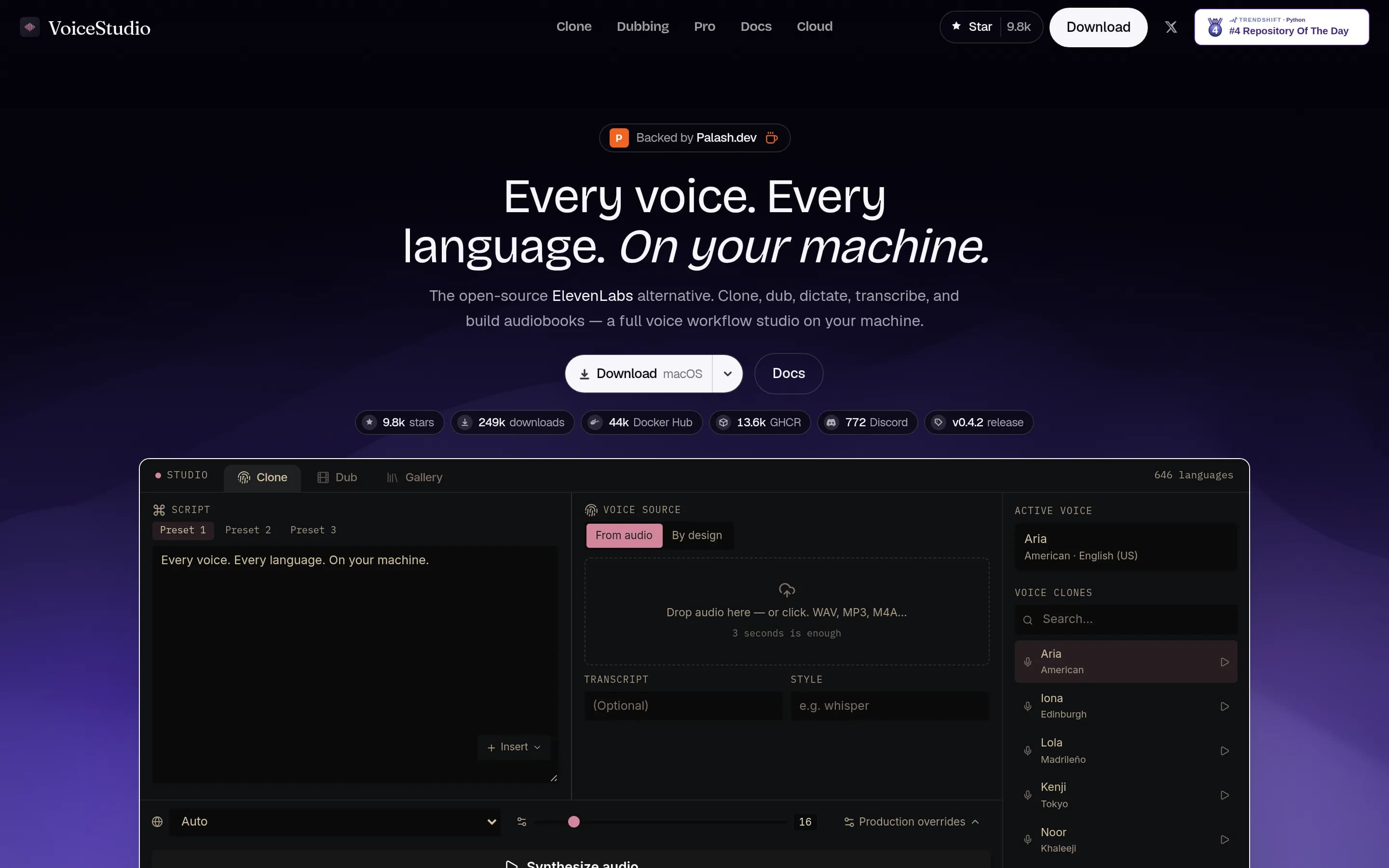
Choose VoiceStudio when the priority is local control over a focused speech workflow: it covers text-to-speech, cloning, transcription, dubbing, audiobooks, and a local API without requiring a cloud account. Choose ElevenLabs when you need the broader documented platform—especially conversational agents, agent testing and guardrails, music, sound effects, or managed cloud operations. VoiceStudio also carries more do‑
What it does
VoiceStudio is an open-source desktop application for generating and working with synthetic speech locally. Its documented workflows include text-to-speech, zero-shot voice cloning, voice design, dictation, transcription, video dubbing, audiobook creation from EPUB or PDF files, and multi-voice stories. It supports multiple TTS and ASR engines, batch queues, speaker diarization, vocal isolation, watermarking, and GPU-aware engine routing.
The application is designed for user-controlled deployment on macOS, Windows, and Linux, with downloadable DMG, MSI, and AppImage releases plus Docker installation guidance. Processing runs on the user’s machine without accounts, API keys, or cloud dependence, while a remote-backend option is also documented. The project is licensed AGPL-3.0 and exposes an OpenAI-compatible API and MCP server.
What it covers
- Text-to-speech generation
- Zero-shot voice cloning
- Prompt-based voice design
- Speech transcription
- Multilingual video dubbing
- Programmatic speech access
What’s different
- No documented conversational agents
- No documented agent testing or guardrails
- No documented music generation
- No documented sound-effect generation
- No documented ElevenLabs project or voice importer
EmotiVoice8,514
EmotiVoice is a focused, self-hostable text-to-speech engine with English and Chinese voices, prompt-controlled emotion, voice cloning, batch generation, and an API. Choose it when infrastructure control and a narrower TTS workflow outweigh the work of operating a GPU-backed service. Choose ElevenLabs when you need a broader managed platform covering transcription, dubbing, music, sound effects, or conversational omn
What it does
EmotiVoice is an open-source text-to-speech engine that generates English and Chinese speech with more than 2,000 voices. Its defining workflow uses prompts to control emotion and style, including happy, excited, sad, and angry delivery. The README also documents personal-data voice cloning, adjustable voice speed, an interactive web interface, batch scripting, and an OpenAI-compatible TTS API.
Users can run the provided Docker image with an NVIDIA GPU, install the project through Conda and pip, or use the Streamlit demo page locally. The project includes pretrained-model setup and command-line inference workflows, and an HTTP API is available for application integration. It is released under the Apache-2.0 license.
What it covers
- Text-to-speech generation
- Multiple selectable voices
- Voice cloning with personal data
- API-based speech generation
- Adjustable voice speed
What’s different
- No documented speech transcription
- No documented multilingual dubbing
- No documented music generation
- No documented sound-effect generation
- No documented conversational agents
- No documented agent testing or guardrails
- Language coverage limited to documented English and Chinese
AAbogen5,692
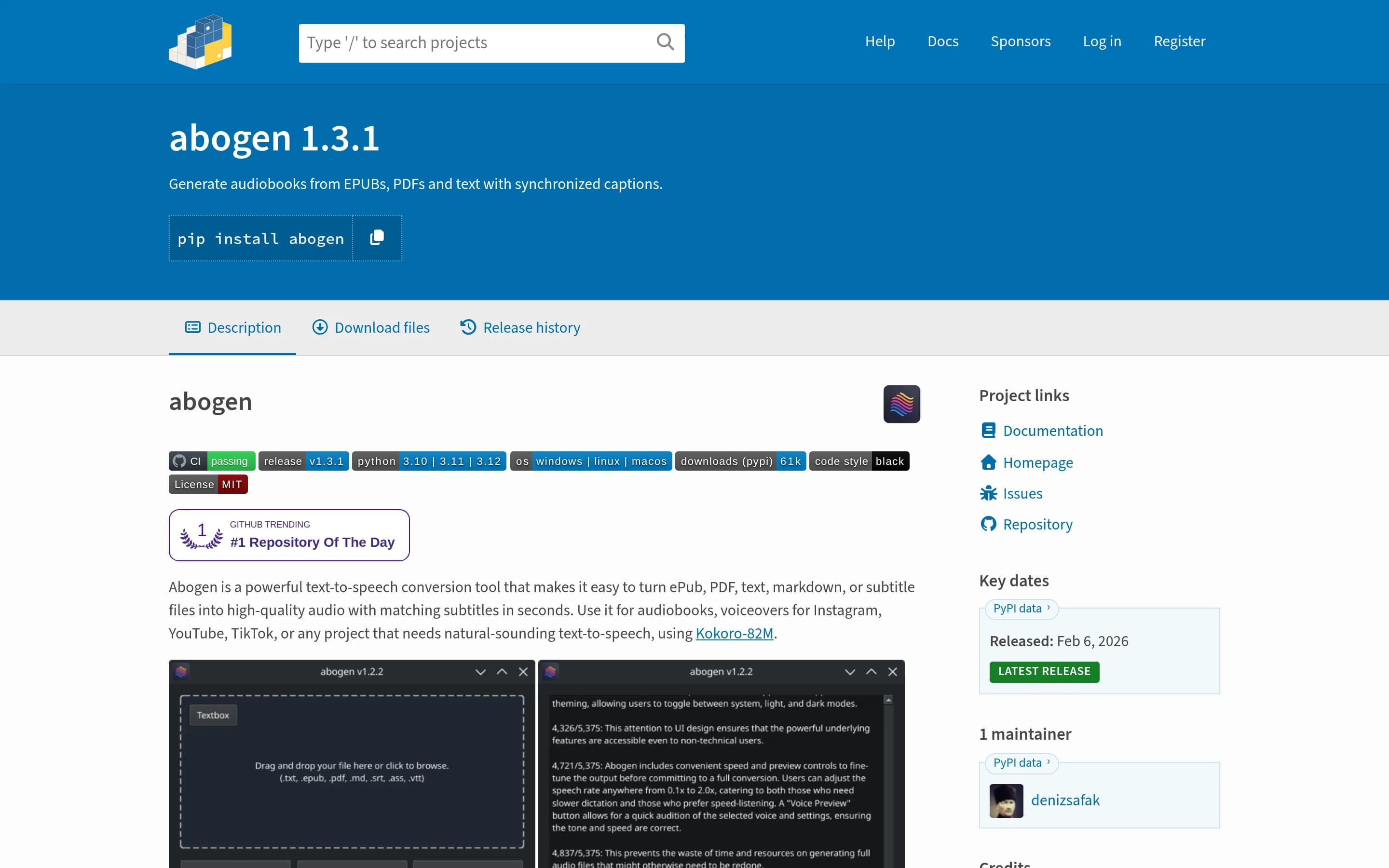
Choose Abogen for self-hosted, offline, document-to-speech production—especially audiobooks with synchronized subtitles, chapter handling, queues, and local output files. Choose ElevenLabs when you need the broader documented platform scope, including transcription, multilingual dubbing, application APIs, conversational agents, music, or sound effects; these capabilities are not documented for Abogen. The central cut
What it does
Abogen is an open-source text-to-speech application for converting EPUB, PDF, text, Markdown, and subtitle files into audio with synchronized captions. It supports audiobook creation, voiceovers, adjustable speech speed, voice previews, custom voice mixing, chapter selection, separate or merged chapter files, and batch queues.
The project provides a PyQt6 desktop GUI and a Flask web UI, with downloadable WAV, FLAC, MP3, OPUS, and M4B outputs plus SRT or ASS subtitles. It uses Kokoro-based models, supports Windows, macOS, and Linux installation, and documents pre-downloading models and voices for offline use. The web interface runs locally at port 8808.
What it covers
- Text-to-speech voiceover generation
- Selectable or customizable voices
- Multilingual voice selection
- Audio output for content production
What’s different
- No documented speech transcription
- No documented multilingual dubbing
- No documented application APIs
- No documented conversational agents
- No documented agent testing or guardrails
- No documented music generation
- No documented sound-effect generation
- No documented direct ElevenLabs import
GPT-SoVITS60,905
Choose GPT-SoVITS when the priority is self-hosted, source-level control over focused text-to-speech, voice conversion, and few-shot voice cloning—and the team can operate its Python/model infrastructure. Choose ElevenLabs when you need a broader managed platform spanning dubbing, developer APIs, music, sound effects, or conversational agents. GPT-SoVITS documents multilingual ASR and cross-lingual synthesis, but not
What it does
GPT-SoVITS is an open-source voice synthesis application with a WebUI for zero-shot and few-shot text-to-speech, voice conversion, and voice cloning. It can use a five-second vocal sample for instant synthesis or about one minute of training data for fine-tuning, with support for Chinese, English, Japanese, Korean, Cantonese, and related workflows.
The project includes tools for audio separation, dataset segmentation, multilingual ASR, transcription proofreading, model fine-tuning, inference, and speech-speed control. It can be installed on Windows, Linux, and macOS, run through Python and Conda, or deployed with Docker Compose; pretrained models and optional ASR and UVR5 models are downloaded separately.
What it covers
- Text-to-speech generation
- Short-sample voice cloning
- Multilingual speech workflows
- Speech transcription tooling
What’s different
- No documented multilingual dubbing workflow
- No documented application API suite
- No documented conversational agents
- No documented agent testing or guardrails
- No documented music generation
- No documented sound-effect generation
CChatTTS39,767
ChatTTS is a focused, self-hostable dialogue text-to-speech model rather than a full replacement for ElevenLabs. Choose ChatTTS for noncommercial research or internally operated English/Chinese conversational-speech experiments where source access and prosody controls matter. Choose ElevenLabs for commercial production or when you need its broader voiceover, transcription, dubbing, cloning, media-generation, agent,
What it does
ChatTTS is an open-source generative speech model designed for dialogue scenarios such as LLM assistants. It synthesizes expressive speech in English and Chinese, supports multiple speakers, and provides control over prosodic elements including laughter, pauses, and interjections. Streaming audio generation and sampled speaker embeddings are documented capabilities.
The repository includes a WebUI, command-line inference, Python usage examples, and audio export through torchaudio. It can be installed from PyPI, GitHub, or a local checkout and run with local Python dependencies and suitable hardware; the README cites at least 4GB of GPU memory for a 30-second clip. The code is AGPLv3+, while the released model is CC BY-NC 4.0 for academic and research use.
What it covers
- Text-to-speech generation
- Expressive speech synthesis
- Multiple-speaker output
- Prosody controls
- Multilingual speech support, with ChatTTS limited to English and Chinese
What’s different
- Speech transcription
- Multilingual dubbing workflow
- User voice cloning
- Audio and agent APIs
- Agent testing and guardrails
- Deployed voice and chat agents
- AI music generation
- Sound-effect generation
- Broad multilingual coverage
- Integrated production audio editor
Ebook2audiobook19,705
Ebook2audiobook is a focused, self-hostable choice for converting legally acquired, non-DRM ebooks or raw text into multilingual audiobooks, with local voice cloning and control over models and infrastructure. ElevenLabs is the better choice when the workflow also requires managed APIs, transcription, performance-preserving dubbing, creative audio generation, or conversational agents. Migrating trades platform scope—
What it does
ebook2audiobook converts ebooks and short text into audiobooks using multiple text-to-speech engines, including XTTSv2, Bark, Fairseq, VITS, Tacotron2, Tortoise, GlowTTS, and YourTTS. It supports many ebook and document formats, OCR for image-based pages, chapter and metadata handling, multilingual synthesis, optional voice cloning, custom or fine-tuned models, SML controls for pauses and voice switching, and output formats such as M4B, MP3, WAV, FLAC, and OGG.
The project can run locally on Linux, macOS, and Windows through a Gradio web interface or headless commands. It documents Docker, Hugging Face Spaces, Google Colab, and Kaggle execution paths, with CPU, CUDA, ROCm, MPS, XPU, and Jetson options. It is intended for use with legally acquired, non-DRM ebooks.
What it covers
- Text-to-speech generation
- Multilingual speech output
- Optional voice cloning
What’s different
- No documented speech transcription
- No documented performance-preserving dubbing
- No documented application API
- No documented conversational agents
- No documented agent tests or guardrails
- No documented music generation
- No documented sound-effect generation
- No documented prompt-based voice design
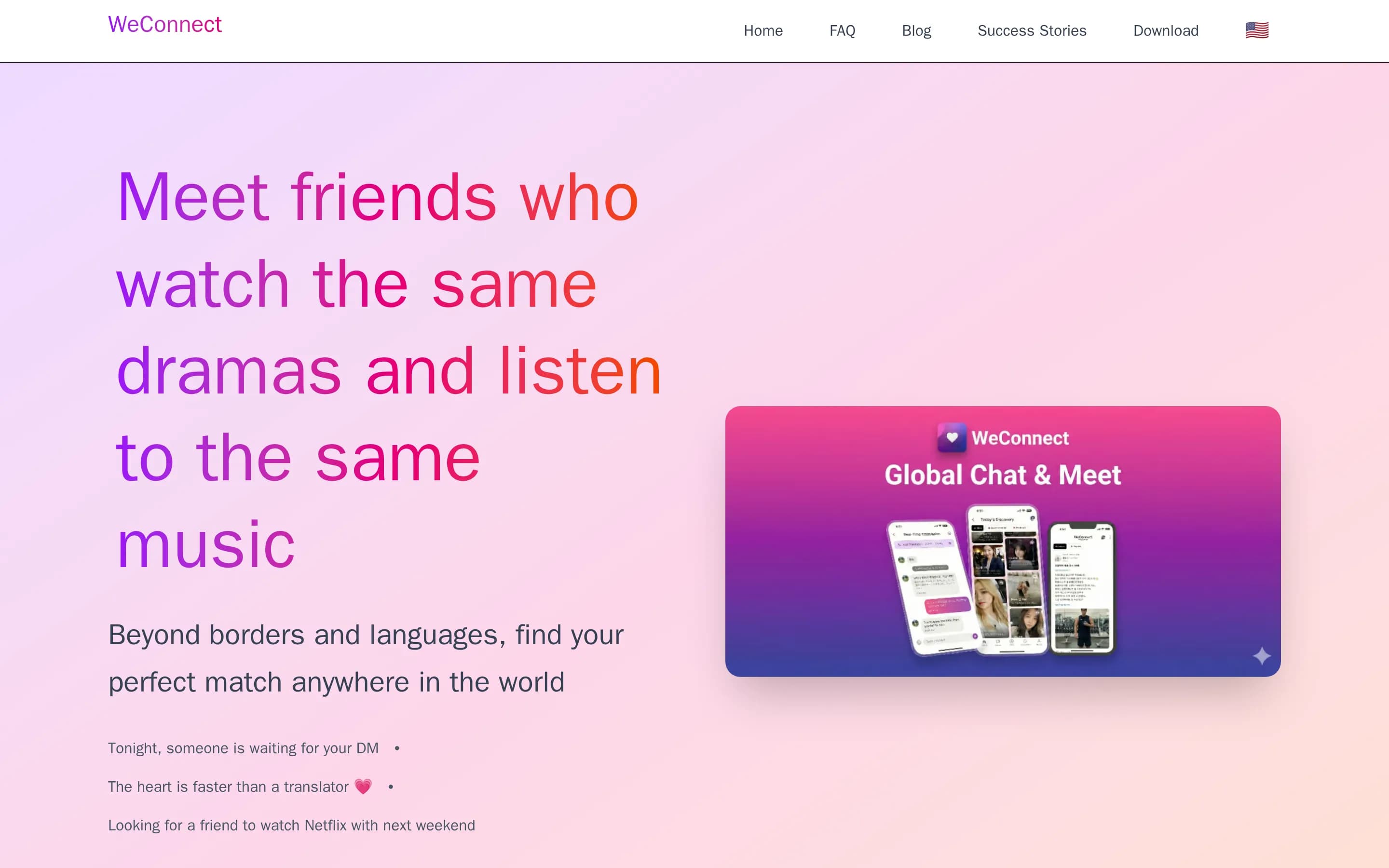
VVoice-pro12,362
Voice-Pro is a narrower, self-hostable alternative for local creator workflows centered on text-to-speech, transcription, translation, dubbing, and voice cloning. ElevenLabs remains the better choice for teams needing managed APIs, conversational agents, agent testing, music generation, or sound effects. The main tradeoff is infrastructure control and focused local tooling versus broader cloud-platform coverage and a
What it does
Voice-Pro is an open-source AI multimedia web application for creators, researchers, and multilingual professionals. Its workflows combine YouTube downloading and audio extraction, vocal separation, speech recognition, translation, subtitle generation, voice cloning, and text-to-speech in a Dubbing Studio. It supports Whisper variants, F5-TTS, E2-TTS, CosyVoice, kokoro, and Edge-TTS, with multilingual processing and configurable speech output.
The Gradio WebUI includes Dubbing Studio, Whisper Caption, Translate, and Speech Generation tabs. Users can process common media formats, export WAV, FLAC, or MP3 audio, create subtitles, translate subtitle files, and perform real-time voice recognition and translation. The repository describes Windows support, especially with an NVIDIA GPU, and provides a portable installer using start.bat; Mac and Linux operation is unverified.
What it covers
- Text-to-speech generation
- Speech-to-text transcription
- Multilingual translation and dubbing
- Zero-shot voice cloning
- Browser-based production interface
What’s different
- Documented application APIs
- Conversational voice and chat agents
- Agent testing and guardrails
- AI music generation
- Sound-effect generation
- Documented ElevenLabs import or compatibility path
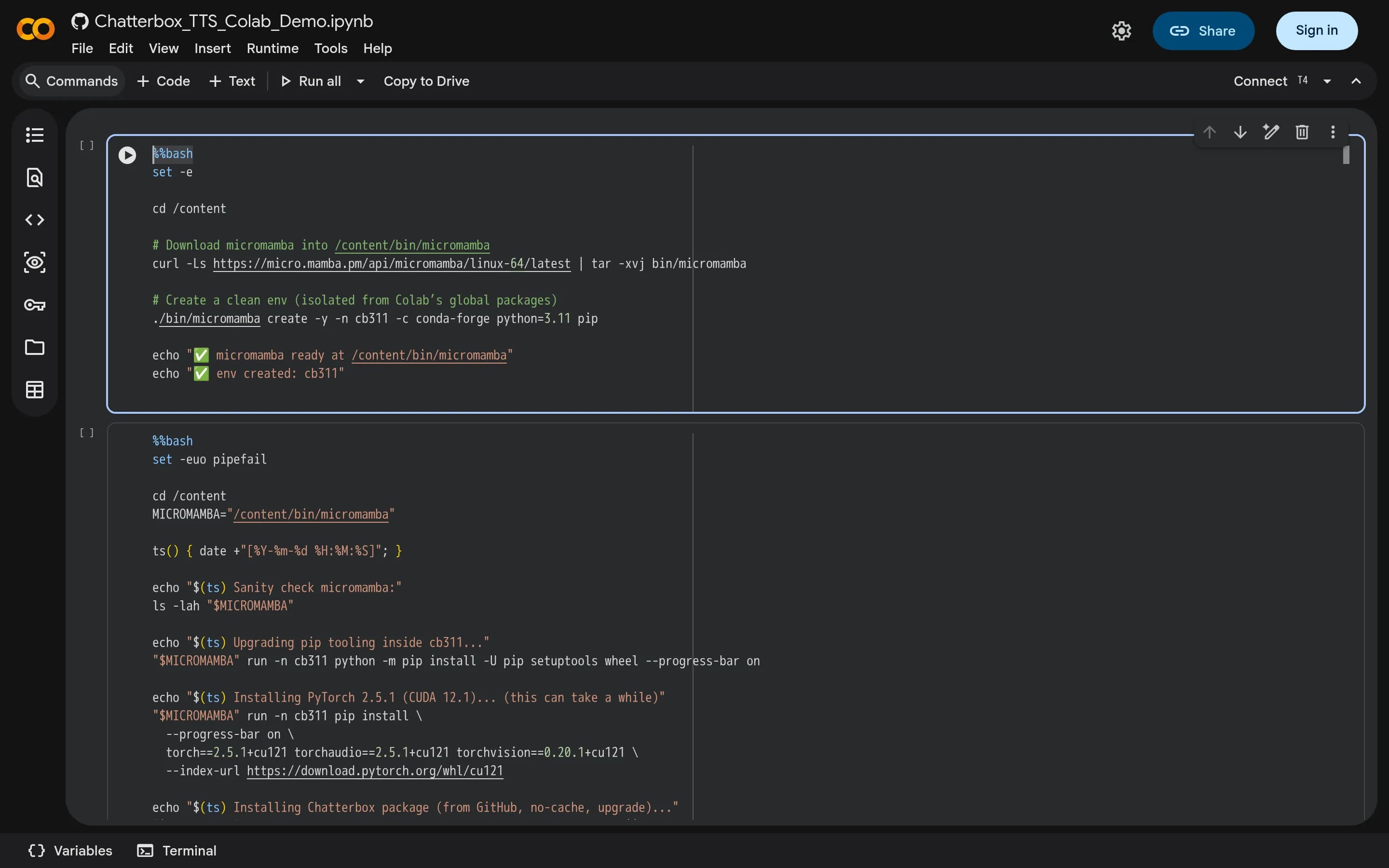
CChatterbox-TTS-Server1,406
Choose Chatterbox-TTS-Server for a focused, self-hosted text-to-speech stack with voice cloning, long-form generation, a Web UI, and an OpenAI-compatible API. Choose ElevenLabs when you need the broader managed platform—particularly transcription, dubbing, music, sound effects, or deployable conversational agents—which the supplied Chatterbox documentation does not cover.
What it does
Chatterbox TTS Server runs Resemble AI’s Chatterbox model family behind a modern Web UI and OpenAI-compatible API. Users can enter text, choose among Original, Multilingual, and Turbo engines, adjust generation parameters, use predefined voices or reference audio for cloning, and generate expressive speech with tags such as [laugh] and [cough]. It supports 23 languages through Chatterbox Multilingual and can process long text by chunking and joining segments for audiobook generation.
The project is self-hostable and documents automated local installation, Windows portable mode, Google Colab use, and Docker deployment. It runs with NVIDIA CUDA, AMD ROCm, Apple Silicon MPS, or CPU fallback, and exposes API endpoints including streaming text-to-speech and voice listing. The documented scope centers on speech synthesis and voice cloning; transcription, dubbing, music, sound-effects, and the
What it covers
- Text-to-speech generation
- Multilingual speech generation
- Reference-audio voice cloning
- Programmatic speech API
- Web-based generation interface
- Long-form narration support
What’s different
- No documented speech transcription
- No documented multilingual dubbing
- No documented music generation
- No documented sound-effect generation
- No documented conversational-agent deployment
- No documented agent testing or guardrails
Alexandria-audiobook863
Alexandria-audiobook is the stronger fit for self-hosted, GPU-backed audiobook production when users need multi-voice narration, local TTS, voice cloning, line-level control, and audiobook/DAW exports. ElevenLabs remains the better choice for teams needing a broader managed audio platform—particularly transcription, cross-language dubbing, application APIs, music or sound-effect generation, and conversational agents—
What it does
Alexandria Audiobook converts books and novels from TXT, Markdown, or EPUB into fully voiced audiobooks. An LLM annotates scripts with speakers, dialogue, and delivery directions, while the built-in Qwen3-TTS engine generates multilingual speech. Users can assign preset, cloned, designed, or LoRA-trained voices, preserve speaker aliases, adjust individual lines, regenerate selected chunks, preview sequences, and review scripts with a second LLM pass.
The browser-based editor provides a five-step workflow for setup, scripting, voice assignment, rendering, and results. Exports include combined MP3, per-line MP3, Audacity multi-track files, and chaptered M4B. It runs locally through Pinokio, Google Colab, or Docker with NVIDIA GPU support, and can connect to local or cloud OpenAI-compatible LLM services.
What it covers
- Text-to-speech generation
- Multilingual speech synthesis
- Voice cloning
- Prompt-based voice design
- Line-level voice direction
- Browser-based editing
- Batch audio generation
What’s different
- No documented speech transcription
- No documented multilingual dubbing workflow
- No documented public audio or agent APIs
- No documented conversational agents
- No documented agent testing or guardrails
- No documented music generation
- No documented sound-effect generation
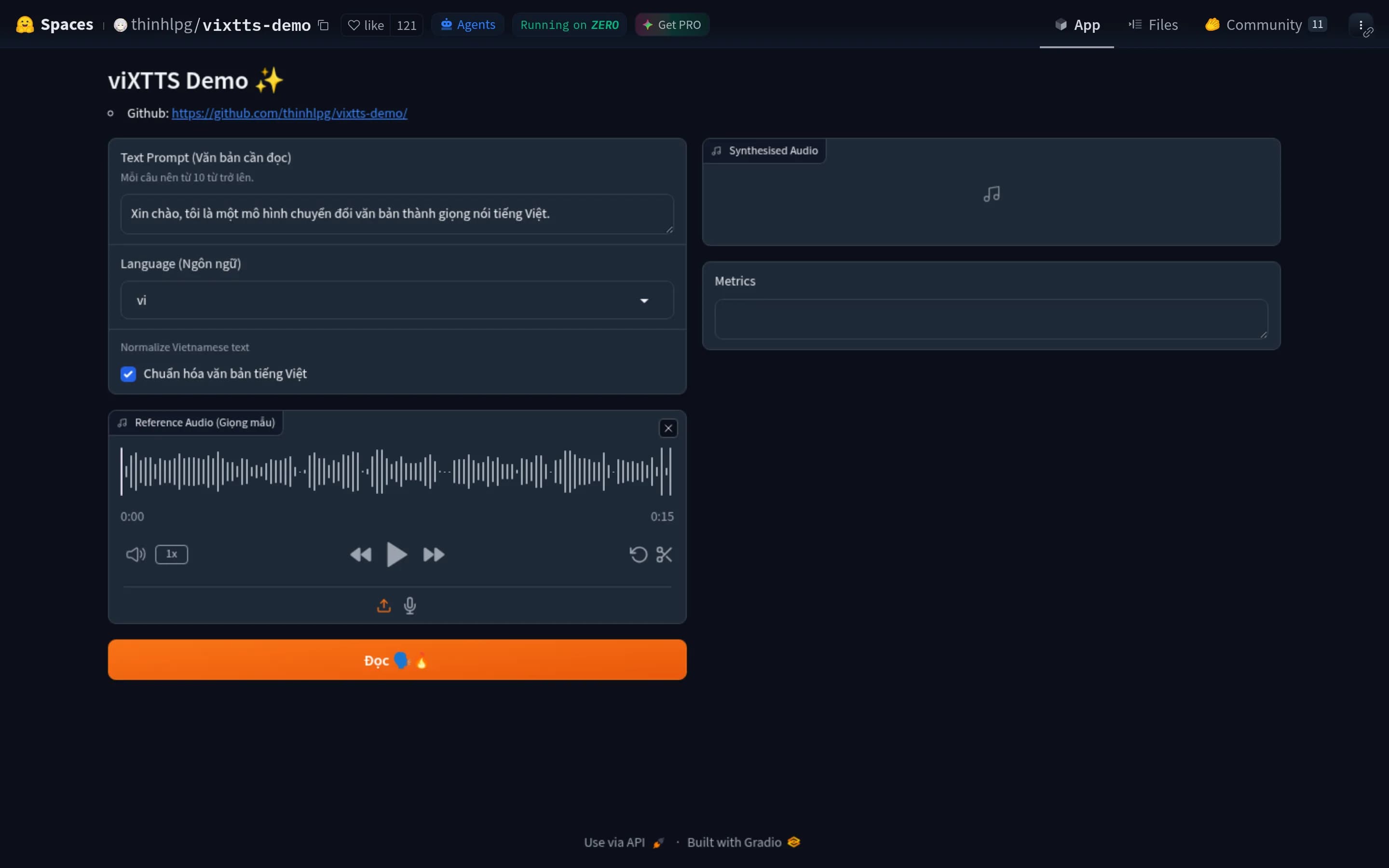
VVixtts-demo516
Vixtts-demo is a narrow, self-hostable Vietnamese-focused text-to-speech and voice-cloning demo, not a feature-complete replacement for ElevenLabs. Choose it when local control and a focused Vietnamese synthesis workflow outweigh operational maturity and breadth. Choose ElevenLabs when you need production APIs, transcription, dubbing, audio editing, generated music or effects, or conversational agents. Vixtts-demo is
What it does
viXTTS Demo is a Vietnamese voice-cloning and text-to-speech tool based on a fine-tuned XTTS-v2.0.3 model and the viVoice dataset. Users can enter text, generate speech in Vietnamese, and use cloned voices; the README also says other languages are offered, though their effectiveness has not been tested.
The project provides a hosted Hugging Face Space and a local Ubuntu or WSL2 workflow. Local use installs dependencies through run.sh, launches a Gradio demo, and saves generated results in an output directory. It recommends at least 16GB of RAM, 10GB of disk space, and an Nvidia GPU with 4GB of VRAM, while CPU inference is supported but slower.
What it covers
- Text-to-speech generation
- Reference-voice cloning
- Some multilingual speech capability
What’s different
- Documented speech transcription
- Documented multilingual dubbing workflow
- Documented production audio or agent APIs
- Voice design from text prompts
- Agent testing and guardrails
- Conversational voice and chat agents
- AI music generation
- Sound-effect generation
- Integrated voiceover editing workflow