
JJira
Jira is a project and work management platform for planning, coordinating, and tracking deliverables across software, marketing, design, operations, and other teams. It combines customizable workflows, flexible project views, automation, cross-team plans, integrations, and AI-assisted updates.
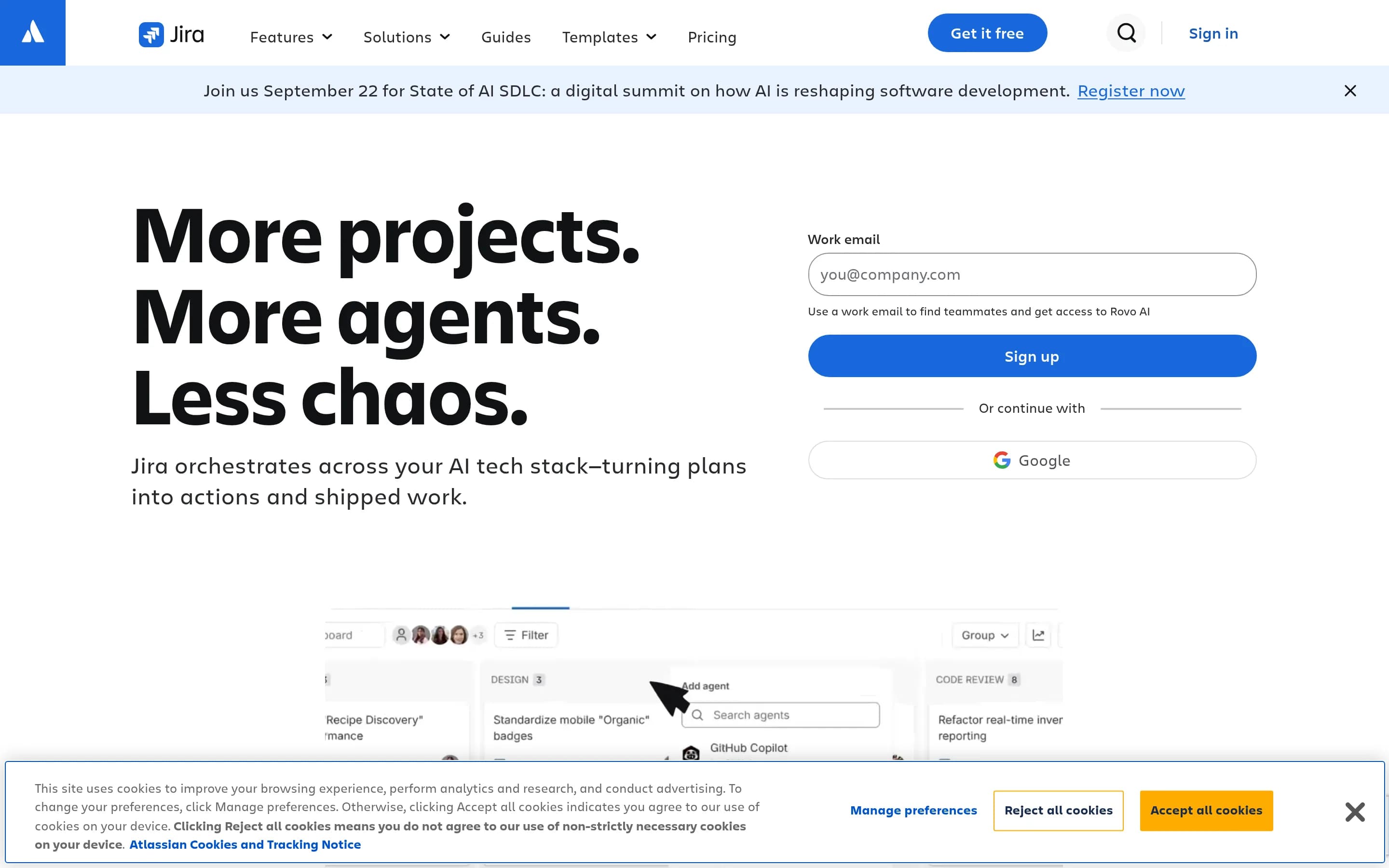
Why people leave Jira
Teams may seek a Jira alternative when its broad scope exceeds what they need. Jira supports software delivery, campaigns, operations, IT, and general project coordination through flexible views, custom workflows, templates, integrations, and automation. That adaptability can be valuable, but a team with a straightforward process may prefer a more focused tool with fewer configuration choices and a simpler path from initial setup to routine use.
Another motivation may be workflow fit. Jira is designed to adapt to different teams’ processes, including agile projects, campaign management, program planning, service requests, and incident tracking. Organizations that do not want to model their work around configurable work items, statuses, and workflows might look for an alternative built specifically for their preferred method. Conversely, teams with highly specialized processes may evaluate products that provide more purpose-built functionality rather than configuring a general project platform.
Jira also emphasizes connections among plans, work, goals, code, AI agents, and a large integration ecosystem. Some organizations may not need that degree of orchestration or may already rely on another ecosystem for documents, communication, development, or automation. They could favor a product that integrates more directly with their existing stack, reduces overlap with current tools, or keeps project data and workflow administration within a smaller system. Teams that do not intend to use AI agents or AI-assisted administration may likewise prioritize alternatives whose main experience is less centered on those capabilities.
Finally, organizations may reassess Jira as their operating model changes. Cross-team plans and centralized tracking can suit large programs, while smaller groups may value a lighter interface and less administrative overhead. A company may also prefer an open-source or self-managed option to gain greater control over deployment, customization, data handling, and long-term platform decisions. These considerations do not mean Jira is unsuitable in general; they reflect differences in team size, process complexity, technical environment, governance requirements, and the level of configurability an organization wants to maintain.
12 Best Open Source Jira Alternatives (Ranked)
Each alternative is evaluated for core feature coverage, deployment options, licensing, project health, and overall fit. The ranking prioritizes how closely a tool matches Jira's primary workflows, using popularity only as a secondary signal.
PPlane56,003
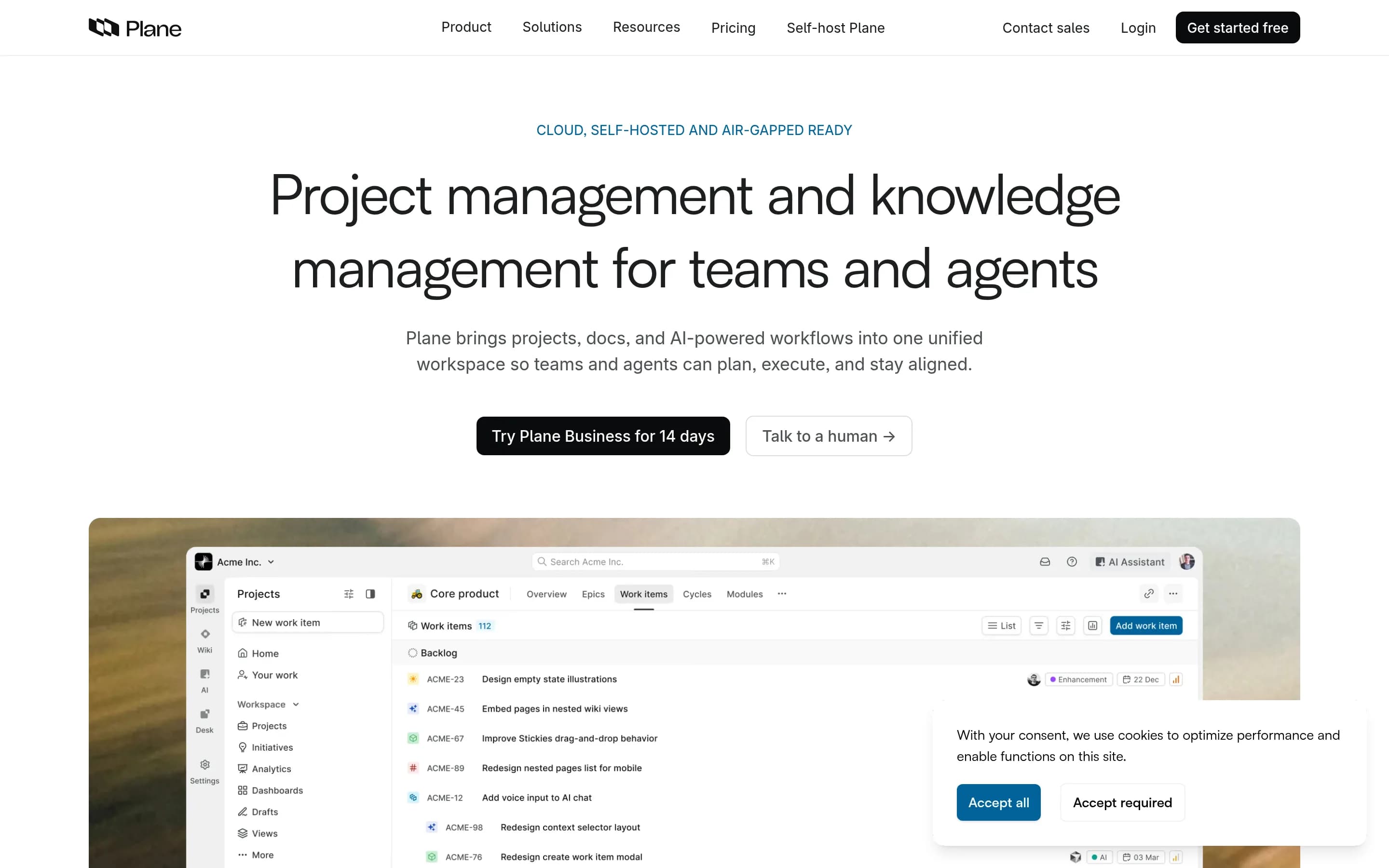
Plane is a credible open-source, self-hostable alternative for teams centered on work items, sprint-like cycles, roadmaps, filtered views, and project documentation. Choose Plane when deployment control and a focused project-management workflow matter most; choose Jira when you require documented breadth across cross-team programs, no-code automation, extensive integrations, or service and incident management, since等
What it does
Plane is an open-source project management platform for creating and managing work items, organizing cycles and modules, tracking issues, and managing product roadmaps. Its documented workflows include rich-text task editing, file uploads, sub-properties, related issues, filters, saved views, and converting notes into actionable items.
Plane also provides burn-down charts, real-time analytics, and Pages for organizing ideas and documentation. It can be used through Plane Cloud or deployed on user-controlled infrastructure, with documented Docker and Kubernetes installation methods. The repository is licensed under AGPL-3.0.
What it covers
- Work-item tracking
- Sprint-style cycles
- Custom filtered views
- Product roadmaps
- Project documentation
- AI-assisted workspace features
What’s different
- No documented service-desk parity
- No documented incident-tracking parity
- No documented no-code automation parity
- No documented integration parity
- No documented Jira configuration compatibility
OOpenproject15,857
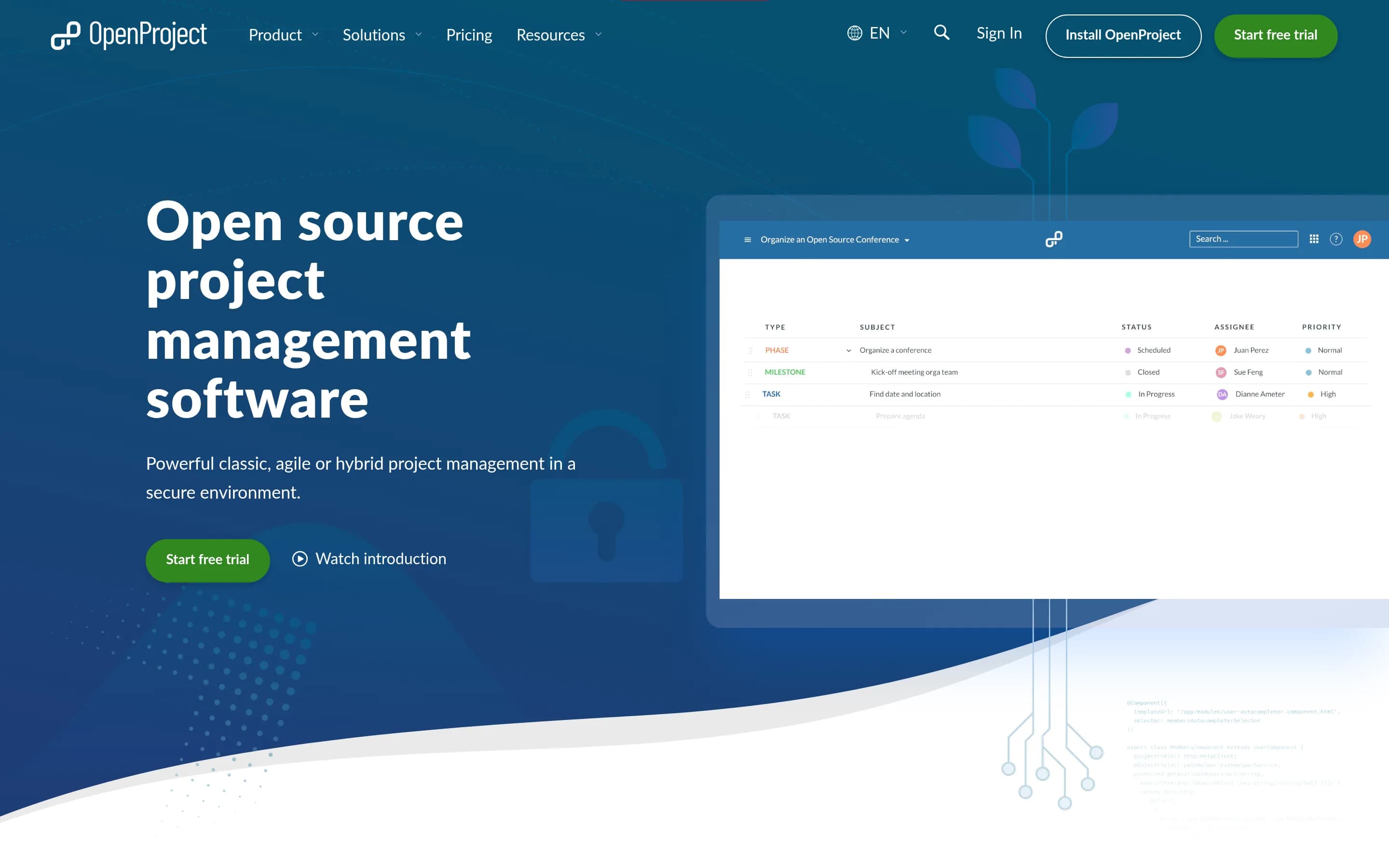
OpenProject is a credible Jira alternative for teams prioritizing open-source licensing, self-hosting, data control, and conventional project or portfolio management. It covers work items, customizable workflows, agile boards, roadmaps, Gantt planning, and developer integrations. Choose Jira when AI-assisted project work, broad application integrations, no-code automation, or service-request and incident workflows—sc
What it does
OpenProject is a web-based, open-source platform for teams and organizations managing projects, portfolios, products, tasks, bugs, agile workflows, and roadmaps. Its documented capabilities include project and portfolio management, Kanban and Scrum boards, Gantt-based planning and scheduling, task management, time tracking, cost reporting, budgeting, and team collaboration.
The software can be deployed under user control through its self-hosted Community Edition, with installation guides provided. An Enterprise Edition is also available through cloud or on-premises deployment, and documented integrations include Nextcloud, XWiki, GitHub, and GitLab.
What it covers
- Customizable work-item workflows
- Project and portfolio planning
- Scrum and Kanban boards
- Sprint and release planning
- Task, issue, and bug tracking
- Roadmaps and timeline planning
- Cross-project views
- GitHub integration
What’s different
- No documented AI project agents
- No documented service-request management
- No documented incident-management workflow
- No documented Slack or Figma integration
- No documented Jira-equivalent no-code automation breadth
LLeantime11,356
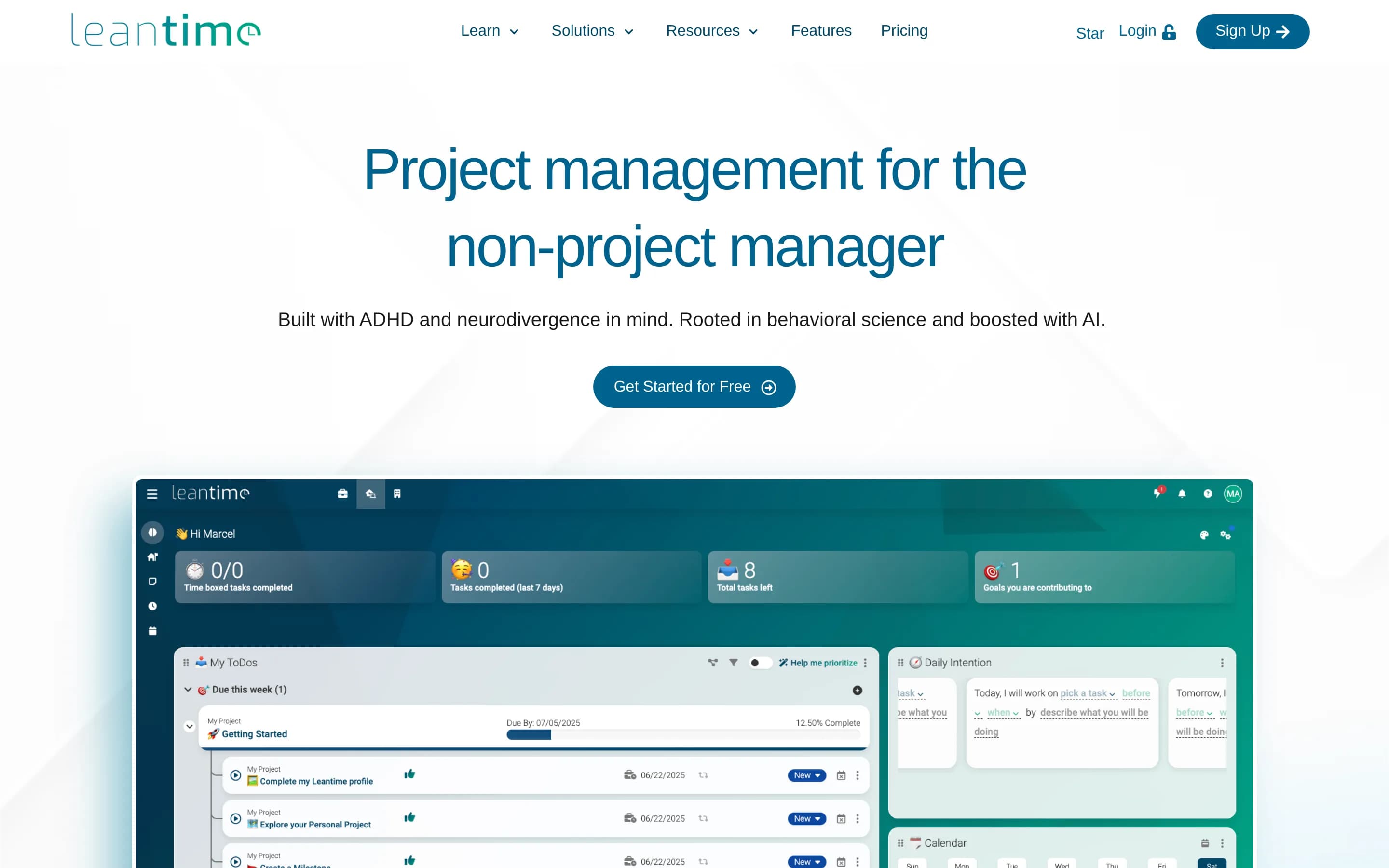
Leantime is a credible open-source replacement for Jira when the priority is self-hosted, goal-oriented project and task management with multiple views, sprint planning, timelines, and knowledge tools. Its documented positioning emphasizes non-project managers and neurodivergent users. Choose Jira when you require documented no-code automation, service-request or incident workflows, Jira-specific migration support, a
What it does
Leantime is an open-source project management system designed for non-project managers. It combines strategy, planning, and execution with task management through kanban, Gantt, table, list, and calendar views. Documented features include subtasks, dependencies, milestones, sprints, timesheets, project dashboards, reports, status updates, goals and metrics, retrospectives, comments, discussions, and project permissions.
The application can be deployed on a user-controlled server through a local PHP, MySQL or MariaDB, and Apache or Nginx installation, or through the official Docker image and Docker Compose setup. It also supports file storage, LDAP and OIDC integration, plugins, a JSON-RPC API, and integrations with Slack, Mattermost, and Discord.
What it covers
- Task and milestone tracking
- Kanban, table, list, calendar, and timeline views
- Sprint management
- Goals and program-level planning
- Project reports and status updates
- Slack integration
- Plugin and API extensibility
What’s different
- No documented Jira import path
- No documented no-code automation equivalent
- No documented service-request workflow
- No documented incident-management workflow
- No documented parity with Jira’s integration breadth
- No documented equivalent to Jira project agents
KKanboard9,797
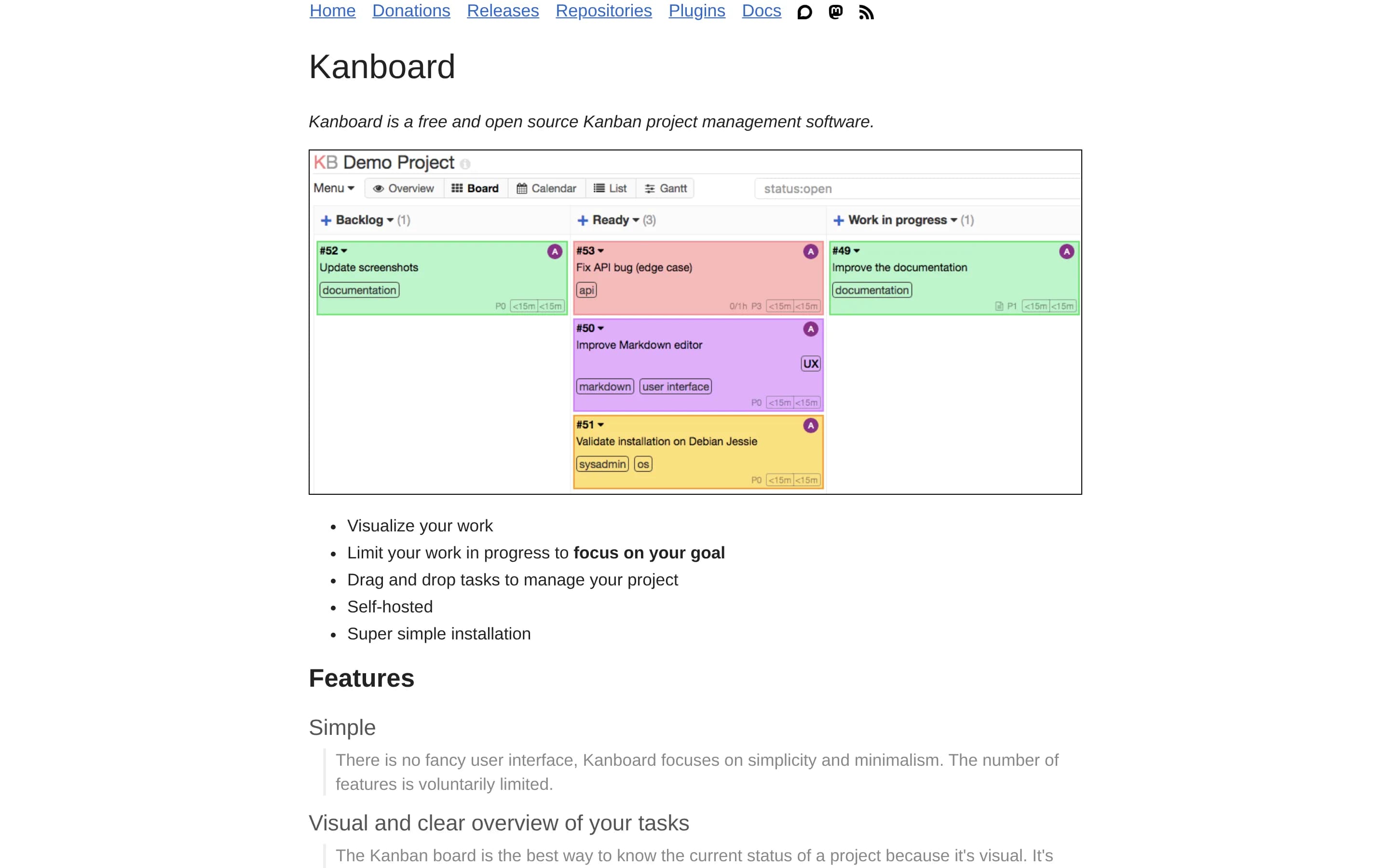
Kanboard is a focused, self-hosted Kanban alternative for teams whose work can be represented as tasks moving through configurable board columns. It offers task details, WIP limits, filtering, and event-based automation, but the supplied evidence does not establish Jira-like cross-team plans, sprint and release management, multiple project views, AI agents, or service-management coverage. Choose Kanboard for a narrow
What it does
Kanboard is open-source project management software focused on the Kanban methodology. Its documented purpose is to help teams organize and track project work through a visual Kanban-oriented workflow.
The repository identifies Kanboard as an application and provides installation instructions, documentation, and Docker usage guidance. It is distributed under the MIT License and can be deployed under user control. The project is in maintenance mode, with ongoing releases depending on community contributions and limited new feature development.
What it covers
- Task-based deliverable tracking
- Configurable workflow columns
- Assignees, categories, and due dates
- Subtasks, comments, and documents
- Event-based workflow automation
- Search and custom filtering
- Developer-tool integrations via plugins or webhooks
What’s different
- No documented cross-team plans and goal tracking
- No documented sprint and release planning
- No documented Jira-scale flexible project views
- No documented AI project agents
- No documented service-request workflow
- No documented incident-management workflow
- No documented Jira import or compatibility path
YYona500
Yona is the narrower, self-hosted choice for software teams that primarily need issue tracking alongside built-in Git/SVN repositories and code review. Jira remains the better fit for organizations needing cross-team plans, configurable views, no-code automation, AI assistance, service workflows, or broad integration coverage. Choose Yona for deployment control and an integrated development workspace; choose Jira for
What it does
Yona is a web-based project hosting and collaboration platform centered on project-based issue tracking. Users can move issues between projects, create subtasks and templates, review change histories, publish bulletin-board posts, and manage groups and project members. The README also documents embedded Git and SVN repositories, online commits, pull requests, and block-based code review with review threads and scores.
The software is distributed for user-controlled installation, either with MariaDB or as a portable H2-based package that can run without separate database setup. It supports LDAP and social login, backups and restoration, migration to and from GitHub, GitHub Enterprise, Redmine, and other Yona instances, and can be built from source. Docker installation is documented through a separate Docker project.
What it covers
- Project-based issue tracking
- Issue change histories
- Software-team collaboration
- Authentication integrations
What’s different
- No documented cross-team plans
- No documented sprint or release planning
- No documented no-code automation
- No documented flexible project views
- No documented AI project agents
- No documented service-request or incident workflows
- No documented broad application-integration catalog
PPlatform27,357
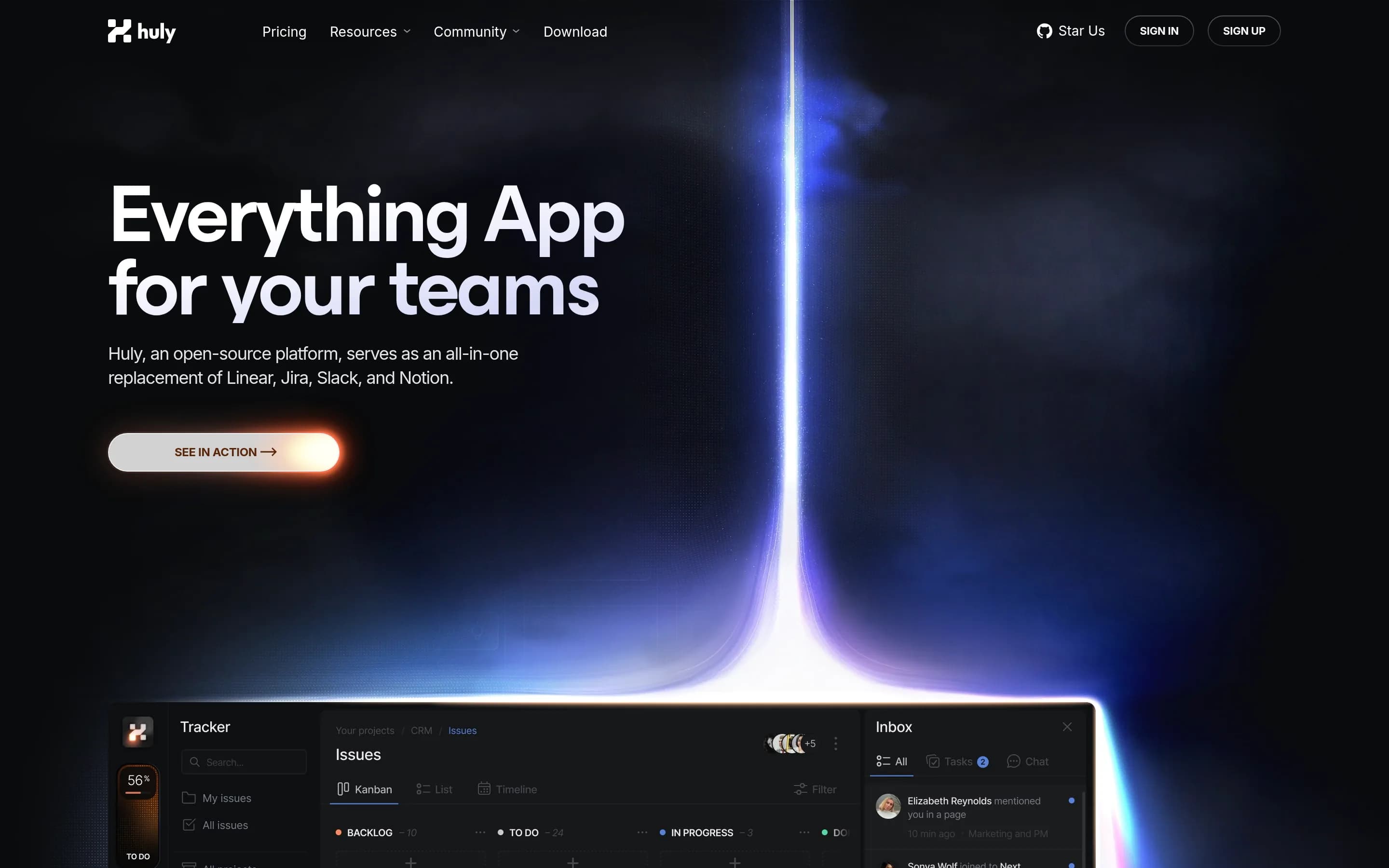
Huly is a plausible Jira alternative for teams that want an EPL-2.0, self-hosted workspace combining project management with chat, documents, planning, calls, and bidirectional GitHub synchronization. Jira remains the safer choice when configurable workflows, sprint and release management, no-code automation, cross-team plans, service operations, or established AI capabilities are requirements, because the supplied H
What it does
Huly is an open-source platform that includes applications for project management, chat, CRM, HRM, and applicant tracking. Its documented project-management scope and workspace setup support teams coordinating business work from a unified application, while the platform architecture also supports teams building products on top of it.
The repository documents production and development releases, API-client access for integrations and custom applications, and a complete local run path. Users can build and launch the application with Docker and Docker Compose, access it through a browser at a local URL, create an account, and create a workspace. The project is licensed under EPL-2.0 and can be self-hosted using the related Huly self-host repository.
What it covers
- Project and task management
- Workspace customization
- Progress tracking
- GitHub integration
- Multi-project planning
- Team notifications
What’s different
- No documented sprint and release management
- No documented no-code workflow automation
- No documented service-request or incident workflows
- No documented Jira import path
- No documented cross-team goal planning
- AI capabilities listed as forthcoming or TBD
KKaneo8,318
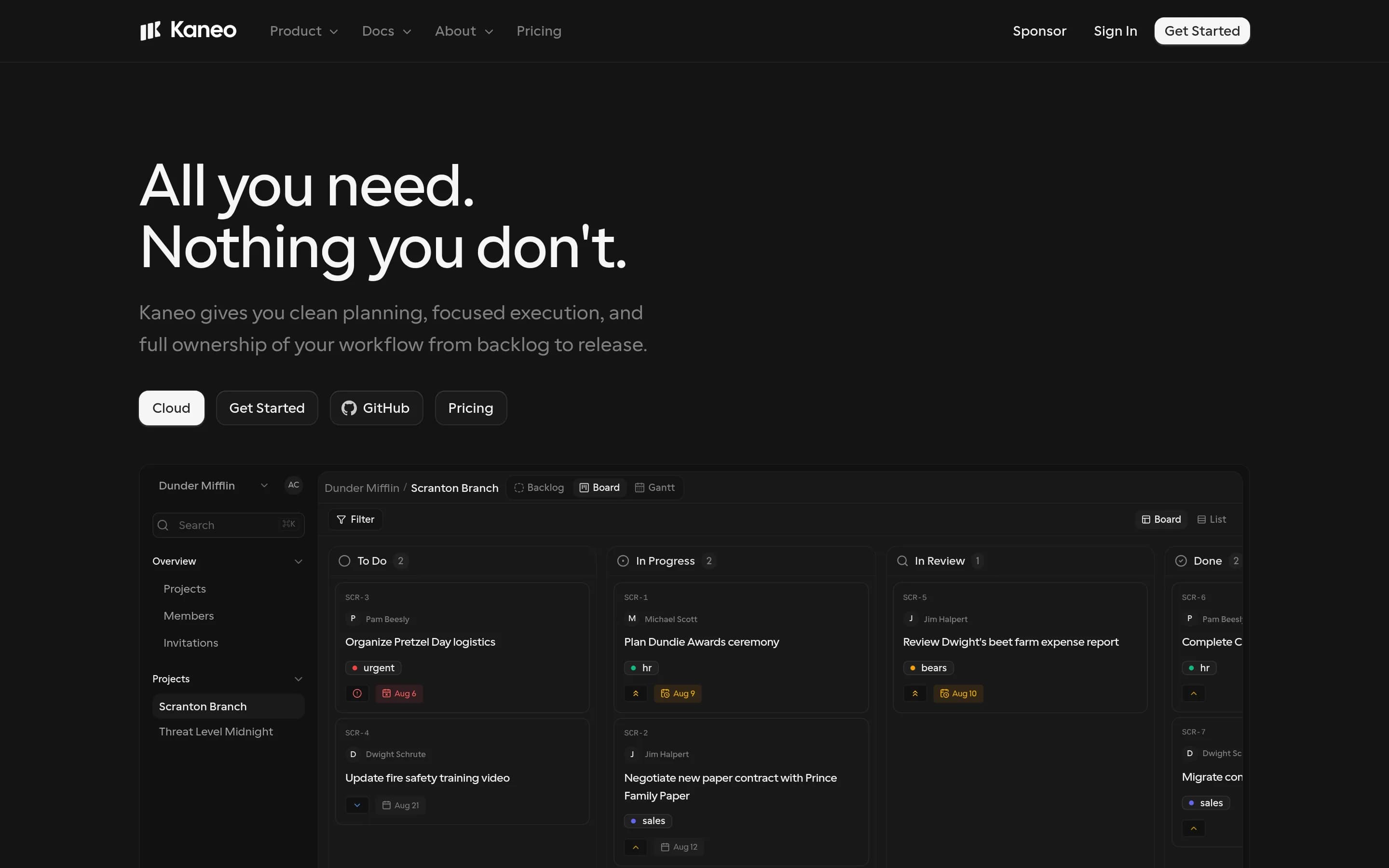
Kaneo is the stronger fit for small or midsize teams seeking focused board, list, backlog, and workflow management with open-source self-hosting. Jira remains the safer choice for large organizations that require deep enterprise workflows, advanced permission schemes, extensive add-ons, cross-team planning, or broader automation and service-management coverage. The central tradeoff is infrastructure ownership and a َ
What it does
Kaneo is an open-source project management platform designed to help teams organize products and projects without a heavily feature-laden interface. The README identifies tasks, projects, labels, issue management, and project management as core uses, and describes a clean interface focused on team work.
The product can be deployed under user control with Docker Compose, a bundled container and PostgreSQL, separate API and web images, or a Kubernetes Helm chart. It also supports a built-in HTTP MCP endpoint and an official MCP package so compatible AI clients can manage tasks, projects, and labels. The repository is MIT-licensed and documents self-hosted and cloud links.
What it covers
- Task and deliverable tracking
- Configurable project workflows
- Board and list views
- Backlog planning
- Labels and priorities
- GitHub integration
- AI-tool task access via MCP
What’s different
- No documented Jira-specific importer
- No documented cross-team program plans
- No documented no-code workflow automation
- No documented sprint or release management
- No documented service-request or incident management
- No documented Jira-scale add-on marketplace
- Less documented enterprise workflow and permission depth
WWorklenz3,147
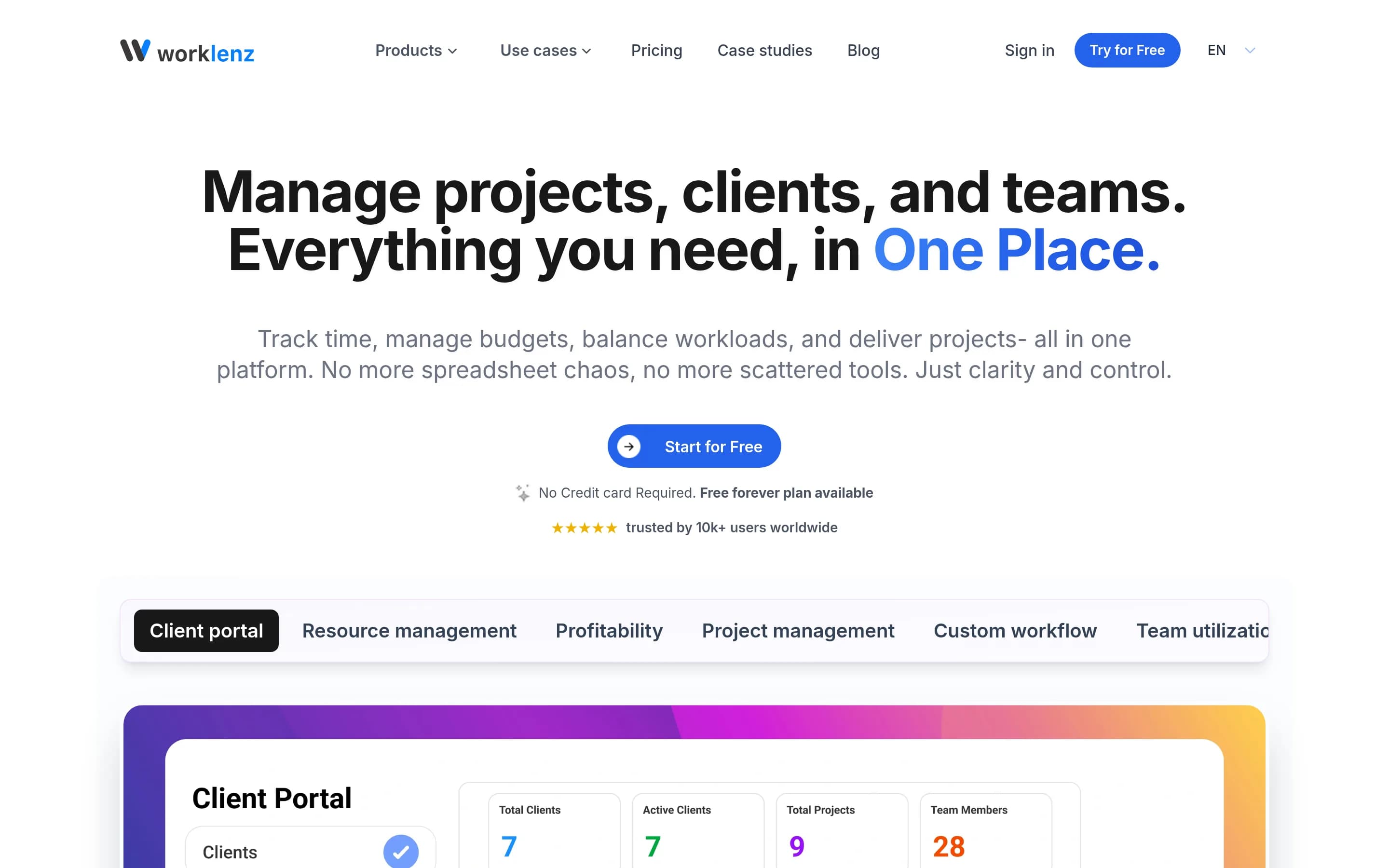
Worklenz is a credible Jira alternative for self-managed, task-centric project work, particularly at agencies and professional-services firms that also need time, capacity, budget, and client tracking. It provides customizable task statuses and list, board, and Gantt views, but the supplied evidence does not document equivalents for Jira’s no-code automation, AI agents, broad integration ecosystem, service and- and-—
What it does
Worklenz is an open-source project management platform for planning, executing, and monitoring projects. Teams can create projects and tasks, set priorities and due dates, track progress through list, board, and Gantt views, use templates, and collaborate through comments and file sharing.
The platform documents resource planning, workload balancing, visual scheduling, time tracking, budgets and costs, analytics, reporting, team utilization, project profitability, and a client portal. It can be used through Worklenz Cloud or deployed under user control with Docker, Docker Compose, or manual installation using React, Express, PostgreSQL, Redis, and object storage.
What it covers
- Task and deliverable tracking
- Custom task statuses and workflows
- List and Kanban views
- Timeline planning through Gantt views
- Task priorities, deadlines, and dependencies
- Assignees, comments, and attachments
- Project templates
- Progress reporting
What’s different
- Documented no-code automation
- Documented AI project agents
- Documented Jira-scale integration coverage
- Documented service-request workflows
- Documented incident-management workflows
- Documented sprint and release tooling
- Documented Jira-specific migration path
- Documented Kubernetes deployment
DDootask5,548
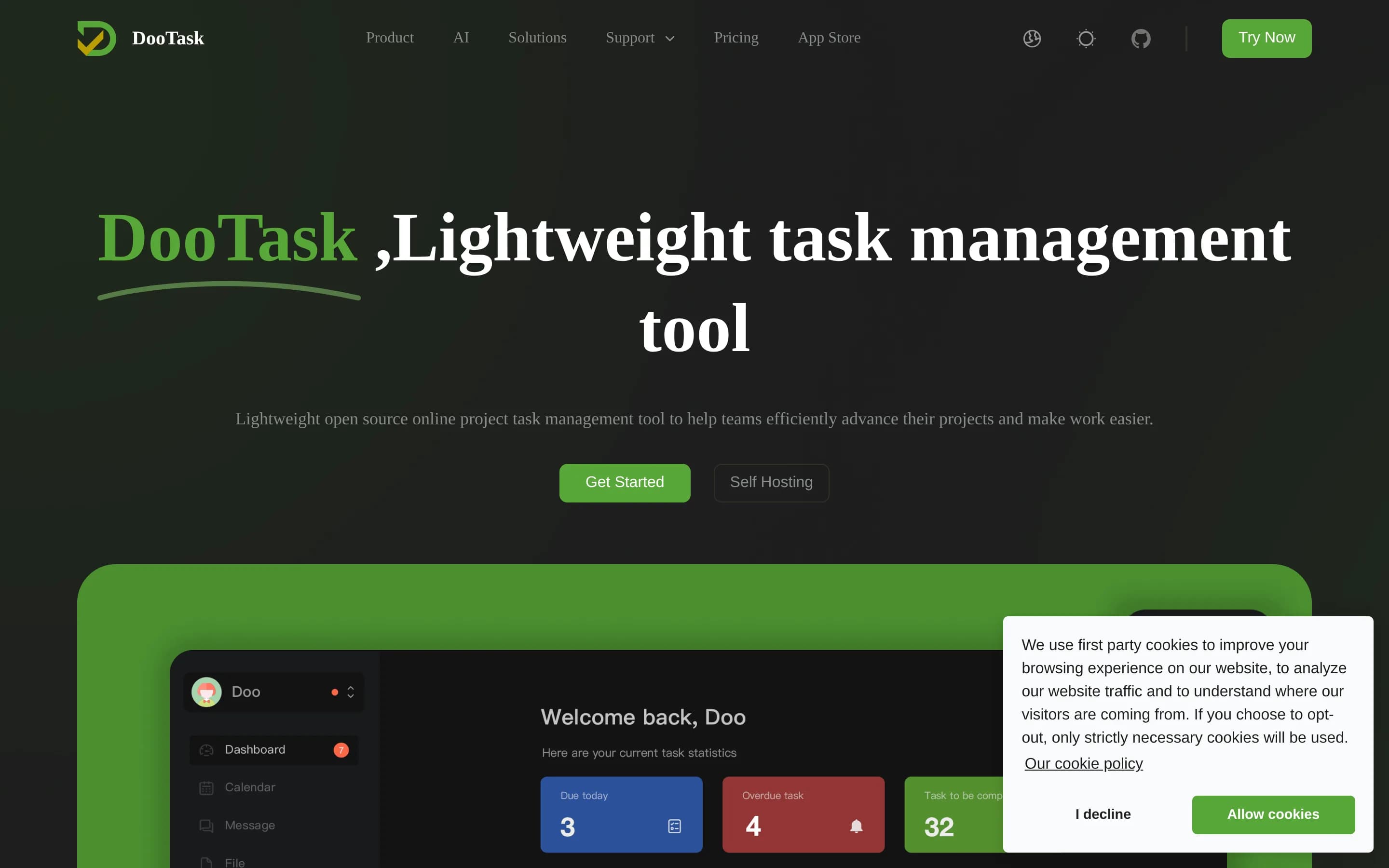
DooTask is a plausible Jira alternative for teams that want an AGPL-licensed, self-hosted workspace combining task management, project views, documents, files, and instant messaging. Jira remains the better fit when the decision depends on documented sprint and release workflows, cross-team plans, no-code automation, developer integrations, or service and incident management; the supplied DooTask materials do notest.
What it does
DooTask is an open-source online project and task management system for organizing projects, distributing tasks, and coordinating remote work. Its documented feature set includes document collaboration, online mind maps, online flowcharts, instant messaging, file management, and task-oriented project workflows. Messaging uses asymmetric encryption according to the repository description.
The project is designed for user-controlled deployment. It requires Docker and Docker Compose, uses MariaDB through the default Compose service, and supports CentOS, Debian, Ubuntu, macOS, and other Linux/Unix systems. Installation, upgrades, service control, port changes, HTTPS configuration, backups, migration, and uninstallation are documented through scripts and commands.
What it covers
- Project and task tracking
- Custom project templates
- Kanban, table, and list views
- Task progress dashboards
- Task calendars
- AI-assisted task creation
What’s different
- No documented Jira importer
- No documented sprint or release workflow
- No documented no-code workflow automation
- No documented cross-team goal planning
- No documented developer-tool integrations
- No documented service-request or incident workflow
TTududi3,252
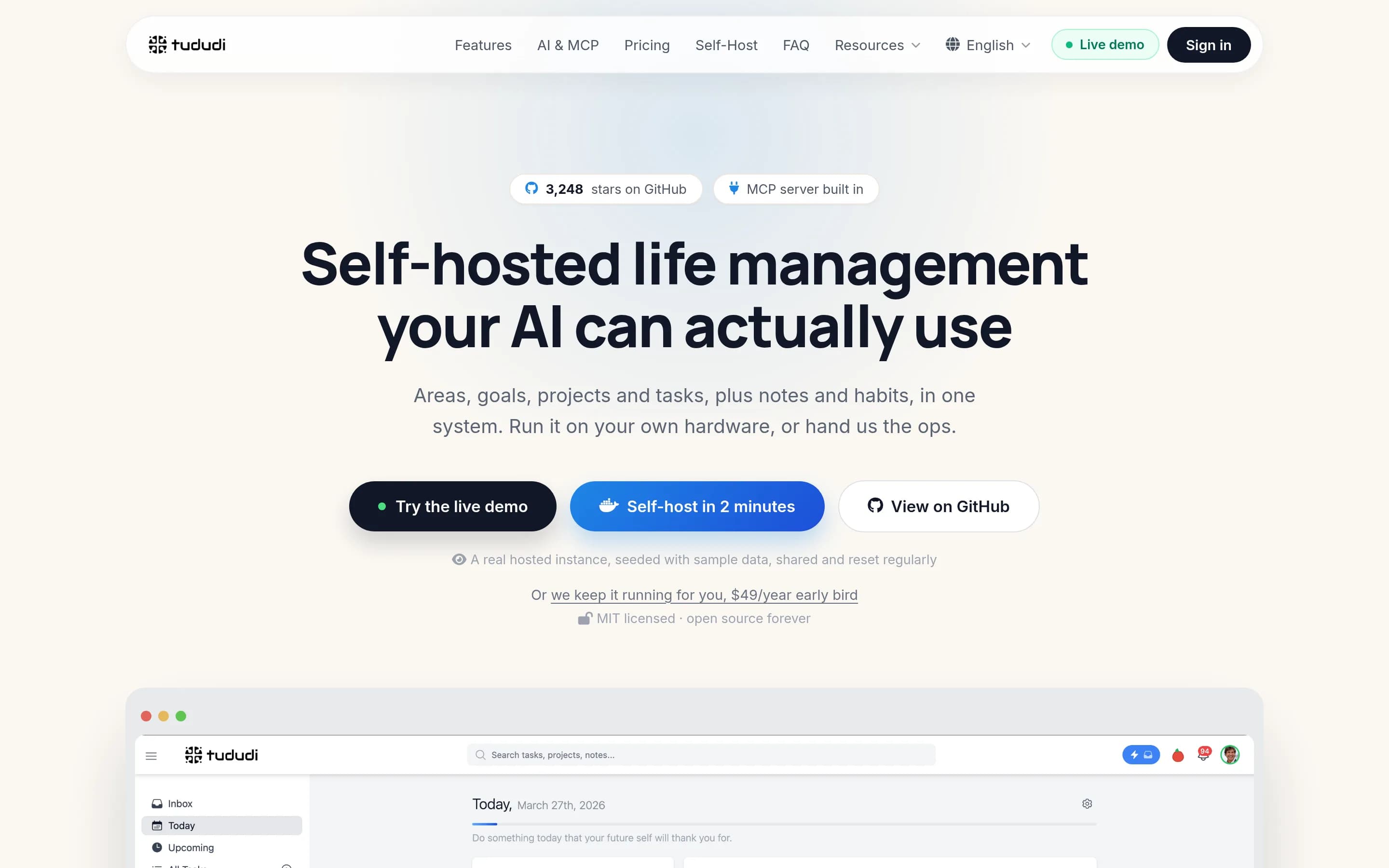
Tududi is a plausible Jira replacement for individuals and small teams whose work can be represented as shared projects, tasks, subtasks, notes, tags, due dates, and a Kanban board—and who want MIT-licensed self-hosting. Jira remains the safer choice for organizations that depend on documented agile delivery, cross-team program planning, configurable workflows, broad integrations, or service and incident tracking; no
What it does
Tududi is a productivity application for organizing personal and shared work. Users can create tasks, subtasks, projects, areas, notes, and tags; assign tasks to projects; track due dates and priorities; filter work by views such as Today, Upcoming, and Someday; and share projects with team members.
The README documents recurring tasks with flexible schedules, completion-based recurrence, subtasks with progress tracking, a responsive interface, an installable PWA with offline queuing, Telegram capture and digests, a REST API, OIDC/SSO, and bidirectional CalDAV synchronization. It can be run locally with Docker or Docker Compose, with persistent database and upload volumes, or used through a hosted subscription.
What it covers
- Project and task tracking
- Kanban-style work view
- Task assignment and project sharing
- Due dates, priorities, tags, and filtering
- API-based integrations
- Optional AI-assisted work updates
What’s different
- Documented Jira import path
- Documented sprint planning
- Documented bug and release management
- Documented cross-team program plans
- Documented configurable status workflows
- Documented no-code automation
- Documented service request and incident workflows
- Documented Kubernetes deployment
EEver-teams543
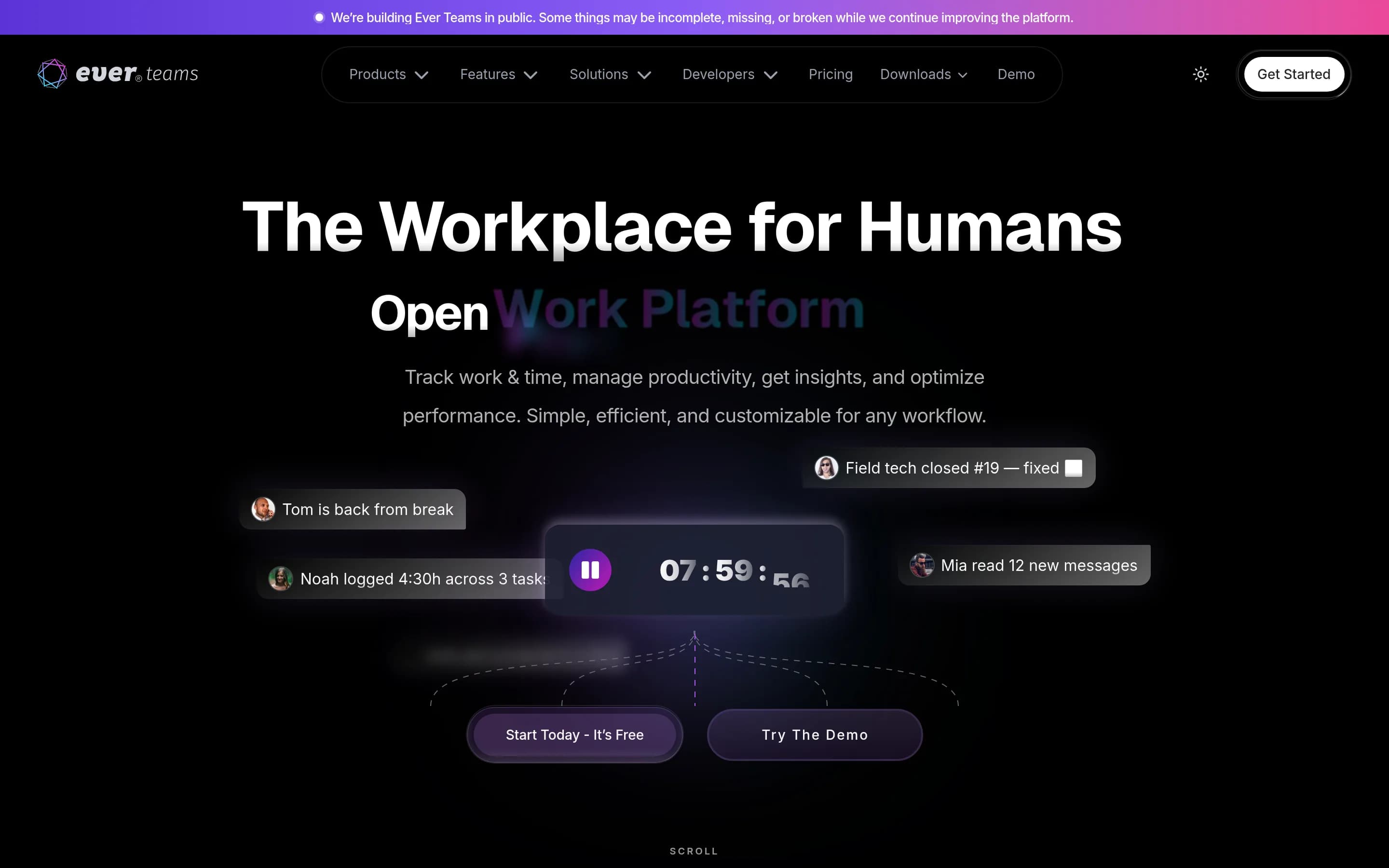
Ever Teams is a self-hostable, open-source-oriented work and project management option, but its README labels the platform active-development/WIP and describes key capabilities as planned. Choose it when deployment control and a TypeScript-based platform outweigh maturity risk; choose Jira when you need documented cross-team planning, agile delivery, automation, flexible views, AI assistance, or service operations.
What it does
Ever Teams is an open work and project management platform for teams. Its documented feature set includes projects, tasks and issues management, organizations and teams, tags and labels, time management, time tracking, activity tracking, productivity metrics, and integrations with GitHub, GitLab, Bitbucket, and Jira. The repository describes the project as actively developed and a work in progress.
The product provides a web application, with mobile apps, a desktop application, and browser extensions listed in the repository. It can be run locally with Docker Compose, Docker, or a manual Node.js build, and supports deployment through several hosting providers. The web frontend requires access to the Ever Gauzy APIs, either through the documented hosted endpoint or a self-hosted Gauzy backend.
What it covers
- Project and task tracking
- Issue management
- Team organization
- Tags and labels
- Developer-tool integrations
What’s different
- No documented cross-team plans
- No documented sprint or release planning
- No documented no-code automation
- No documented configurable project views
- No documented AI project agents
- No documented service-request workflows
VVikunja5,069
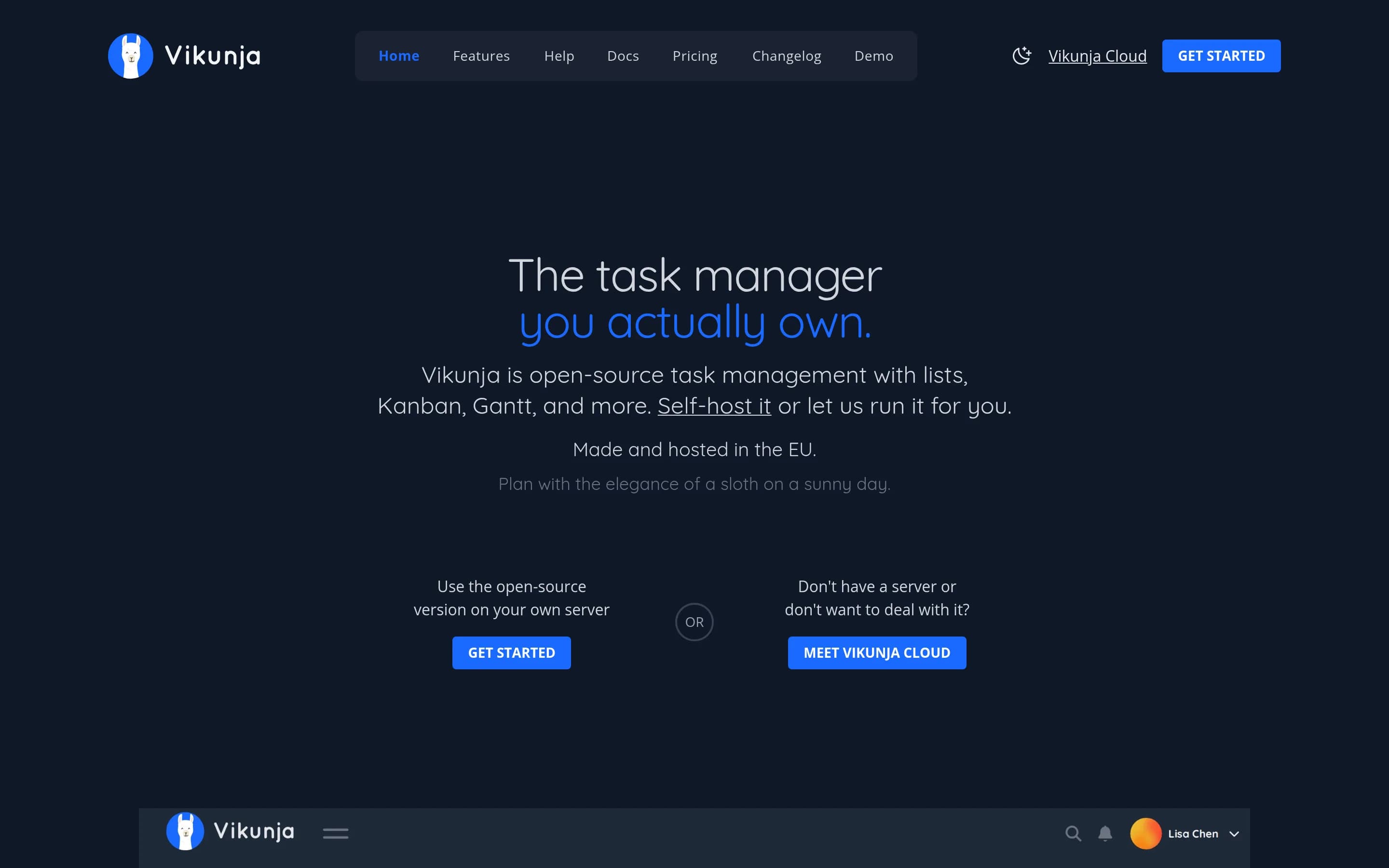
Vikunja is the more focused choice for teams that primarily need self-hostable task and project tracking through list, Kanban, table, and Gantt views. Jira remains the better fit when cross-team program planning, agile release management, no-code automation, service/incident workflows, AI assistance, or a broad integration ecosystem are requirements; the supplied Vikunja sources do not establish comparable coverage.
What it does
Vikunja is an open-source task and project management product described as a task manager that users own. The repository identifies project-management use, provides an API, and links to a hosted version for individuals or teams. The supplied README does not enumerate specific task, scheduling, assignment, or reporting workflows beyond the product's task-manager description.
Users can install Vikunja from the project documentation, build it from source, or use Docker images. The repository also points to a hosted service and a browser-accessible trial, but does not explicitly document a graphical interface in the supplied text. Vikunja Pro is mentioned as a separate offering with admin panels, audit logs, and time tracking.
What it covers
- Project and task organization
- Assignees and team sharing
- Kanban-style status tracking
- Timeline-oriented Gantt views
- Configurable task views
- Task relations and subtasks
- Attachments, labels, and due dates
What’s different
- No documented Jira importer
- No documented sprint and release management
- No documented cross-team goals and plans
- No documented no-code workflow automation
- No documented AI project agents
- No documented service-request and incident workflows
- No documented parity with Jira’s integration ecosystem