
SSalesforce
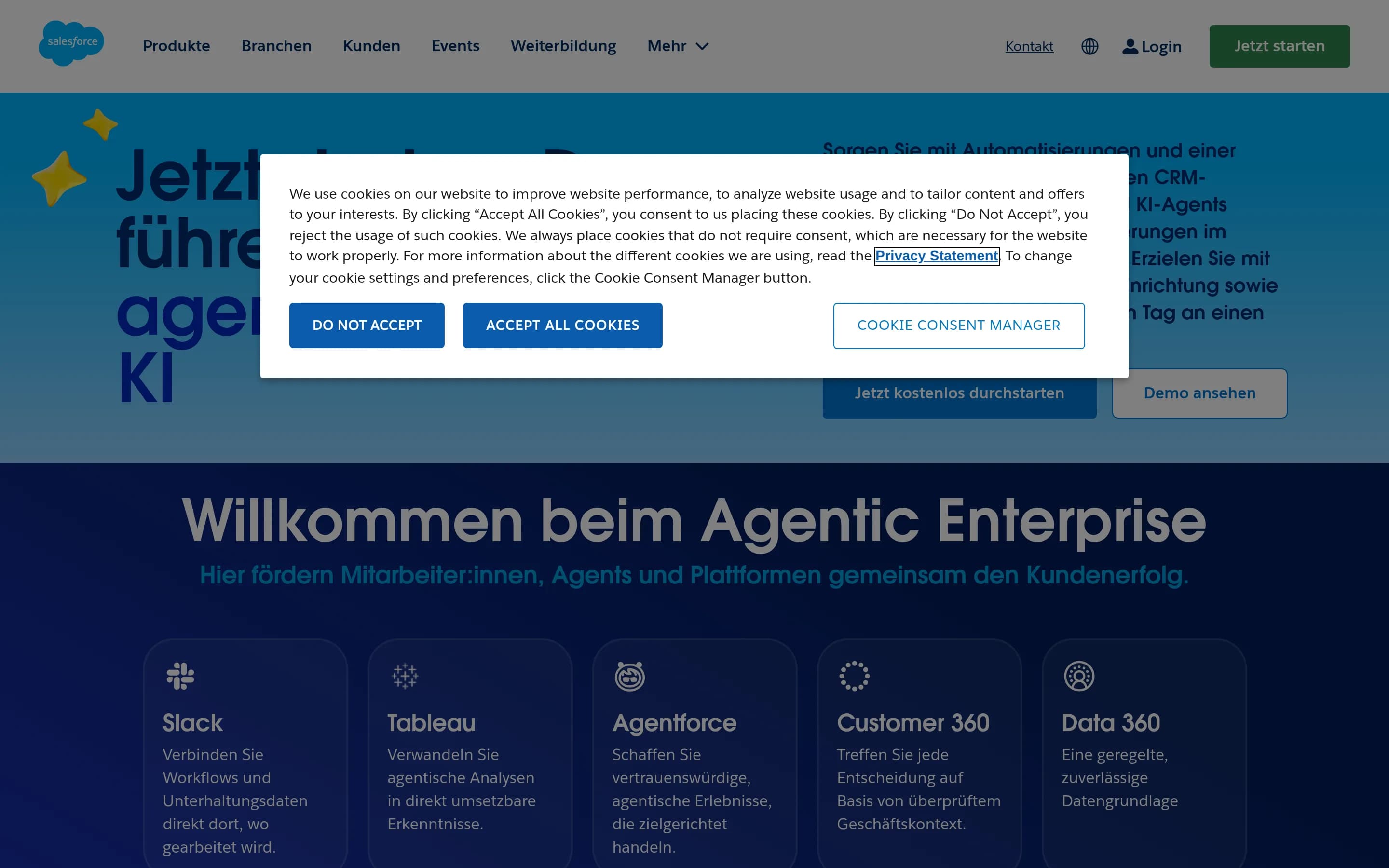
Salesforce is a cloud CRM platform that brings customer data, sales workflows, service operations, marketing, commerce, analytics, and AI agents into a shared Customer 360 environment. Its central use case is managing customer relationships and revenue pipelines across their lifecycle.
Why people leave Salesforce
Organizations may look for a Salesforce alternative when they need a more focused CRM rather than a broad platform spanning sales, service, marketing, commerce, analytics, data, collaboration, and AI agents. Salesforce presents these functions as an interconnected portfolio, which can be useful for cross-department operations but may exceed the requirements of a small team or a company with a narrowly defined sales process. A simpler product may offer a shorter path from initial setup to routine contact and pipeline work.
Another motivation may be implementation and administration fit. Salesforce emphasizes extensive customization, app development, automation, integrations, industry solutions, partner applications, and professional services. Organizations that do not have dedicated administrators, developers, consultants, or internal platform owners may prefer a system with fewer configuration decisions and more opinionated workflows. Teams may also seek an alternative when they want to change fields, stages, reports, or automations without maintaining a larger platform architecture.
Product scope and commercial predictability can also influence an evaluation. The crawled page separates capabilities into sales, service, marketing, commerce, analytics, data, Slack, Agentforce, and other solutions, each with its own product and pricing paths. Buyers may therefore want to compare alternatives that package their required capabilities more simply, especially if they only need core CRM, customer support, or marketing automation. The relevant trade-off would depend on the modules, user counts, support plans, and integrations required by a particular organization rather than on the platform in the abstract.
Finally, some organizations may prioritize greater control over hosting, source code, data architecture, or migration paths. Salesforce is positioned as a unified cloud platform with a large partner ecosystem, whereas an open-source or self-hostable alternative may better match requirements for infrastructure control, internal customization, or reduced dependence on one vendor’s product ecosystem. Such alternatives may require more internal technical ownership, so the decision is usually a balance between control and the convenience of Salesforce’s integrated applications, services, connectors, training, and partner network.
15 Best Open Source Salesforce Alternatives (Ranked)
Each alternative is evaluated for core feature coverage, deployment options, licensing, project health, and overall fit. The ranking prioritizes how closely a tool matches Salesforce's primary workflows, using popularity only as a secondary signal.
EEspocrm3,249
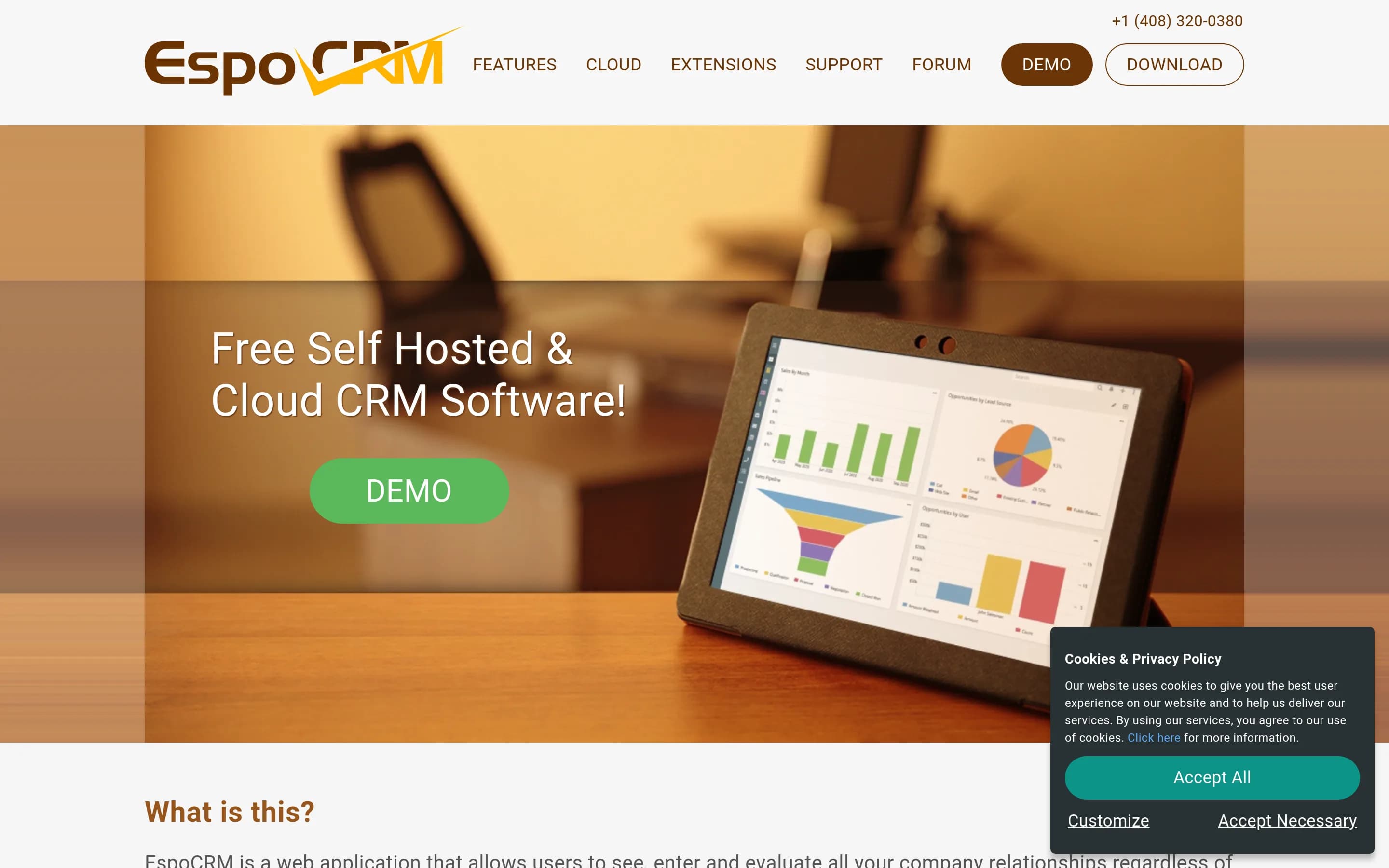
EspoCRM is a credible alternative for organizations centered on conventional CRM work—leads, contacts, opportunities, campaigns, support cases, reports, and configurable workflows—especially when source-code and hosting control matter. Salesforce remains the better fit for organizations that need one documented portfolio spanning CRM, unified customer data, advanced service, marketing personalization, commerce, low‑/
What it does
EspoCRM is an open-source CRM web application for building and maintaining customer relationships. Its documented workflows include storing and organizing leads, contacts, sales opportunities, marketing campaigns, support cases, and other business information in a unified interface. The project also identifies sales automation, customer support, contacts, calendar, documents, and customer portal functionality through its repository topics.
The application uses a single-page frontend with a PHP REST API backend. Organizations can customize entities, fields, relationships, and buttons, extend the system, and integrate it with other applications through the REST API. EspoCRM can be installed manually or by script, and deployment documentation covers Docker and Traefik. Supported databases include MySQL, MariaDB, and PostgreSQL.
What it covers
- Lead, account, and contact records
- Opportunity pipeline management
- Marketing campaigns and mass email
- Support cases and self-service portal
- CRM reports and analytics
- Workflow and process automation
- Custom entities, fields, and relationships
- Role- and team-based access
What’s different
- Unified cross-application customer profiles
- Configurable AI-agent platform
- End-to-end commerce and order management
- Documented omnichannel contact-center suite
- Documented field-service operations
- Salesforce-specific migration tooling
LLaravel-crm23,690
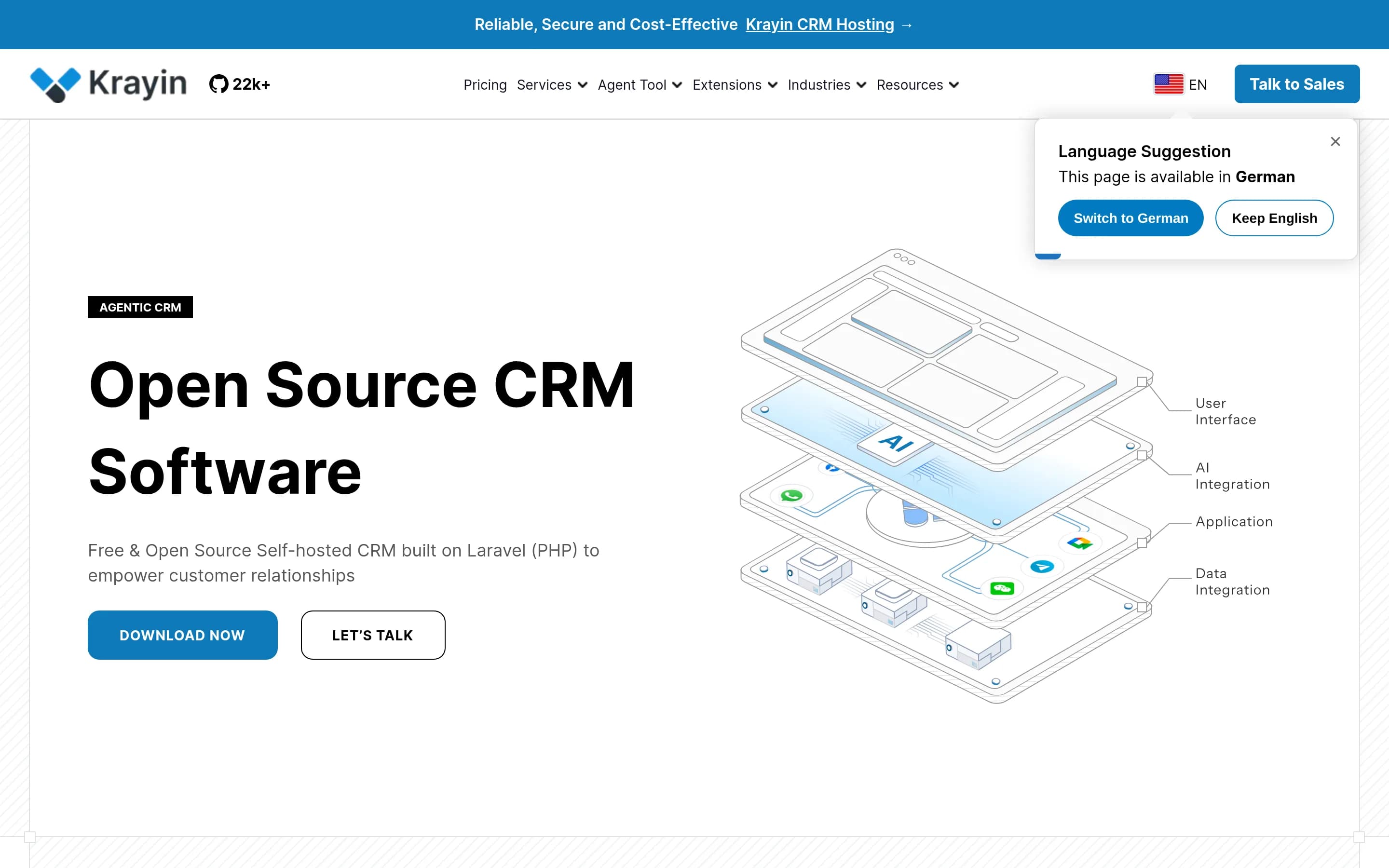
Choose Laravel-crm (Krayin CRM) when the priority is a focused, self-hostable CRM for contacts, leads, opportunities, and sales workflows—and the organization can operate a PHP/Laravel stack. Keep Salesforce when one integrated platform must also cover mature service, marketing, commerce, unified customer data, analytics, low-code development, and AI-agent workflows. The central tradeoff is infrastructure and source-
What it does
Krayin CRM is a free, open-source CRM application for SMEs and enterprises. Its documented focus is complete customer lifecycle management, including customer, lead, and sales management. The README lists an admin panel, dashboard, custom attributes, modular architecture, and email parsing through SendGrid.
The application is built with Laravel, PHP, and Vue.js. It can be installed with Composer and configured with database, mail, and application URL settings, then run locally with Laravel or deployed behind Apache or NGINX. The project also documents Docker installation, managed cloud hosting, multi-tenant SaaS, WhatsApp lead generation, and VoIP extensions.
What it covers
- Contact and organization records
- Lead and opportunity tracking
- Sales pipeline workflows
- Custom fields
- Sales activities
- Access roles
- Products and services
- Reporting and sales forecasting claims
- Marketing automation claims
- AI workflow claims
What’s different
- No documented Salesforce importer
- No documented service or marketing parity
- No documented unified customer-data layer
- No documented commerce and payments suite
- No documented low-code application platform
- No documented Kubernetes deployment
CCrm8,578
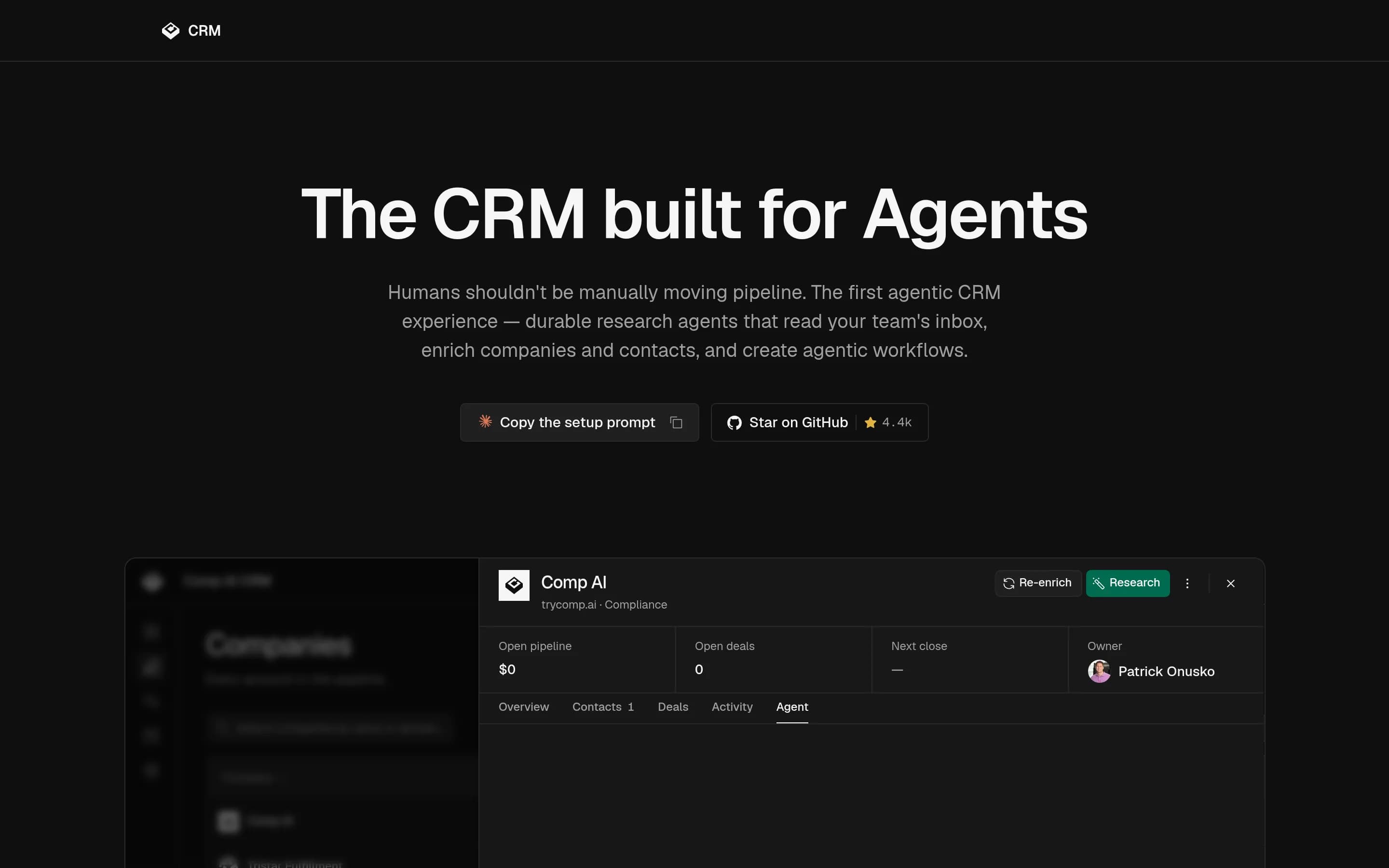
Comp AI CRM is the stronger fit for technically capable teams seeking a focused, self-hostable, agent-oriented CRM with control of source code and infrastructure. Salesforce remains the safer choice for organizations requiring a broad, integrated portfolio across sales, service, marketing, commerce, analytics, unified data, and low-code development. The key tradeoff is operational control and narrower agentic CRM use
What it does
Comp AI CRM is an open-source, agent-first customer relationship management system. It provides records for contacts, companies, and deals, including a pipeline that can be seeded with sample data. Its agent can search CRM history, identify contacts, research people, enrich companies, record evidence-backed facts, write briefs, and schedule follow-up checks.
The repository documents a Next.js front end, NestJS API, Postgres database, authentication, mailbox synchronization, durable agent sessions, work queues, and an Agent tab on records. Local deployment uses Bun and Docker Compose for Postgres, with separate app, API, and agent processes; production deployment is described as three independent deployments plus Postgres. The project is single-tenant and licensed under MIT.
What it covers
- Company, contact, and deal records
- Sales pipeline tracking
- AI-assisted CRM workflows
- Scheduled follow-up automation
What’s different
- No documented service-management suite
- No documented marketing-automation suite
- No documented commerce operations
- No documented CPQ or revenue-lifecycle suite
- No documented unified customer-data platform
- No documented Tableau-equivalent analytics
- No multi-organization tenancy
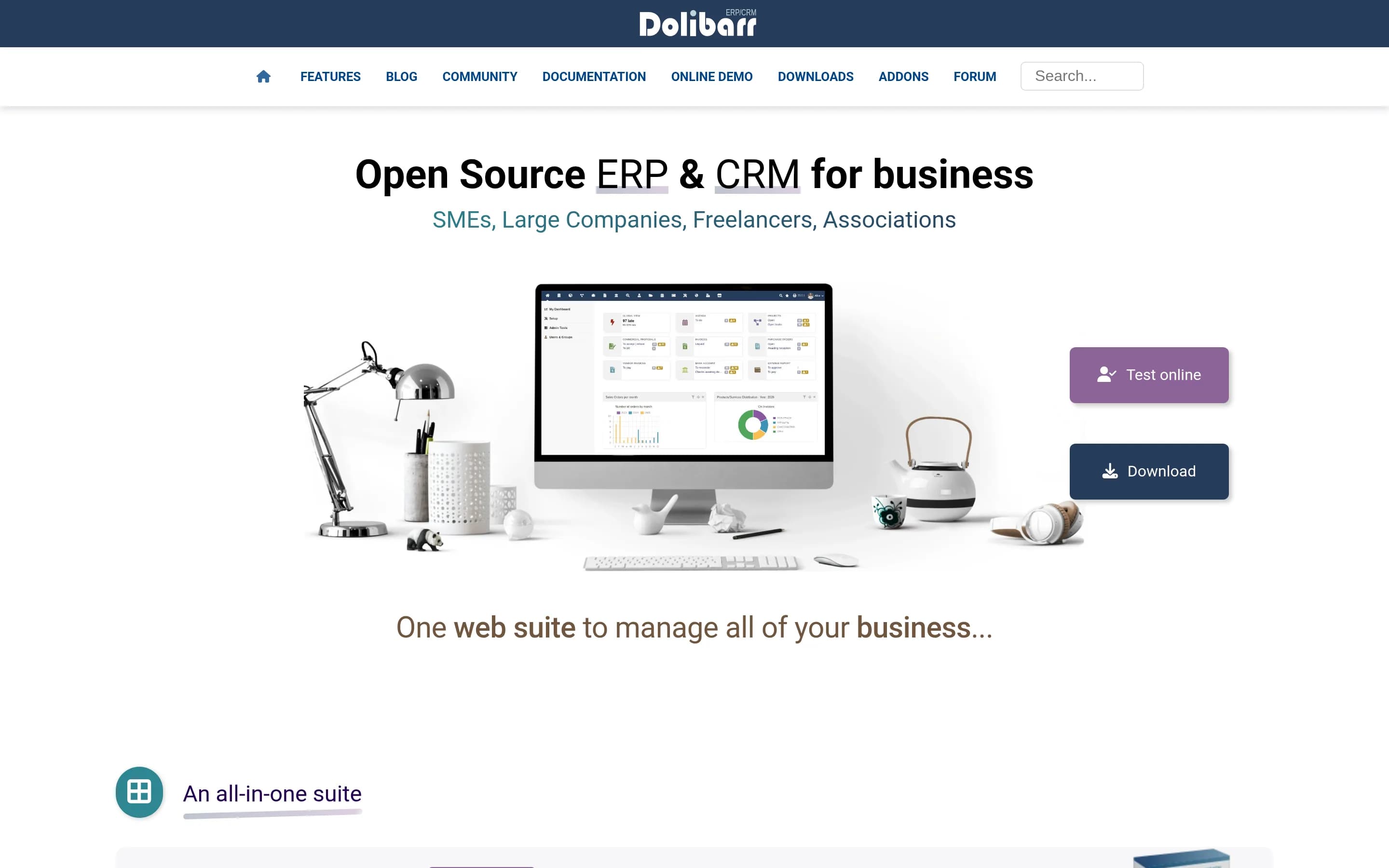
DDolibarr7,520
Dolibarr is a credible alternative for organizations that want self-hosted, open-source CRM combined with quoting, orders, invoicing, inventory, accounting, and related business operations. Choose it when infrastructure control and integrated ERP workflows matter more than reproducing Salesforce’s broader customer-data, marketing, service, commerce, analytics, and AI-agent platform. Choose Salesforce when those cross
What it does
Dolibarr is an open-source ERP and CRM suite for companies, foundations, and freelancers. It manages customers, prospects, leads, contacts, suppliers, opportunities, commercial proposals, orders, contracts, invoices, payments, products, stock, purchasing, accounting, projects, tickets, memberships, and human resources.
The software is modular, with customizable dashboards, multi-user permissions, multi-language and multi-currency support, reporting, data import/export, APIs, document generation, mass emailing, and integrations including payment platforms. It can run standalone or as a web application over a LAN or the Internet.
Dolibarr is self-hostable using PHP with MariaDB, MySQL, or PostgreSQL and supports installation through a web server, packaged distributions, or Docker. Commercial cloud offerings and third-party extensions are also available.
What it covers
- Customer and contact records
- Lead and opportunity management
- Sales proposals and orders
- Contracts and subscriptions
- Service tickets and knowledge management
- Reports and customizable dashboards
- Mass email capabilities
- Role-based user permissions
- REST and SOAP APIs
- Custom fields and modular configuration
What’s different
- No documented unified customer-data activation layer
- No documented Agentforce-equivalent agent platform
- No documented advanced marketing-personalization suite
- No documented omnichannel contact-center suite
- No documented Tableau-equivalent analytics platform
- No documented Salesforce-specific migration tooling
SSuiteCRM5,668
Choose SuiteCRM when the priority is an open-source, self-hostable CRM for customer records, lead and opportunity management, marketing, service, reporting, and API-based integration—and the organization can own or outsource its infrastructure and upgrades. Keep Salesforce when you need the broader documented Customer 360 scope, particularly commerce, configurable AI agents, unified cross-application data, or low‑/no
What it does
SuiteCRM is an open-source, enterprise-ready customer relationship management application. Its documented topics and CRM positioning cover accounts, contacts, leads, opportunities, cases, contracts, quotes, documents, reports, multi-currency, multi-language support, portals, and workflow functionality.
SuiteCRM 7 can be deployed on Linux or Windows servers using Apache or IIS, PHP, and MySQL, MariaDB, or MSSQL. The README describes local, internal-network, public-cloud, and managed-hosting deployment options. It is licensed under AGPLv3 and also provides an online demo and optional managed hosting and support services.
What it covers
- Central customer-data repository
- Lead and opportunity management
- Personalized quotations
- Customer segmentation and targeted marketing
- Customer-service support
- Reports and dashboards
- Workflow automation
- Third-party integration through an API
What’s different
- No documented commerce or order-management module
- No documented configurable AI-agent platform
- No documented Salesforce-scale low-code application platform
- No documented equivalent to Salesforce’s cross-application customer-data layer
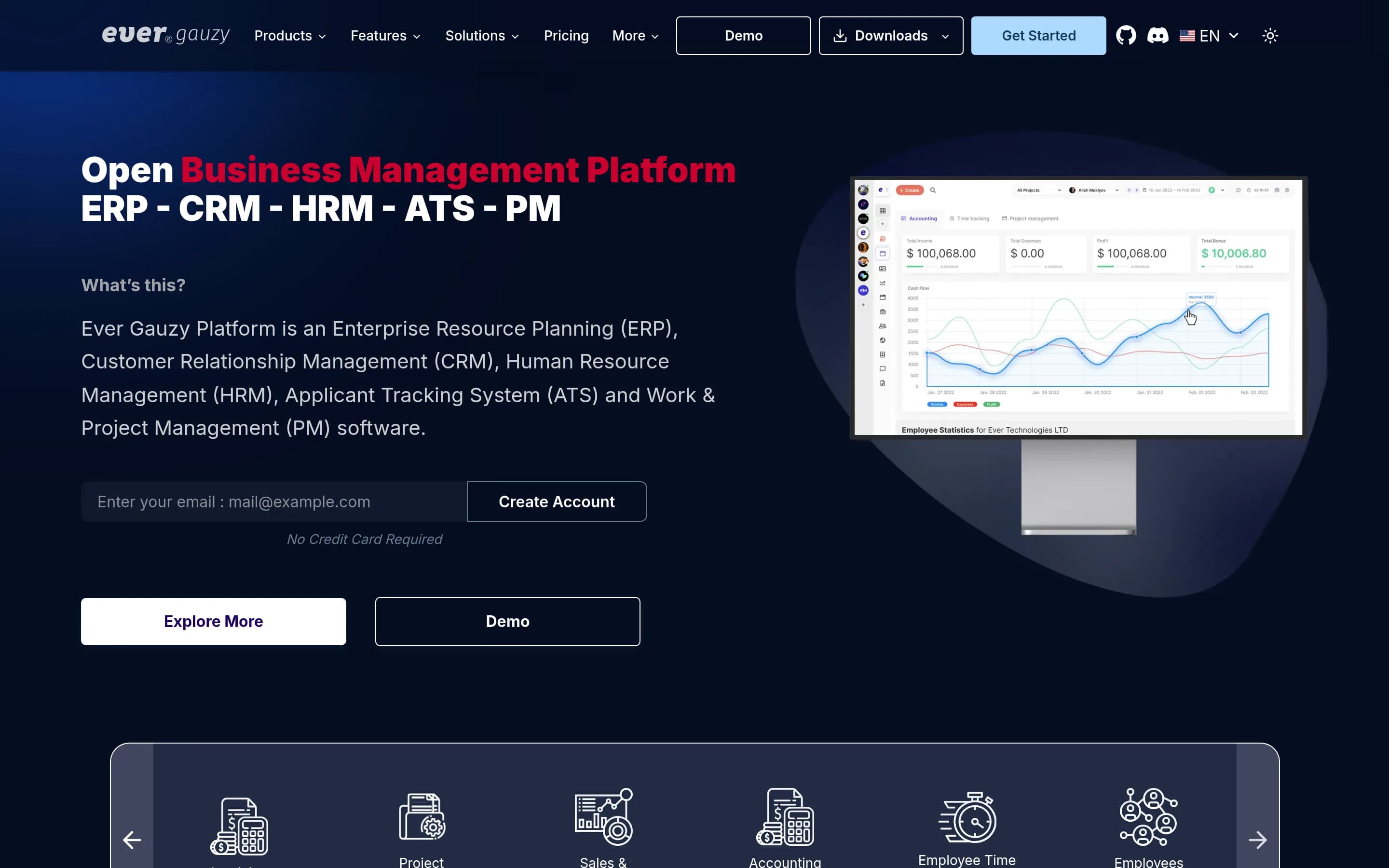
EEver-gauzy4,332
Ever Gauzy is a plausible self-hosted replacement for organizations whose Salesforce use is limited to contacts, sales pipelines, reporting, and adjacent ERP/HR/project workflows. Choose it when source and infrastructure control outweigh the need for a managed platform. Keep Salesforce when operations depend on its documented service, marketing, unified-data, commerce, AI-agent, or low-code capabilities; equivalent覆盖
What it does
Ever Gauzy is an open business-management platform combining customer relationship management with ERP, HRM, applicant tracking, project management, sales, financial management, inventory, and production features. Its CRM workflows include contacts for clients, customers, and leads, sales pipelines, proposals, schedules, email history, and organization management.
The platform also provides dashboards, reports, insights, analytics, accounting, invoicing, billing, payments, time tracking, employee management, and permissions. It can run as a SaaS service, browser-based server, or Windows, macOS, and Linux desktop application. The repository documents local installation with Node.js, a browser UI, Docker Compose, and Kubernetes recommendations, using SQLite or external databases such as PostgreSQL.
What it covers
- Contact and lead records
- Sales pipelines
- Reports and analytics
- Roles and permissions
- Email history and templates
- Data import and export
What’s different
- No documented omnichannel service coverage
- No documented marketing automation coverage
- No documented unified customer profile layer
- No documented AI-agent equivalent
- No documented B2C/B2B commerce suite
- No documented low-code application builder
CCrm3,344
Frappe CRM is a direct open-source CRM alternative with documented lead and deal management, sales workflows, customer relationship features, and a web interface. It does not document Salesforce’s broader service, marketing, unified-data, analytics, commerce, or AI-agent scope.
What it does
Frappe CRM is an open-source CRM designed for modern sales teams. It provides a web interface for managing leads and deals, with consolidated records for activities, comments, notes, and tasks. Kanban boards support visual stage tracking, while custom views provide filtering, sorting, and configurable columns.
The project documents built-in Twilio and Exotel calling integrations, call recording, WhatsApp messaging through Frappe WhatsApp, and ERPNext integration for invoicing and accounting. It can be used through managed Frappe Cloud hosting or deployed locally with Frappe, Docker Compose, or the documented production installation script.
What it covers
- Lead and deal record management
- Sales pipeline stage tracking
- Customer relationship activity management
- Calling and messaging integrations
- Custom views and workflow organization
What’s different
- Documented customer service operations such as contact-center, field service, or self-service workflows
- Documented marketing automation and personalization
- Documented unified customer data profiles across multiple sources
- Documented analytics and dashboards
- Documented configurable AI agents
- Documented commerce operations
- Documented low-code application and workflow development
DDjango-CRM2,384
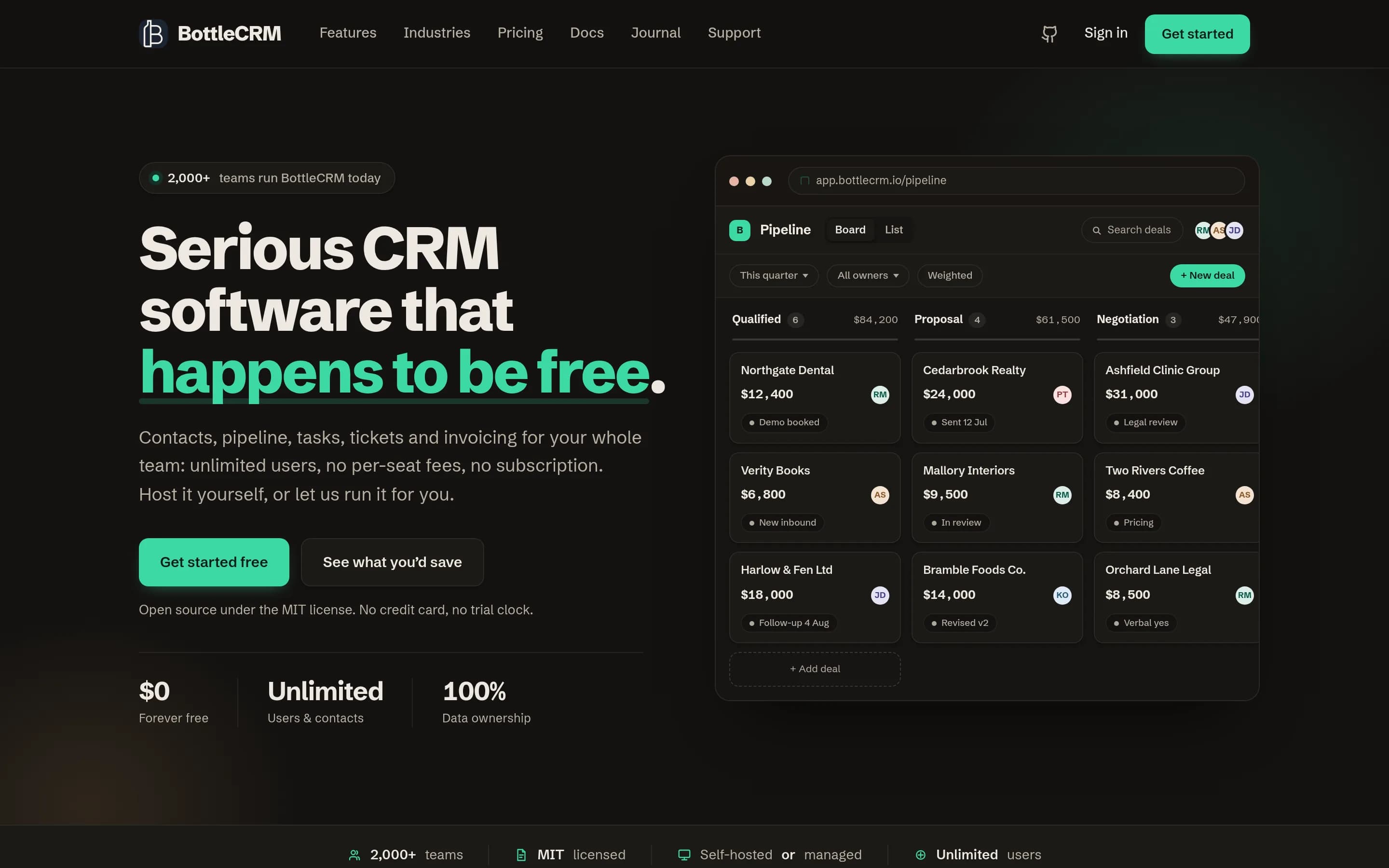
Django-CRM (branded BottleCRM) is a focused, self-hostable alternative for teams that primarily need customer records, pipelines, tasks, support tickets, invoicing, mobile access, and an API—and can operate the required infrastructure. Salesforce remains the stronger fit for organizations needing broad sales automation, marketing, commerce, unified-data, low-code, or advanced analytics coverage. The central tradeoff}
What it does
BottleCRM is an open-source CRM for startups and enterprises. It manages the customer lifecycle through leads, accounts, contacts, opportunities, support tickets, tasks, and invoices. The product provides a SvelteKit web application, a native Flutter mobile app, and a Django REST API backed by PostgreSQL.
The platform supports multi-tenancy with PostgreSQL Row-Level Security, helpdesk workflows with SLA timers, approvals, escalations, macros, and a knowledge base, plus agent access through per-user API tokens and OpenAPI documentation. It is MIT licensed and designed for self-hosting, with Docker Compose and manual deployment documentation covering production setup, backups, and security hardening.
What it covers
- Lead, contact, and account records
- Deal pipeline management
- Task management
- Customer support tickets
- CRM analytics and forecasts
- Custom fields
- Mobile CRM access
- API-based record access
What’s different
- Lead scoring and nurturing
- Workflow automation
- Outbound webhooks
- Calendar feeds
- Payment processing
- Dashboard builder
- Granular role matrix
- Usable CSV import interface
- Documented marketing automation
- Documented commerce operations
RRelaticle1,516
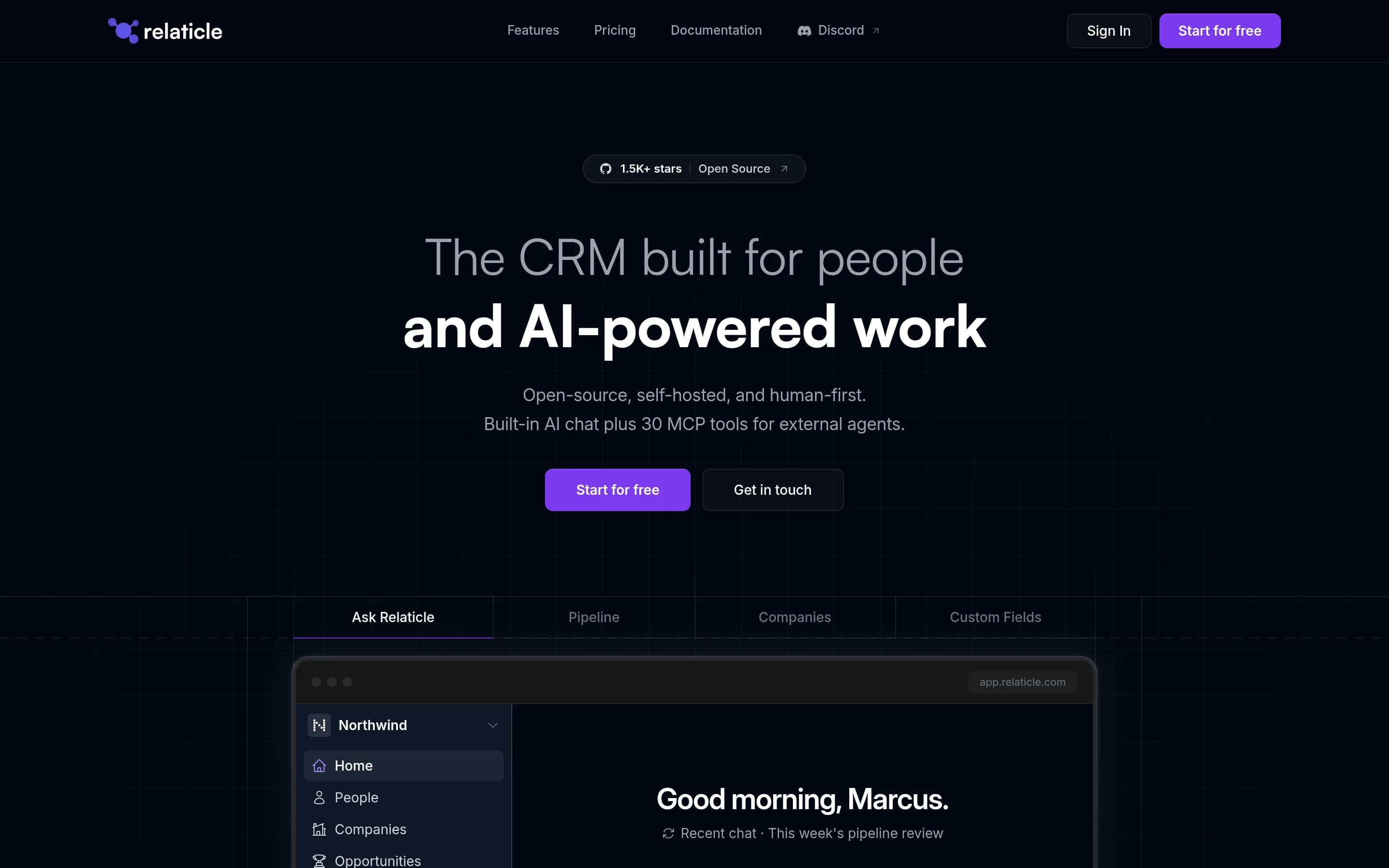
Relaticle is a narrower, open-source CRM centered on companies, people, opportunities, tasks, custom fields, and AI-agent access. Choose it when infrastructure control and focused pipeline management matter more than Salesforce’s broader sales, service, marketing, commerce, analytics, data, and low-code platform. Choose Salesforce when those cross-department capabilities or their existing configurations are required;
What it does
Relaticle is an open-source CRM designed for developer-led teams, AI-focused startups, and SMBs. Its documented workflow centers on managing contacts, companies, opportunities, notes, tasks, and customizable CRM records through a modern interface. The application includes 22 custom field types, entity relationships, conditional visibility, encryption, and multi-team data isolation.
Relaticle also provides a production-grade MCP server with 32 tools, schema discovery, and a REST API with full CRUD operations for AI-agent and system integrations. It is self-hostable under AGPL-3.0, with documented Docker and manual deployment paths. The repository lists Laravel, Filament, PHP, PostgreSQL, Composer, Node.js, and optional Redis requirements.
What it covers
- Company and contact records
- Opportunity pipeline tracking
- Custom fields and sales stages
- Tasks, notes, and activity history
- Role-based team access
- AI-assisted CRM workflows
What’s different
- No documented service operations suite
- No documented marketing automation suite
- No documented unified multi-source customer profiles
- No documented commerce or payments suite
- No documented Tableau-equivalent analytics
- No documented CPQ or revenue lifecycle suite
AAtomic-crm1,199
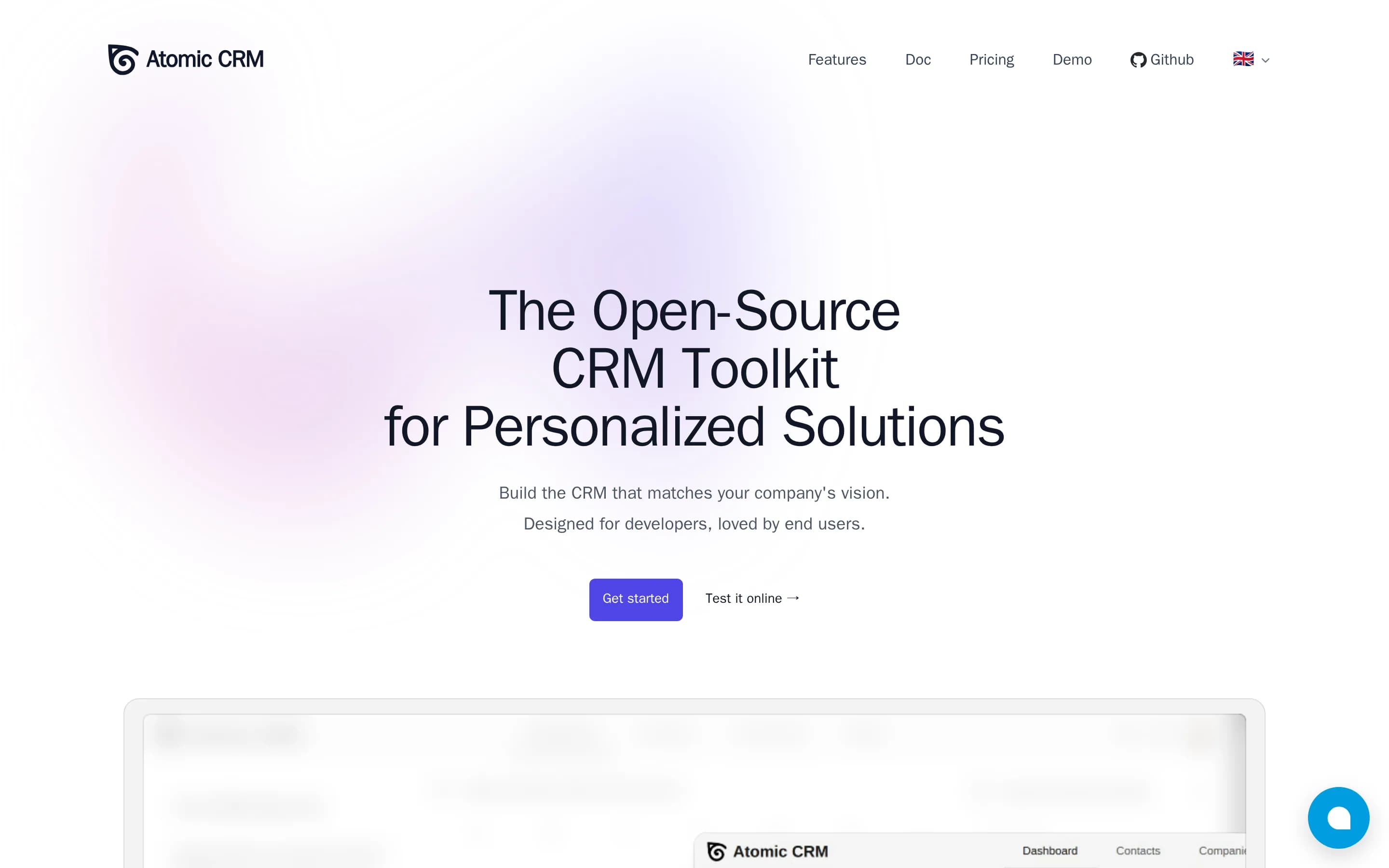
Atomic CRM is the stronger fit for teams seeking a self-hostable, code-customizable CRM centered on contacts, follow-ups, and visual deal pipelines. Salesforce remains the better choice for organizations that need a broad, integrated platform spanning advanced sales automation, service, marketing, unified customer data, analytics, commerce, and business-facing AI agents. The main tradeoff is infrastructure and source
What it does
Atomic CRM is a full-featured CRM built with React, shadcn-admin-kit, and Supabase. Its documented workflows include organizing contacts, creating tasks and reminders, taking notes, capturing emails as notes, viewing aggregated activity history, and importing or exporting data.
The application manages deals through a Kanban sales pipeline and supports custom fields, theme changes, replaceable components, API integrations, and access through Google, Azure, Keycloak, and Auth0. It is available under the MIT license, can be tested online, and can be run locally with Node, Make, Docker, a local Supabase instance, and PostgreSQL.
What it covers
- Contact and customer records
- Visual deal-pipeline tracking
- Tasks, reminders, and notes
- Captured email history
- Custom fields and UI customization
- API-based integrations
- Authentication and access control
What’s different
- No documented service-operations suite
- No documented marketing-automation suite
- No documented multi-source unified profiles
- No documented CRM analytics or reporting suite
- No documented commerce or order management
- No documented CPQ or revenue-lifecycle operations
- No documented business-workflow AI agents
NNextcrm-app680
Choose NextCRM when self-hosting, source access, and a focused CRM with projects, invoicing, documents, email, and AI integration outweigh the need for Salesforce’s broader enterprise platform. Choose Salesforce when you require documented service, marketing, commerce, unified customer-data, or low-code platform coverage; those areas are not established for NextCRM by the supplied evidence.
What it does
NextCRM is an open-source CRM application for managing accounts, contacts, leads, opportunities, targets, contracts, products, activities, campaigns, projects, documents, and invoices. Its CRM entities support create, update, search, linked activities, audit history, soft deletion, and pipeline-oriented opportunity management. It also includes unified keyword and semantic search, reports, an email client, invoicing with payments and PDF export, and AI enrichment for targets and contacts.
The application is implemented with Next.js, React, PostgreSQL, Prisma, and shadcn/ui, with authentication and background jobs provided through documented integrations. Users can run it locally or deploy it with the supplied Docker Compose setup, which bundles the application, PostgreSQL with pgvector, MinIO, and Inngest. An MCP server exposes authenticated tools for reading and writing CRM data.
What it covers
- Account, contact, lead, and opportunity records
- Sales activities and pipeline tracking
- Reports and charts
- AI-assisted CRM workflows
- Email-related workflows
What’s different
- No documented Salesforce importer or compatibility layer
- No documented contact-center or field-service suite
- No documented commerce and order-management suite
- No documented unified multi-source customer-data platform
- No documented general low-code application platform
- No established parity with Salesforce-scale marketing automation
DDjango-crm612
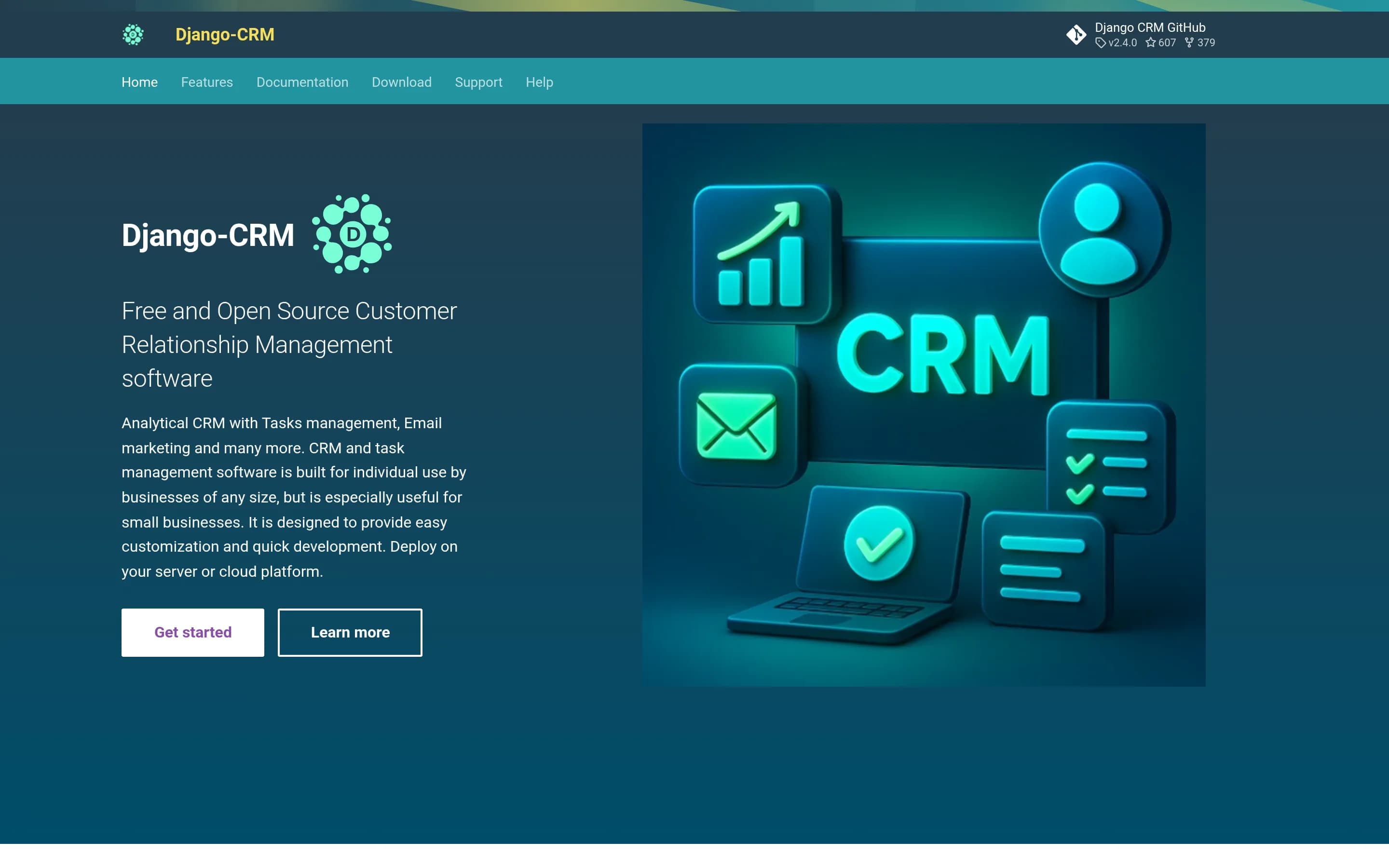
Django-crm is a plausible Salesforce replacement for teams whose scope is primarily self-hosted contact, lead, deal, task, email-campaign, and basic CRM analytics work. Choose it when source and infrastructure control outweigh the convenience of a managed platform and your team can maintain a Python/Django application. Keep Salesforce when you depend on its broader documented scope—service operations, unified cross-
What it does
Django-CRM is a production-stable, open-source customer relationship management system for businesses and freelancers. It manages leads, opportunities, companies, contacts, deals, products, payments, requests, tasks, projects, subtasks, reminders, files, and team assignments, with role-based permissions and interconnected CRM models for sales workflows.
The platform includes sales funnel and income reports, lead-source analytics, email accounts using SMTP and IMAP, newsletters, campaigns, dynamic templates, contact segmentation, and correspondence linked to CRM objects. It also provides web-form integration, imports and exports, messenger and VoIP integrations, multilingual support, and an adaptive Django Admin interface. It runs as a standard Django project with SQLite, MySQL, or PostgreSQL and is intended for self-hosted or on-premise deployment.
What it covers
- Lead, contact, company, and deal records
- Sales pipeline tracking and forecasting
- Email campaigns and contact segmentation
- CRM reports and sales-funnel analytics
- Roles and record-level permissions
- Customizable workflows and integrations
What’s different
- Salesforce-specific data migration tooling
- Full customer-service and contact-center suite
- Unified multi-source customer data profiles
- Agentforce-style AI agents
- B2B, B2C, and D2C commerce operations
- CPQ and broad revenue-lifecycle operations
- Documented low-code application builder
DDeskcommCRM565
Choose DeskcommCRM when the priority is a self-hosted, open-source CRM centered on WhatsApp sales, configurable pipelines, automation, and AI-assisted lead handling—and the organization can operate its own infrastructure. Choose Salesforce when broader, documented platform coverage across customer service, marketing, commerce, unified customer data, analytics, and low-code development matters more than source ande/
What it does
DeskcommCRM is an open-source CRM and sales operations system for businesses that sell through WhatsApp. It provides contact and funnel management, Kanban pipeline views, lead capture through webhooks, follow-ups, routing, team assignment, performance views, and automations that can tag, move, assign, message, or notify external systems.
The product combines human support with configurable AI agents using RAG, memory, skills, sentiment analysis, audited handoffs, and selectable OpenRouter, Anthropic, or OpenAI providers. WhatsApp connectivity is available through QR-based WAHA or Meta Cloud API, with Nuvemshop integration documented. It is multi-tenant and designed for LGPD controls, RBAC, audit logging, and self-managed deployment on a VPS with Docker and Supabase.
What it covers
- Contact and lead records
- Configurable deal pipelines
- Rule-based workflow automation
- Sales-performance views
- AI-assisted sales workflows
- Role-based team assignment
What’s different
- Broad contact-center and field-service suite
- Advertising, loyalty, and mobile-marketing suite
- Unified cross-application customer-data platform
- Commerce, order-management, and payments suite
- General-purpose low-code application platform
- Documented Salesforce data importer or compatibility path
MMycompany318
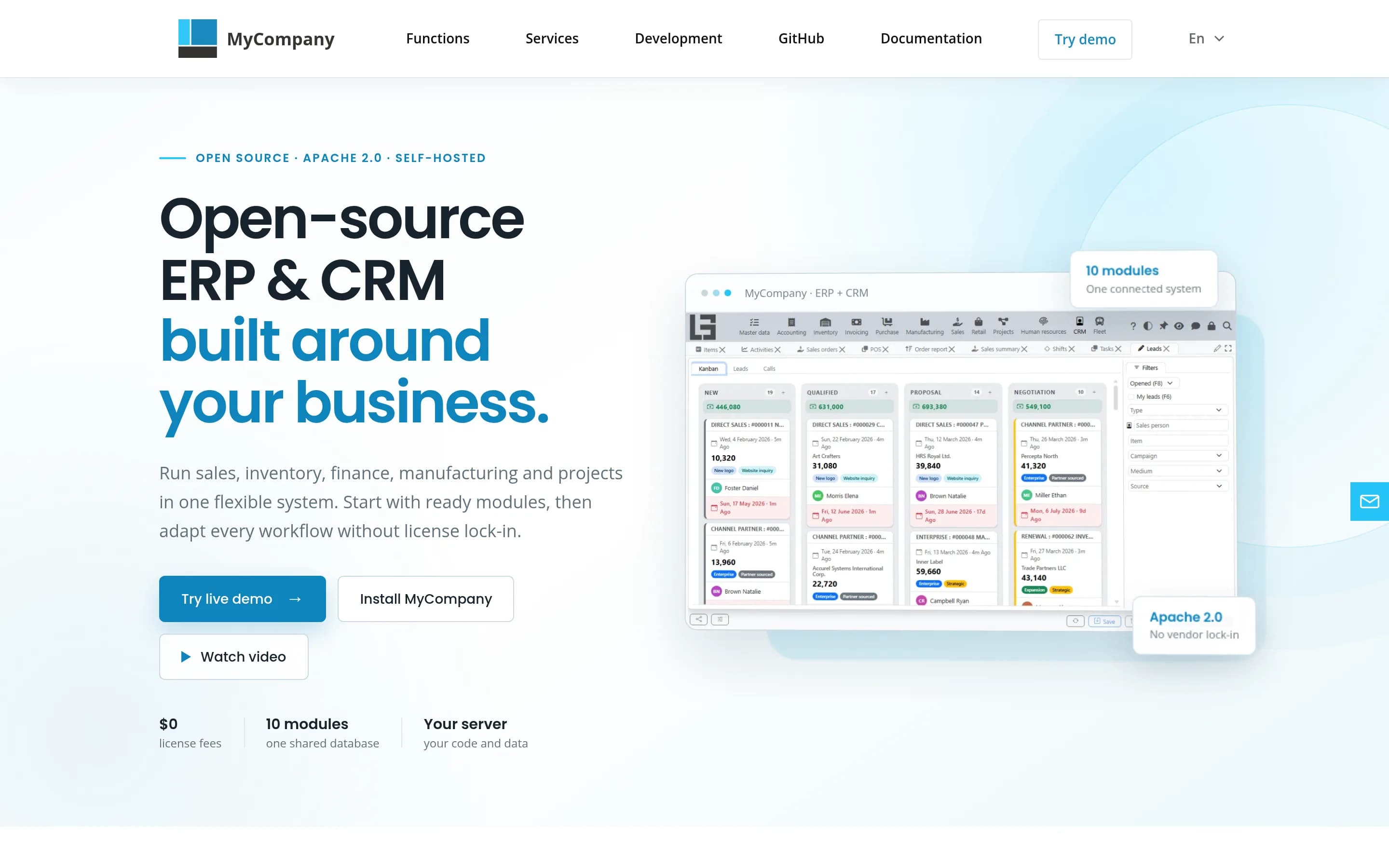
Choose MyCompany when a small or midsize business wants a self-hosted, open-source CRM combined with operational ERP modules such as inventory, invoicing, manufacturing, projects, HR, and POS. Choose Salesforce when the priority is a broader cloud customer platform covering advanced sales automation, service, marketing, unified customer profiles, analytics, commerce, and AI agents. The central tradeoff is greater run
What it does
MyCompany is an open-source ERP and CRM for small and medium-sized businesses. Its Sales & CRM module provides a lead kanban board, logs calls and emails, tracks marketing sources, and creates sales orders and invoices from leads. Other modules cover purchasing, inventory, invoicing, manufacturing, projects, HR, and retail POS in a shared database.
The product can be installed on Linux or Windows, with a web client and desktop client documented. Docker installation is supported, and the project provides installation scripts, an installer, documentation, and a live demo. Company-specific fields and modules can be added through separate lsFusion modules.
What it covers
- Lead and sales-pipeline management
- Sales activity logging
- Orders and invoices linked to sales
- Customizable business workflows
- Shared application data
What’s different
- No documented contact-center or field-service suite
- No documented broad marketing-automation suite
- No documented customer-data-platform profiles
- No documented Tableau-equivalent analytics suite
- No documented configurable AI agents
IIdurar-erp-crm8,672
Choose Idurar-erp-crm when a self-hosted, open-source system for customer, quote, invoice, and payment management covers the workflow and your team can operate a MERN application. Choose Salesforce when you need the broader documented platform spanning sales automation, service, marketing, unified customer data, analytics, AI agents, commerce, or low-code development. The central tradeoff is infrastructure and source
What it does
IDURAR is an open-source ERP and CRM application built with Node.js, Express.js, MongoDB, React, Ant Design, and Redux. Its documented workflows include customer management, quote management, invoice management, payment management, and accounting, with the repository also describing inventory and HR capabilities.
The project provides a self-hosted deployment path. Setup involves cloning the repository, configuring a MongoDB account and database, editing environment settings, installing backend and frontend dependencies, running the setup script, and starting the backend and frontend servers. The README describes an enterprise self-hosted version and permits personal or commercial use under AGPL-3.0.
What it covers
- Customer record management
- CRM-oriented business workflows
What’s different
- Documented lead and opportunity pipelines
- Sales automation and CPQ
- Customer service operations
- Marketing automation and personalization
- Unified multi-source customer profiles
- Analytics and dashboards
- Configurable AI agents
- Commerce and order operations
- Low-code application development