
SSemrush
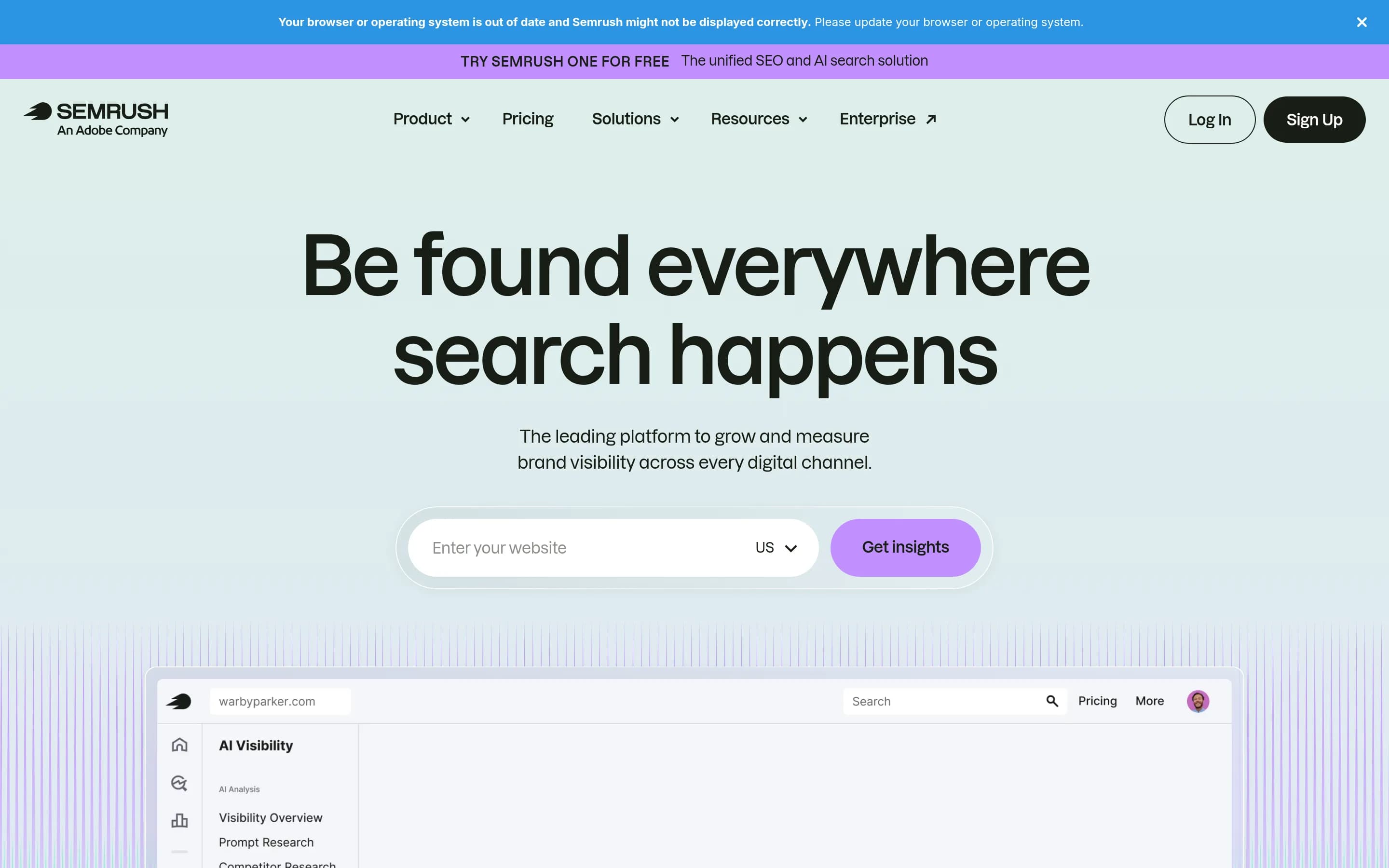
Semrush is a digital marketing analytics platform for researching keywords and competitors, auditing websites, tracking search and AI-answer visibility, and analyzing backlinks and traffic. It also includes tools for content optimization, local search, advertising research, digital PR, and social media.
Why people leave Semrush
Someone might seek a Semrush alternative when the breadth of the platform exceeds the job they actually need to accomplish. Semrush spans SEO, AI visibility, market and traffic analysis, content, local search, advertising, digital PR, and social media. A team focused only on rank tracking, keyword research, backlink analysis, or technical audits may prefer a narrower product with a simpler workflow and fewer unrelated modules.
Cost and packaging may also influence the decision. The crawled page promotes a seven-day trial but does not provide plan details, while presenting products for organizations ranging from freelancers and solopreneurs to agencies and enterprises. Prospective users may therefore compare alternatives that offer a pricing structure, usage limits, or feature bundle better aligned with their team size. Agencies and large organizations might likewise look for different reporting, domain, geographic, prompt-monitoring, or data-access arrangements.
The platform’s emphasis on proprietary search, competitive, traffic, backlink, geographic, and LLM-prompt data can create another reason to evaluate substitutes. Organizations may want to compare database coverage, update frequency, regional relevance, methodology, or compatibility with their existing measurements. Teams with specialized geographic markets or channel requirements may find that another provider’s dataset is a closer fit. Others may prefer direct integrations, APIs, or self-hosted workflows that give them more control over how marketing data is collected, combined, and retained.
Finally, Semrush is expanding beyond traditional SEO into AI-answer visibility, content optimization, advertising, PR, local presence, and social publishing. That unified approach can be useful, but it may not suit teams that want best-of-breed tools for each discipline or that already have established systems for content, ads, social media, and reporting. Users may also seek an open-source alternative for inspectable code, customization, deployment control, reduced dependence on a single vendor, or the ability to build a focused analytics workflow around their own data. Such an alternative would not necessarily reproduce Semrush’s large proprietary databases, so the trade-off between openness and supplied market intelligence would need careful evaluation.
4 Best Open Source Semrush Alternatives (Ranked)
Each alternative is evaluated for core feature coverage, deployment options, licensing, project health, and overall fit. The ranking prioritizes how closely a tool matches Semrush's primary workflows, using popularity only as a secondary signal.
OOpen-seo12,059
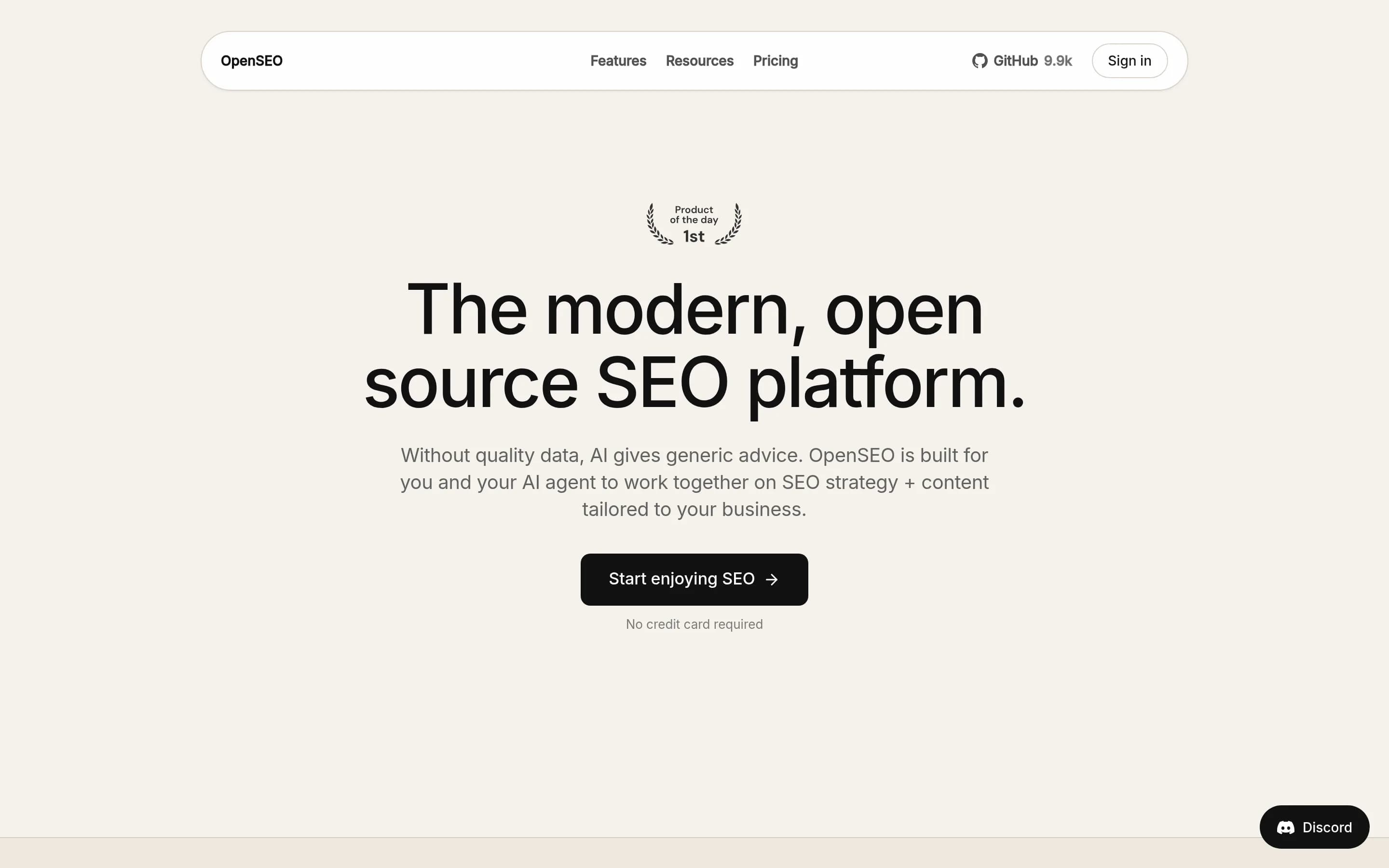
OpenSEO is the better fit for teams that want a narrower, inspectable SEO stack they can self-host and connect to AI agents, while accepting dependence on DataForSEO for underlying SEO data. Choose Semrush when the broader marketing suite—especially advertising, local search, content optimization, digital PR, social media, and established proprietary datasets—is required; those areas are not documented in OpenSEO’s35
What it does
OpenSEO is an open-source, pay-as-you-go SEO platform covering keyword research, rank tracking, competitor insights, backlink analysis, site audits, and AI visibility. It presents focused workflows through a modern UI and can connect SEO data to AI agents such as Claude Code, OpenClaw, and Hermes through MCP and reusable agent skills.
The project supports a hosted version as well as self-hosting with Docker for personal use or Cloudflare for internet-facing deployments. Users supply their own DataForSEO API key and pay the underlying provider directly for SEO data. The repository also documents local development and customization through forking.
What it covers
- Keyword research
- Rank tracking
- Competitor visibility analysis
- Backlink analysis
- Technical site audits
- AI-search visibility
What’s different
- No documented advertising research
- No documented local search management
- No documented digital PR tools
- No documented social-media tools
- No documented real-time content optimization
- No documented equivalent marketing-report builder
Crawlseo538
CrawlSEO is a narrower, self-hosted alternative for teams primarily needing Google Search Console analytics, technical crawling, Core Web Vitals, rank tracking, and optional keyword/backlink data. Its main tradeoff is operational control and inspectable MIT-licensed code versus Semrush’s broader supplied market intelligence and marketing suite. Choose CrawlSEO when focused SEO monitoring and self-hosting justify 운영g~
What it does
CrawlSEO is an open-source SEO monitoring dashboard for founders and site owners. It connects Google Search Console with site crawling and Core Web Vitals, presenting keywords, pages, clicks, impressions, CTR, position changes, health scores, technical issues, content scoring, and remediation guidance.
The application also documents DataForSEO-powered keyword ideas and backlink analysis, historical rank snapshots, SEO opportunity detection, CSV export, and alerts through email, Slack, Telegram, or webhooks. An included MCP server exposes ten tools for querying SEO data, running crawls, and finding opportunities through supported AI-agent clients.
CrawlSEO is self-hosted under the MIT license. The README documents Docker Compose deployment with PostgreSQL, Google OAuth, and prebuilt multi-architecture images, plus a manual Node.js and PostgreSQL installation path.
What it covers
- Keyword research, with external-data caveats
- Technical site crawling and audits
- Backlink-profile analysis, with external-data caveats
- Historical rank tracking
- Search-performance reporting
What’s different
- No documented AI-answer visibility tracking
- No documented competitor or market analysis
- No documented advertising research
- No documented local-search management
- No documented real-time content optimization
- No documented Semrush project import
Geo-aeo-tracker235
Geo-aeo-tracker is a focused, self-hostable alternative for AI-answer visibility, prompt tracking, citation analysis, and AEO/SRO checks—not a full Semrush replacement. Choose it when code access, local-first storage, deployment control, and tracking across six AI models matter more than broad marketing intelligence. Choose Semrush when you need proprietary keyword, backlink, traffic, traditional rank-tracking, local
What it does
GEO/AEO Tracker is a local-first dashboard for monitoring how a brand appears in ChatGPT, Perplexity, Gemini, Copilot, Google AI Overview, and Grok. Users configure brands, aliases, websites, keywords, and prompts, then run single or batch checks, compare visibility scores over time, review responses and citations, and generate competitor battlecards.
It also provides geo-scoped tracking, drift alerts, scheduled runs, an AEO site audit, and SRO Analysis that combines SERP data, page scraping, citations, site context, and LLM analysis into scores and recommendations. The Next.js application runs locally with IndexedDB and localStorage, can optionally sync through a user-controlled Supabase project, and supports Vercel deployment. External Bright Data, OpenRouter, and optionally Gemini credentials are required for live analysis.
What it covers
- AI-answer visibility tracking
- Competitor-oriented analysis
- Website readiness auditing
- Visibility trend reporting
- Geographic visibility comparison
What’s different
- Semrush-scale keyword database research
- Backlink-profile analysis
- Traffic and market analytics
- Traditional search-rank tracking
- Advertising research
- Local listings management
- Broad real-time content optimization
GGeolook500
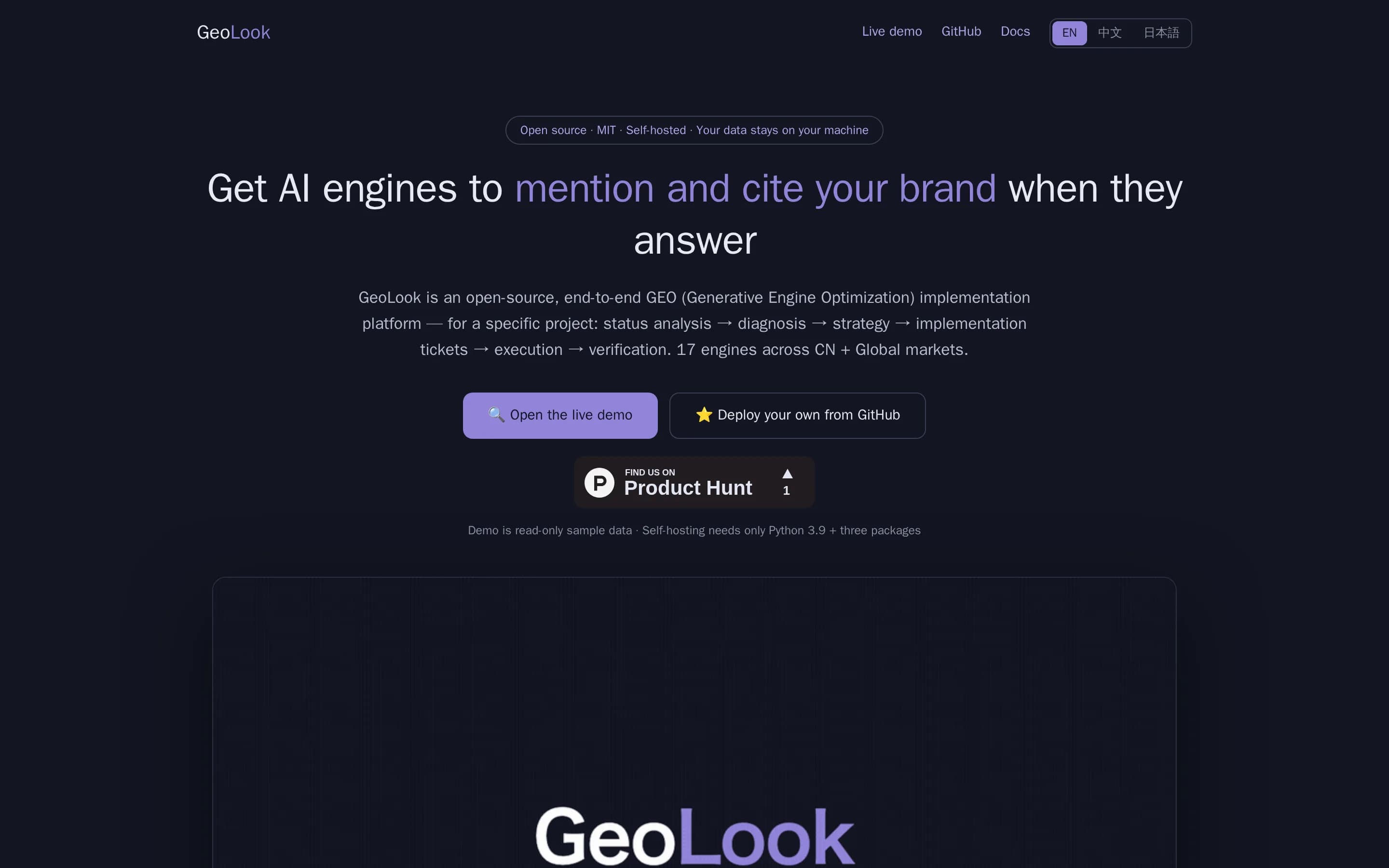
GeoLook is a focused, self-hosted alternative for generative-engine optimization rather than a full Semrush replacement. Choose GeoLook when AI-answer mention and citation monitoring, diagnosis, implementation tickets, and local data control are the priority. Choose Semrush when you need the broader digital-marketing suite—especially conventional rank tracking, backlink and traffic intelligence, advertising research,
What it does
GeoLook is an open-source, self-hosted platform for generative engine optimization. It samples answers from multiple AI engines, measures brand mention rate, rank, and citation share, compares competitors, and provides before-and-after verification across sampling rounds.
Its workflow covers keyword and question mining, six-dimension site audits, channel and citation analysis, brand facts, structured implementation tickets, content checks, deployable assets such as llms.txt and JSON-LD, and client-ready reports. It also supports scheduled reruns, manual sampling, and optional API-based sampling.
The product runs locally on macOS or Linux with Python 3.9+ and opens a browser dashboard at localhost. It stores project data on the user's machine, supports SSH-tunneled remote access, and can run without API keys through manual sampling.
What it covers
- AI-answer visibility monitoring
- Keyword and question discovery
- Competitor visibility comparisons
- Technical site auditing
- Content optimization guidance
- Marketing and client reports
What’s different
- No documented classic SERP rank tracking
- No documented backlink-profile database
- No documented traffic or audience estimates
- No documented advertising research
- No documented local-listing management
- No documented multi-user collaboration