
SShopify
Shopify is a commerce platform for building and operating online stores, processing checkout and payments, and managing products, orders, inventory, shipping, and sales channels. It also supports point-of-sale, international and B2B commerce, marketing, analytics, automation, and extensions through an app ecosystem.
Why people leave Shopify
Organizations may seek a Shopify alternative when its broad, all-in-one commerce model does not match the scope of their operation. A small seller might prefer a simpler product focused only on storefronts and checkout, while a larger or specialized business may need a platform designed around more complex operational requirements. Shopify presents website building, payments, inventory, shipping, marketing, analytics, point of sale, international selling, B2B, funding, and automation together; teams that need only a subset may want a more narrowly focused system.
Customization requirements can also prompt a comparison. Shopify offers themes, custom storefront options, APIs, developer tools, and an App Store with thousands of commerce apps. That extensibility may be useful, but a business with unusual product, checkout, fulfillment, or account workflows might evaluate whether its desired setup can be handled directly or would depend on custom development and multiple apps. Teams may instead prefer software whose default data model and workflows more closely fit their industry.
Businesses may also reconsider Shopify when their commerce stack is centered on existing payment, inventory, warehouse, finance, marketing, or enterprise systems. Shopify includes its own capabilities across many of these areas, but some organizations may want a storefront that plays a narrower role alongside established back-office tools. Others may prioritize a different balance between built-in functionality, integrations, and responsibility for maintaining the surrounding stack.
Finally, sales-channel strategy can affect fit. Shopify supports online stores, point of sale, social and marketplace channels, the Shop app, international markets, B2B, and newer commerce experiences involving AI chats. A merchant focused on one channel may prefer a purpose-built option, while a business with distinctive regional, wholesale, in-person, or marketplace requirements may compare platforms based on the depth of those specific workflows. Teams evaluating alternatives may also prioritize different approaches to portability, infrastructure control, ecosystem dependence, or long-term platform flexibility rather than adopting one platform for most commerce operations.
13 Best Open Source Shopify Alternatives (Ranked)
Each alternative is evaluated for core feature coverage, deployment options, licensing, project health, and overall fit. The ranking prioritizes how closely a tool matches Shopify's primary workflows, using popularity only as a secondary signal.
SSpree15,623
Choose Spree when infrastructure control, source access, headless customization, and ownership of the commerce stack outweigh the convenience of a managed platform. Choose Shopify when the priority is an all-in-one hosted service with broader documented coverage for marketing, analytics, app-based extensions, social and marketplace selling, and an admin AI assistant. Spree covers core storefront, checkout, catalog, B
What it does
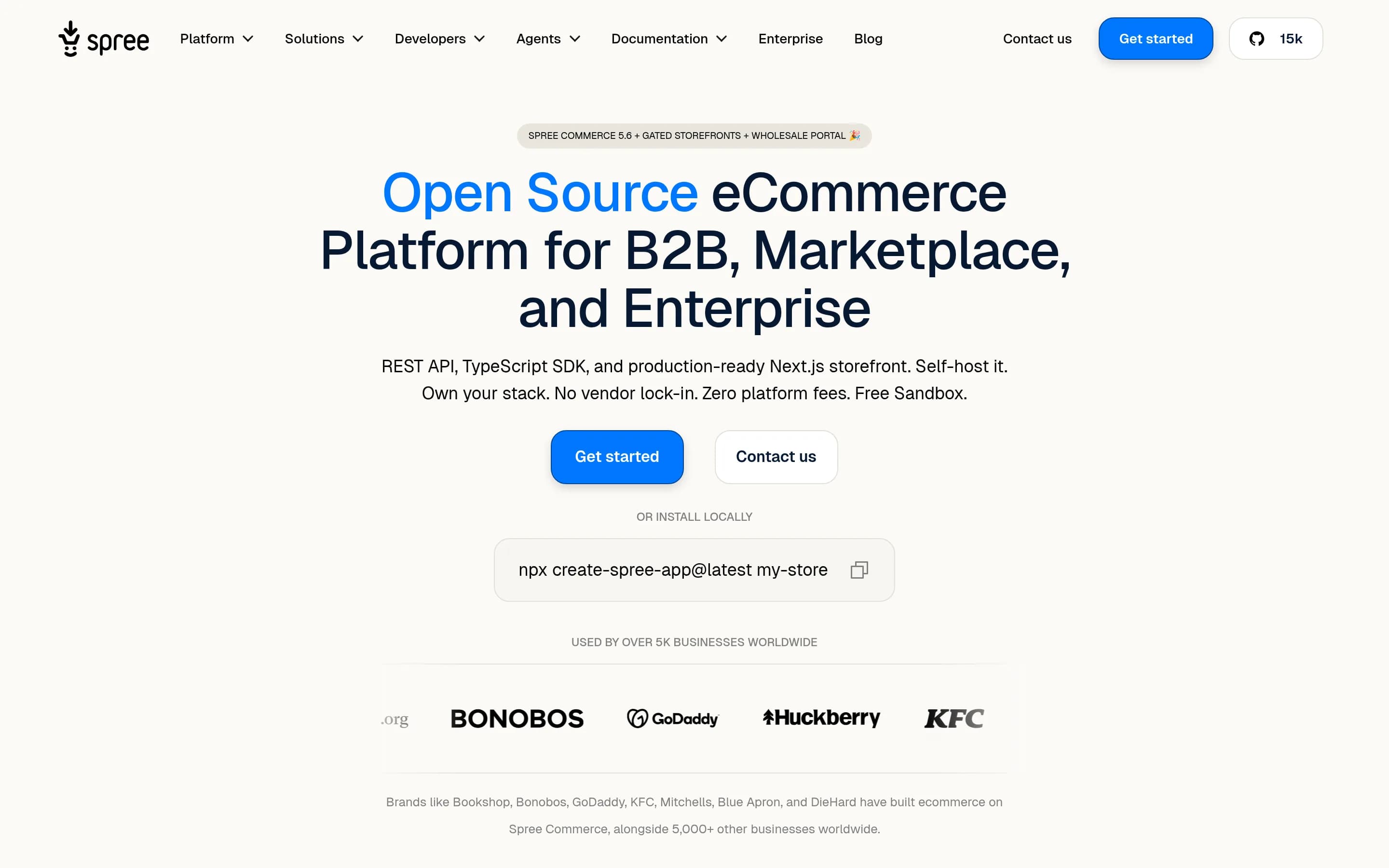
Spree is an open-source, headless e-commerce platform for building and operating online stores, custom commerce backends, B2B and wholesale storefronts, and multi-vendor marketplaces. It includes a REST API, TypeScript SDK, Admin Dashboard, and production-ready Next.js storefront.
Documented capabilities include product and catalog management, orders, promotions, gift cards, sales channels, payment integrations, multi-region currencies and shipping rules, customer accounts, SEO, and B2B pricing. The repository supports local setup through create-spree-app, Docker-based deployment, and hosting on cloud, on-premises, or VPS infrastructure.
What it covers
- Published storefront and checkout
- Product, order, and inventory management
- Multiple payment providers
- Sales channels and POS support
- Cross-border market configuration
- B2B and wholesale pricing
- APIs and extensibility
What’s different
- Shopify-specific social and marketplace channels
- Shop app and AI-chat selling
- Sidekick-style admin assistant
- Comparable packaged marketing and analytics suite
- Comparable large app marketplace
SShopware3,406
Choose Shopware when infrastructure control, source access, headless architecture, and deep PHP/Symfony customization outweigh the operational burden of maintaining a commerce platform. Choose Shopify when you want a broader managed package with documented coverage across POS, shipping, international markets, and multiple sales channels; the supplied Shopware evidence does not establish equivalent coverage for all of
What it does
Shopware 6 is an open-source, API-first and headless commerce platform built with Symfony and Vue.js. It provides a ready-to-use shopping cart system for operating online shops and can also serve as an extensible e-commerce framework.
Users can extend the platform through apps, plugins, bundles, and more than 3,100 community extensions. The repository documents managed Shopware Cloud as well as on-premise installation through a flex template, web-based installer, or documented local and Docker development setups. Shopware is released under the MIT License.
What it covers
- Online storefront and shopping cart
- Headless and custom storefront options
- APIs and extension systems
- B2B commerce options
- Marketing and analytics capabilities
- Administrative AI assistant
What’s different
- No documented synchronized point-of-sale coverage
- No documented built-in shipping parity
- No documented international-markets parity
- No documented full Shopify channel parity
- No documented Shopify-specific migration tool
SSmartstore1,511
Choose Smartstore when source access, self-hosting, and control of an ASP.NET-based commerce stack outweigh the convenience of a managed platform. It covers storefront, catalog, checkout-related modules, inventory, payments, shipping, marketing, and international store basics. Choose Shopify when the documented breadth of managed channels—especially POS, social and marketplace selling, the Shop app, B2B, and Shopify’
What it does
Smartstore is a modular, open-source e-commerce platform built on ASP.NET Core. It provides configurable storefronts for desktop and mobile shoppers, with multi-language, multi-store, and multi-currency support, product catalogs, variants, bundles, discounts, coupons, and SEO features.
The platform includes sales, customer, inventory, CRM, checkout, payment, shipping, marketing, CMS, search, import/export, and reporting-related capabilities. It also documents a visual CMS page builder, theme configuration, AI-assisted content and image generation, REST API access, and a marketplace for extensions.
Smartstore can run on Windows, Linux, or macOS and supports SQL Server, MySQL, PostgreSQL, and SQLite. The repository documents local execution through Visual Studio, self-contained builds, and Docker image and container creation.
What it covers
- Published online storefront
- Product catalog and variants
- Sales and inventory management
- Payment and shipping options
- Multi-language and multi-currency stores
- Marketing and promotion tools
- Themes, plugins, and web API
- AI-assisted commerce content
What’s different
- Documented Shopify POS equivalent
- Documented social and marketplace channels
- Documented Shop app channel
- Documented AI-chat sales channel
- Documented Shopify-specific migration tool
- Documented Kubernetes deployment
BBagisto27,975
Choose Bagisto when source-code control, self-hosting, and Laravel-based customization outweigh the convenience of Shopify’s broader managed commerce suite. Bagisto covers storefront, B2B, POS, headless, marketplace, and extension-based workflows, but the supplied evidence does not establish equivalents for several Shopify-specific capabilities. Choose Shopify when integrated payments, international shipping, named fi
What it does
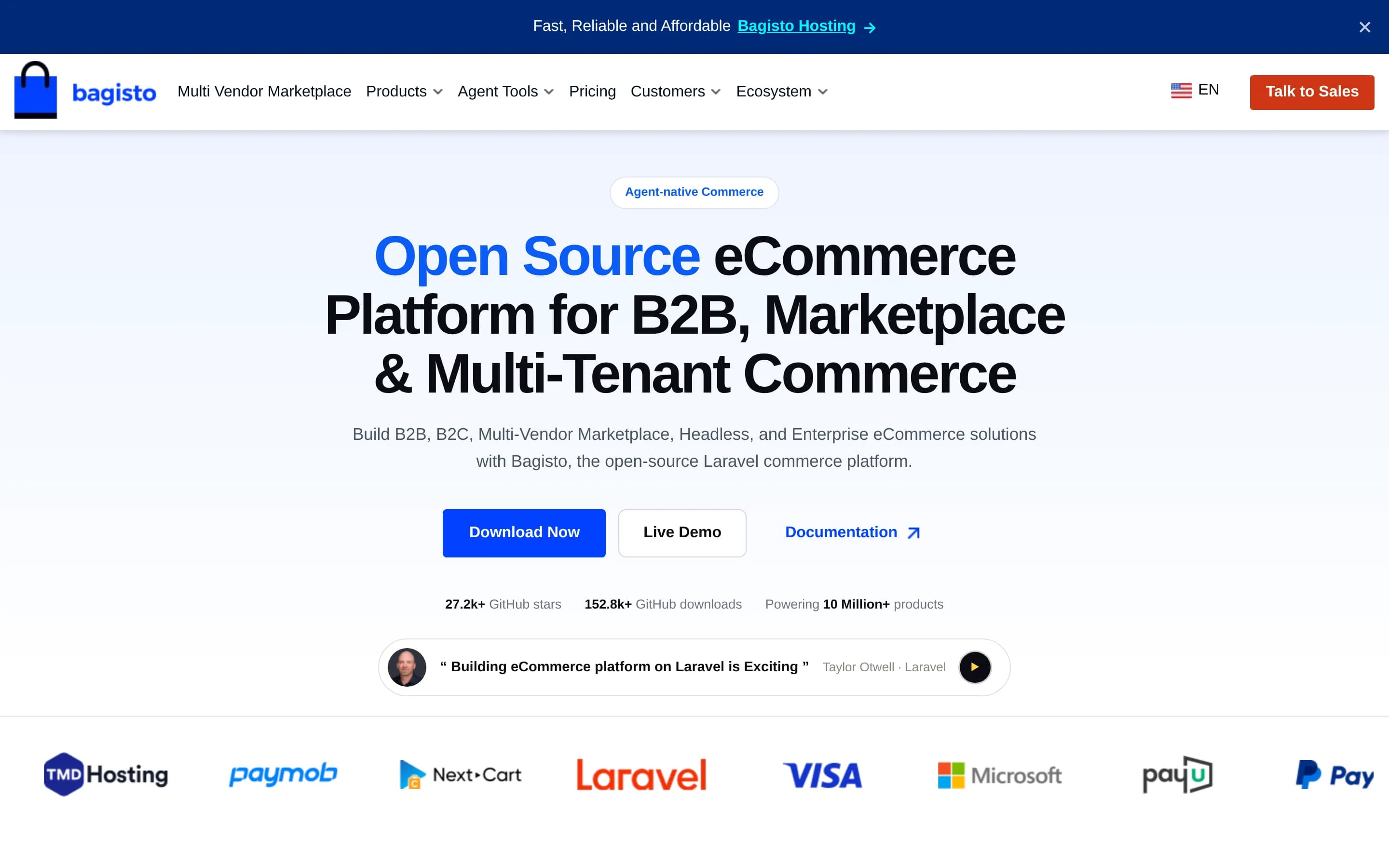
Bagisto is an open-source e-commerce platform and Laravel framework for building and operating online stores. Its documented capabilities include storefront creation, product catalog and order handling, inventory management, customer checkout, B2B purchasing, quote negotiation, procurement workflows, and multi-vendor marketplaces.
The platform also documents point-of-sale operations, headless storefronts with Next.js, mobile commerce integrations, multi-tenant stores, and extensions. It can be installed locally with or without Composer, deployed using Docker, launched through an AWS Marketplace AMI, or hosted through Bagisto Cloud. The project is released under the MIT License.
What it covers
- Online storefront commerce
- Product, order, and inventory workflows
- Online and retail POS selling
- B2B commerce options
- Headless storefront support
- Extensions and custom integrations
- AI-assisted commerce options
What’s different
- No documented Shopify Payments equivalent
- No documented Shop Pay equivalent
- No documented Shopify Markets equivalent
- No documented Shop app channel equivalent
- No documented social or AI-chat channel parity
- No documented marketing analytics parity
- No documented Sidekick-style admin assistant parity

NNextjs-commerce6,270
Nextjs-commerce is a narrower, self-hostable headless storefront rather than a documented one-for-one replacement for Shopify’s all-in-one commerce platform. Choose it when a technical team wants control of a Next.js storefront backed by Bagisto and can operate the required infrastructure. Choose Shopify when the business needs a managed platform spanning storefront, checkout, POS, multichannel, international, B2B,营销
What it does
Bagisto Next.js Commerce is an open-source headless e-commerce storefront built with Next.js and powered by Bagisto APIs. It provides responsive product browsing, search, pagination, product detail pages, hierarchical categories, filtering, sorting, SEO metadata, and support for simple, configurable, bundled, and downloadable products.
The storefront includes cart management, guest and authenticated checkout, shipping-address selection, payment-method selection, order synchronization with the Bagisto backend, and customer accounts for profiles, addresses, order history, downloads, reviews, wishlists, and product comparison. It uses NextAuth.js, GraphQL APIs, caching, ISR, and optimized rendering. Deployment is documented locally or through Netlify and Vercel, with Bagisto and its headless extension installed on a server or local environment.
What it covers
- Published product storefront
- Product browsing and search
- Cart and checkout flow
- Guest and account checkout
- Customer order history
- Backend order synchronization
What’s different
- No documented point-of-sale workflow
- No documented social or marketplace channels
- No documented international-markets tooling
- No documented B2B commerce workflow
- No documented marketing automation or analytics suite
- No documented app-store equivalent
- No documented admin AI assistant
AAimeos5,446
Aimeos is a credible self-hosted alternative for engineering-led teams that want a customizable Laravel storefront, headless APIs, multi-vendor or complex B2B workflows, and control of their infrastructure. The tradeoff is that the team must operate and maintain a PHP/Laravel commerce stack, while some advanced B2B, marketplace, and scaling capabilities require commercial extensions. Shopify is the better choice for5
What it does
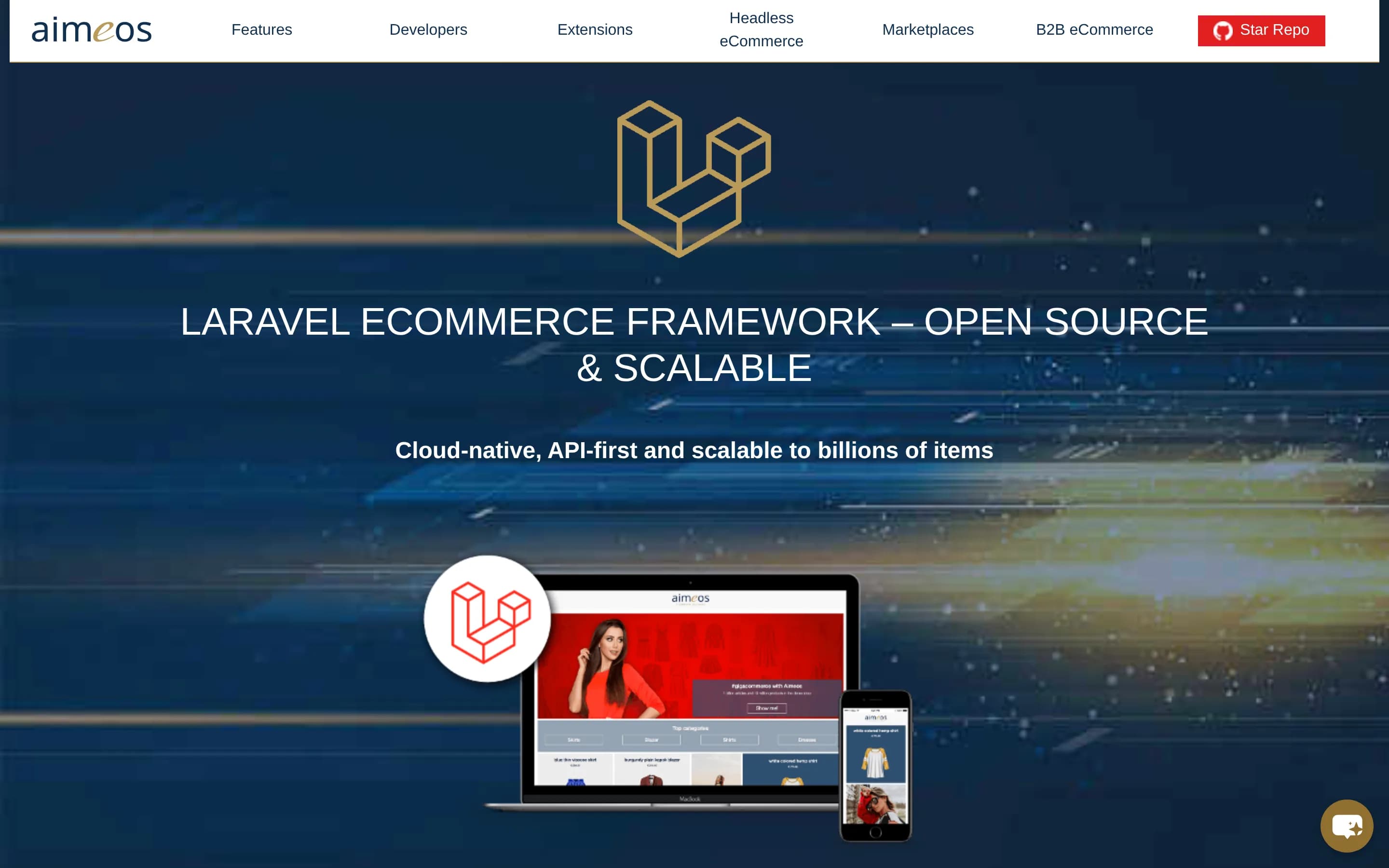
Aimeos is a Laravel-based e-commerce platform for building and operating online shops, scalable marketplaces, and complex B2B applications. Its documented feature set includes a storefront, shopping cart, configurable products, bundles, subscriptions, vouchers, recurring payments, more than 100 payment gateways, SEO support, multiple languages, and multi-vendor, multi-channel, and multi-warehouse operation.
The distribution includes a full-featured administration backend and dashboard for managing commerce data and configuration. It can be installed as a standalone shop with Composer, run through Laravel's integrated PHP server, and deployed behind Apache or Nginx with supported SQL databases. Aimeos also documents REST, GraphQL, and headless distribution options for integrations and custom frontends.
What it covers
- Published storefront and checkout
- Product, inventory, and order administration
- Payment-provider integration
- Multi-channel commerce
- International language and currency support
- B2B commerce, partly through extensions
- Storefront and administration APIs
- Discounts, vouchers, and configurable products
What’s different
- No documented synchronized point of sale
- No documented Shopify-specific sales channels
- No documented marketing and analytics suite
- No documented workflow automation equivalent
- No documented admin AI assistant
- No documented Shopify data importer
SShopizer3,940
Shopizer is a self-hostable, Apache-2.0 Java option for teams that want a headless commerce backend and REST API around catalog, cart, checkout, merchant, order, and customer functions. Choose it when infrastructure control and direct Java customization outweigh the convenience of a managed platform. Choose Shopify when you need a broader, integrated commerce suite—especially POS, multichannel sales, international, B
What it does
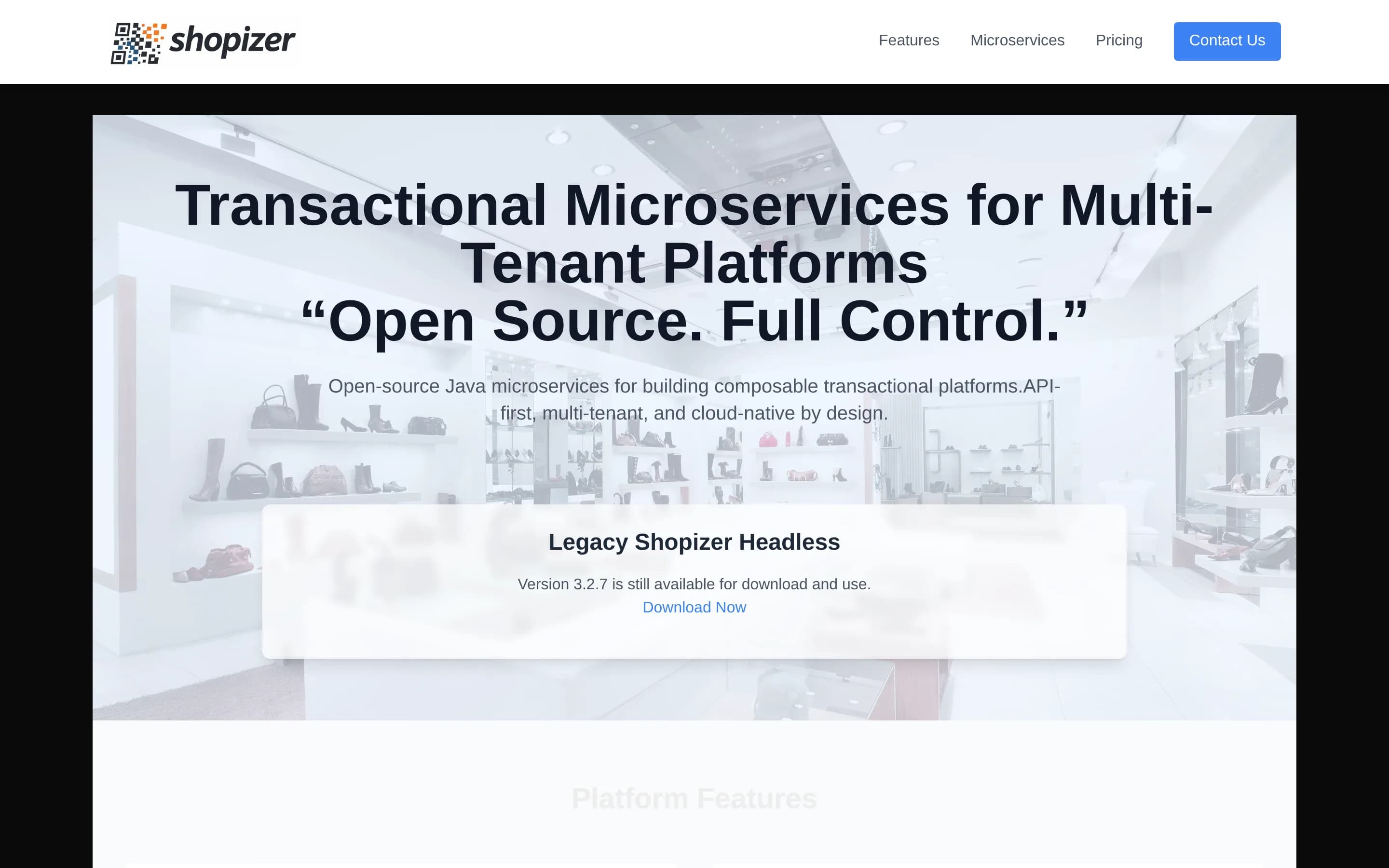
Shopizer is open-source Java e-commerce software built around headless commerce and REST APIs. Its documented capabilities include product catalogs, shopping carts, checkout, merchant management, orders, customers, and users, providing core workflows for operating an online shop.
The repository documents a backend, an administration tool, and a React shop sample. The complete application can run locally with Spring Boot or through Docker images, with the backend, admin interface, and sample storefront deployed as separate components. API access is documented through Swagger UI, and the project supports Java 11 and 17.
What it covers
- Product catalog management
- Shopping cart and checkout
- Customer and order management
- Inventory management
- Commerce APIs
- Online storefront components
What’s different
- No documented synchronized POS
- No documented social or marketplace channels
- No documented international markets or shipping tools
- No documented B2B workflows
- No documented marketing or analytics suite
- No documented app marketplace or workflow automation
- No documented administrative AI assistant

SSvelte-commerce1,804
Svelte-commerce is a self-hostable, MIT-licensed headless storefront, not a full replacement for Shopify’s all-in-one commerce operations. Choose it when a development team wants control of a SvelteKit storefront while retaining or selecting a separate commerce backend. Choose Shopify when the business needs one managed platform spanning storefront, administration, payments, POS, multichannel sales, shipping, markets
What it does
Svelte Commerce is an open-source SvelteKit headless storefront for existing e-commerce backends. It supports product listings and detail pages, categories, cart, checkout, payment methods, order placement, and, depending on the connector, order history, authentication, customer profiles, addresses, coupons, reviews, wishlists, currencies, and faceted search.
The project connects through backend-specific connector packages for Litekart, Medusa, Vendure, Saleor, Shopify, or WooCommerce, with the active backend selected in configuration. It supports SSR and SPA modes and can run locally with npm or be deployed through Netlify, Vercel, or Docker. The README identifies Litekart as the most complete reference implementation; other connectors cover the core browse-to-order path with varying support.
What it covers
- Online product storefront
- Product listing and search
- Product detail pages
- Cart and checkout
- Payment-method integration
- Order placement
What’s different
- No documented point of sale
- No documented B2B commerce
- No documented marketing suite
- No documented commerce analytics
- No documented workflow automation
- No documented broad multichannel management
- Uneven customer-account coverage
- Uneven international-commerce coverage
Ecommerce-CodeIgniter-Bootstrap1,426
Ecommerce-CodeIgniter-Bootstrap is a narrower, self-hosted PHP storefront with documented cart, multilingual, multi-vendor, product, order, stock, API, and limited payment capabilities. It suits teams willing to operate their own PHP/MySQL installation and customize source code. Shopify is the safer choice for organizations needing a broader managed commerce platform—particularly POS, extensive sales channels, built‑
What it does
Ecommerce-CodeIgniter-Bootstrap is an open-source shopping cart and online shop platform built with CodeIgniter, Bootstrap, PHP, and MySQL. It provides responsive public storefronts and administration and vendor pages, with multilingual and multi-vendor support, virtual products, templates, content pages, a blog, subscriptions, search, discounts, and role-based administration.
The documented commerce workflow includes AJAX shopping carts, product management, order storage and email notifications, stock updates from orders, order statistics, PayPal and bank-account payments, and customer order-history tracking. It can be installed locally or on a PHP/MySQL server through a browser installer or manual database import, making it self-hostable and editable.
What it covers
- Published online storefront and shopping cart
- Product and order administration
- Stock updates from orders
- Checkout payment options
- Discount codes
- Commerce statistics
- APIs and editable templates
What’s different
- No documented point-of-sale workflow
- No documented social or marketplace channels
- No documented shipping management
- No documented international-market tooling
- No documented B2B workflows
- No documented app marketplace or workflow automation
- No documented AI administration assistant

CComplete-Ecommerce-in-laravel-101,017
Complete-Ecommerce-in-laravel-10 is a narrower, self-hosted Laravel storefront with an admin panel and PayPal integration; Shopify is the better fit when the broader managed commerce platform—such as POS, multichannel, international, B2B, shipping, apps, and automation—is required. Choose the open-source project when source-code control and a conventional web-store workflow outweigh the work of operating the stack; (
What it does
Complete E-commerce Website in Laravel 10 is a MIT-licensed application for operating an online shop. Its customer-facing workflow includes a responsive storefront, progressive web app support, product browsing, shopping cart, wishlist, order tracking, PayPal payment integration, social login, reviews, and SEO-friendly URLs and metadata.
The application includes an admin panel for product and order management, role management, analytics and reporting, coupons and discounts, categories, blog content, media, banners, notifications, and messaging. Users receive dashboards for order history, tracking, profiles, reviews, and comments. Deployment is self-hosted: install PHP, Composer, Node.js, and a database, configure the Laravel environment, run migrations and seeders, then start the application with `php artisan serve`.
What it covers
- Online storefront and shopping cart
- Product and order administration
- Integrated payment checkout
- Coupons and discounts
- Order history and tracking
- Commerce analytics and reporting
What’s different
- No documented point-of-sale commerce
- No documented multichannel selling
- No documented shipping or international markets
- No documented B2B commerce
- No documented app marketplace or workflow automation
- No documented Shopify data importer
- No clearly documented inventory management
TThelia876
Thelia is the stronger fit for teams that want a GPL-licensed, self-hosted PHP commerce framework they can customize and connect to existing business systems, while accepting responsibility for infrastructure and development. Shopify is the safer choice for merchants seeking a broader integrated platform with documented POS, multichannel, shipping, international, marketing, analytics, automation, and B2B coverage; T
What it does
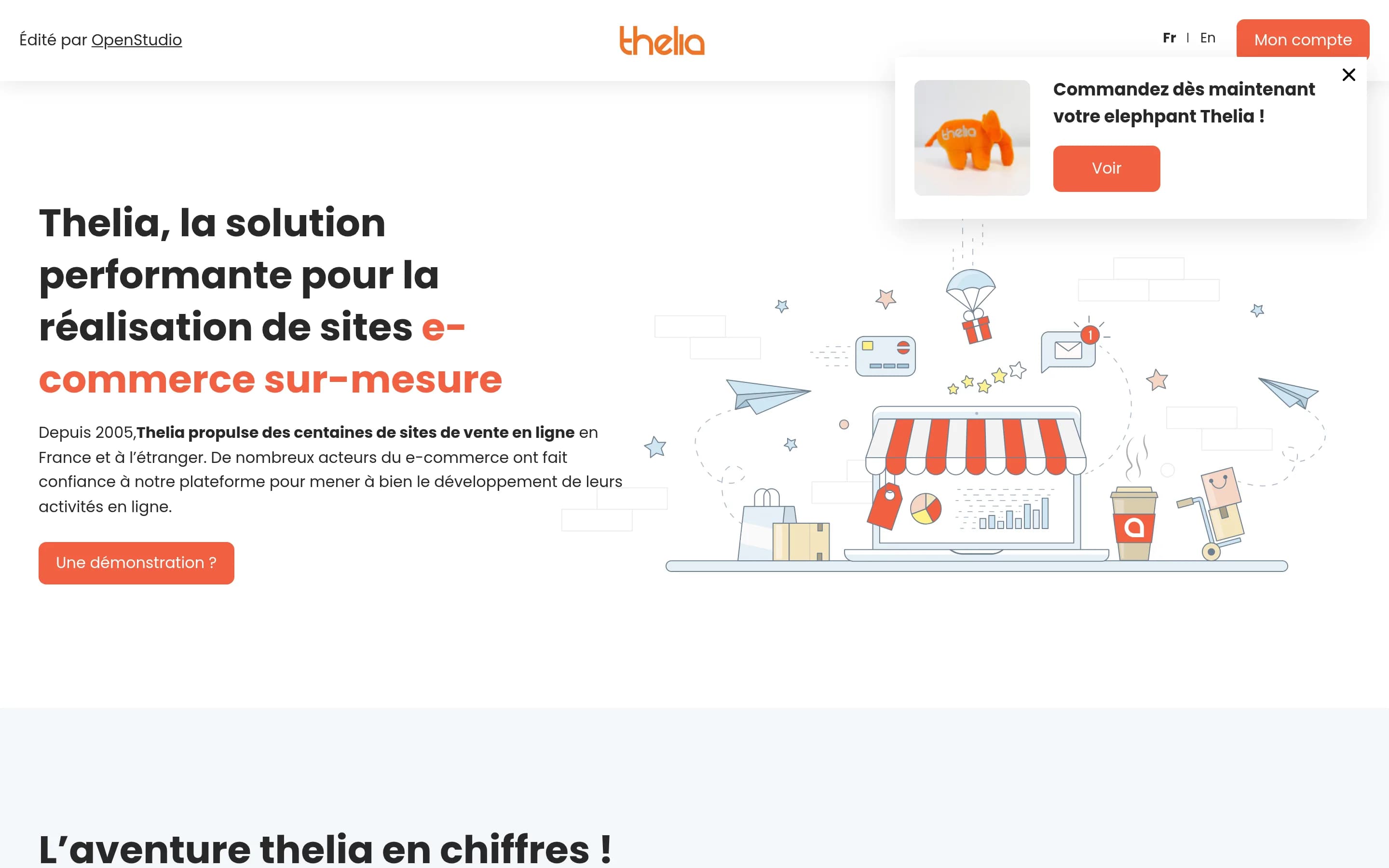
Thelia is an open-source e-commerce framework for creating and operating online stores while managing web content. It provides a Twig-based front office for storefronts and a Twig-based back office for administration, with an additional Smarty back office available for migration scenarios.
The repository documents a self-managed deployment using PHP 8.3, Symfony 7.4, MariaDB or MySQL, Composer, Node.js, and Nginx or Apache. Installation initializes the database and templates, supports demo and administrator setup, and produces a storefront plus an `/admin` interface. DDEV is recommended for development, but the repository does not ship a Docker setup.
What it covers
- Online storefront creation
- Custom storefront templates
- Web-content management
- APIs for external integrations
- Extension through modules or apps
What’s different
- No documented Shopify importer
- No documented point-of-sale system
- No documented social or marketplace channels
- No documented integrated shipping or markets suite
- No documented marketing or analytics suite
- No documented AI administration assistant
NNuxtcommerce247
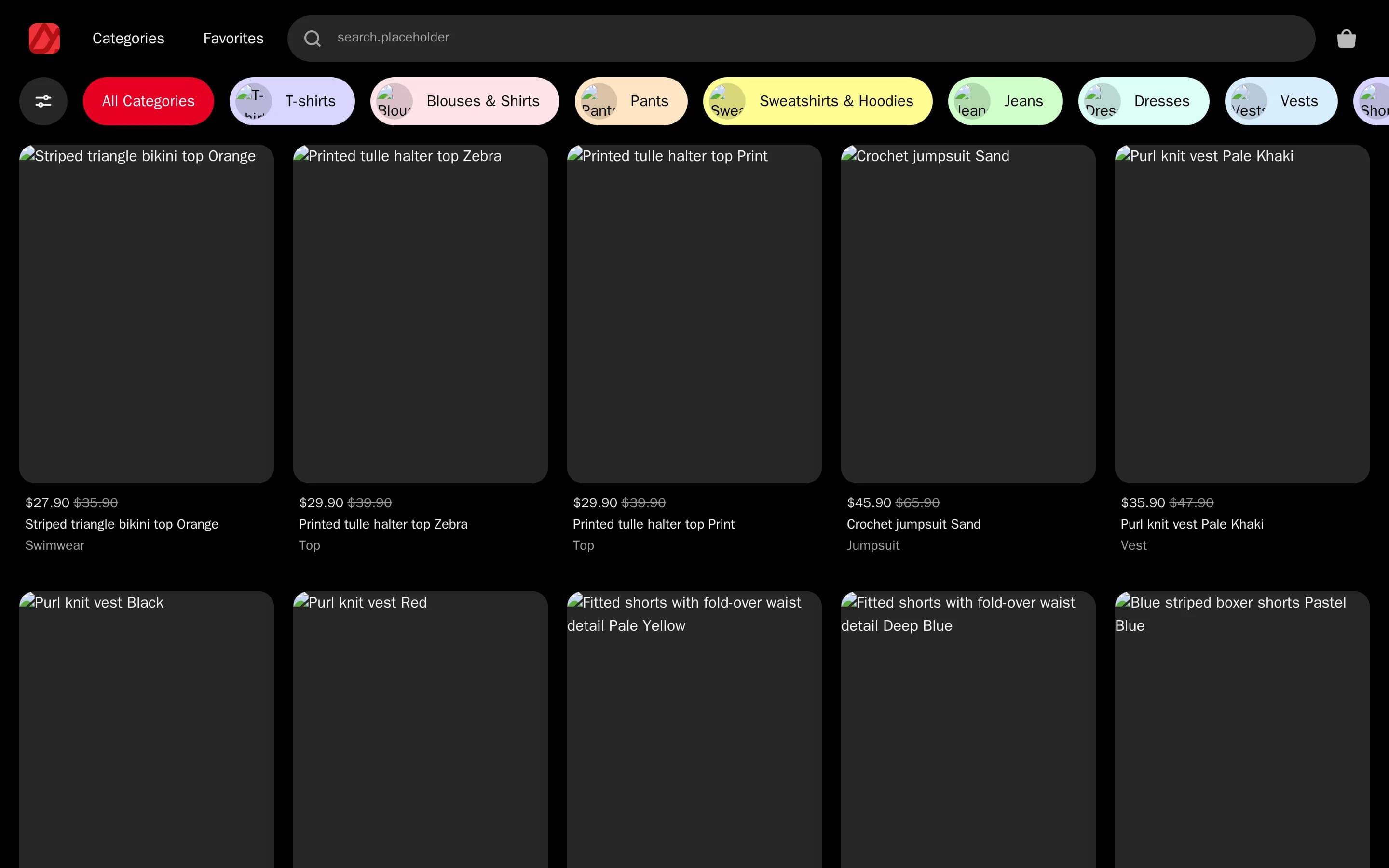
NuxtCommerce is a narrower, self-hostable storefront rather than a like-for-like Shopify replacement: it provides a customizable Nuxt/Vue frontend with cart and checkout, while relying on WordPress, WooCommerce, WPGraphQL, and WooGraphQL for commerce data and operations. Choose it when a development team wants infrastructure and frontend control around an existing WooCommerce backend. Choose Shopify when the business
What it does
NuxtCommerce is an open-source headless storefront for WooCommerce, built with Nuxt 4, Vue 3, Nitro, and GraphQL. It presents products through a Pinterest-style grid with infinite scroll, product detail pages, search, categories, favorites, dark mode, multilingual support, SEO defaults, and optimized images.
The application includes cart operations and a checkout flow using WooCommerce session cookies, with server endpoints for product retrieval, cart updates, and checkout. It requires an existing WordPress and WooCommerce installation with WPGraphQL and WooGraphQL, configured through a GraphQL host environment variable. The frontend can run locally with pnpm, build and preview through Nuxt, or deploy through NuxtHub and Cloudflare Workers.
What it covers
- Customer-facing product storefront
- Cart and checkout flow
- Product and variation browsing
- Order creation through checkout
- Internationalized storefront support
- Developer customization surface
What’s different
- Documented point-of-sale support
- Documented social or marketplace channels
- Documented integrated card-payment setup
- Documented B2B workflows
- Documented marketing and analytics suite
- Documented workflow automation
- Documented administrative AI assistant
- Documented Shopify import path
EShop10,776
EShop is a self-hostable MIT-licensed .NET reference application, not a documented feature-for-feature replacement for Shopify’s managed commerce platform. Choose EShop when a development team wants an e-commerce codebase and services-based architecture it can modify and operate itself. Choose Shopify when the business needs a production commerce service with documented coverage for payments, inventory, shipping, POS
What it does
dotnet/eShop is a reference .NET application implementing an e-commerce website called “AdventureWorks.” It uses a services-based architecture with .NET Aspire and includes sample catalog data, product images, and an eShop homepage and storefront workflow.
Users can clone the repository, install .NET 9 and Docker Desktop, run the application through Visual Studio or the terminal, and open the resulting web application and Aspire dashboard locally. The project can also be initialized and deployed to Azure with the Azure Developer CLI. The supplied README does not document broader commerce administration features such as inventory, order management, multichannel selling, POS, shipping, or international commerce.
What it covers
- Customer-facing e-commerce website
- Web storefront application
What’s different
- No documented Shopify data importer
- No documented integrated payment processing
- No documented inventory administration
- No documented shipping or international markets
- No documented POS synchronization
- No documented B2B commerce
- No documented multichannel selling
- No documented marketing or analytics suite
- No documented app marketplace or workflow automation