
ZZoho CRM
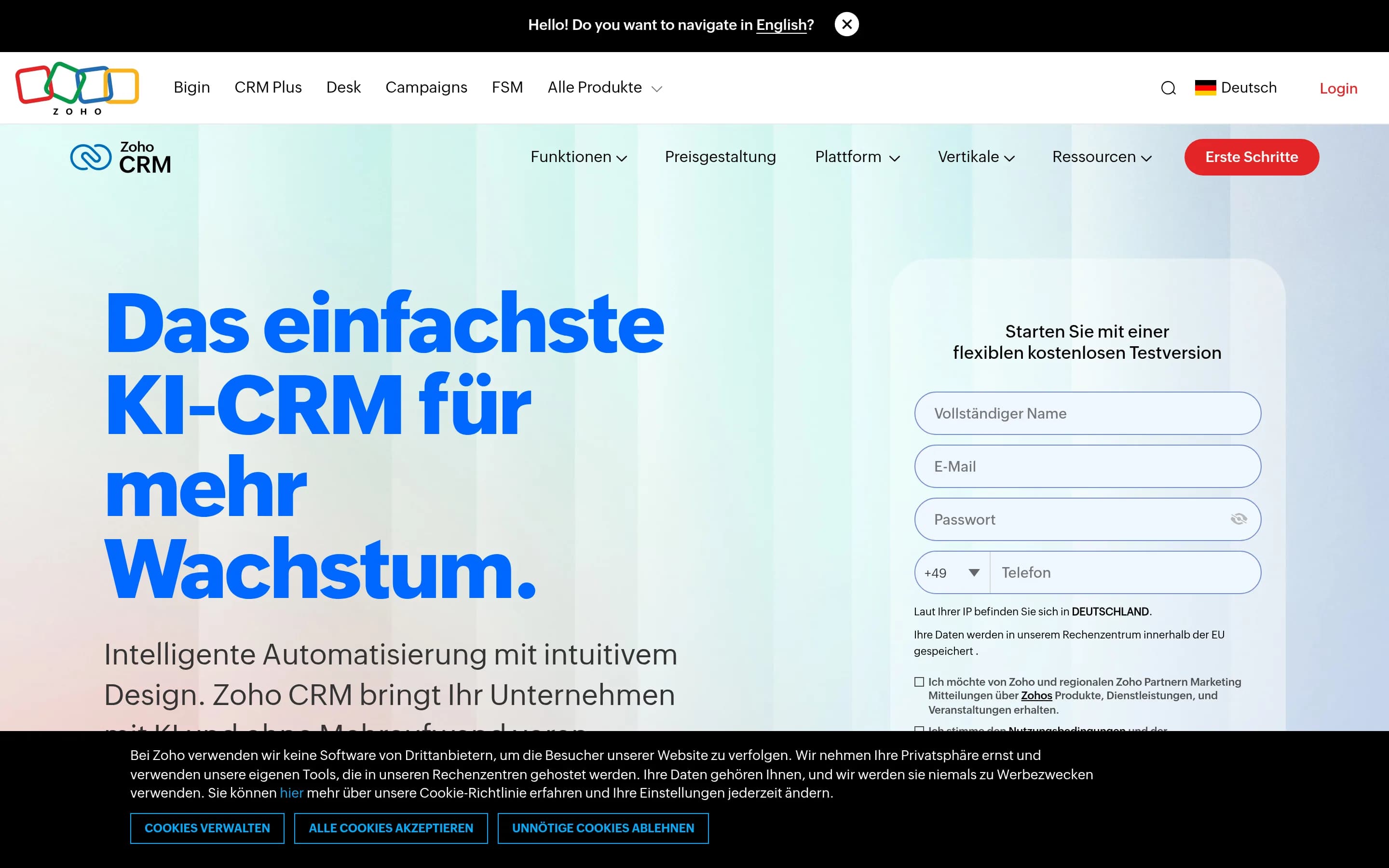
Zoho CRM is a customer relationship management system for organizing leads, accounts, contacts, sales opportunities, and customer interactions in a shared 360-degree view. It combines sales workflows with automation, cross-channel engagement, forecasting, reporting, AI assistance, and configurable team modules.
Why people leave Zoho CRM
Organizations may consider alternatives when Zoho CRM’s breadth exceeds what their sales process requires. The product combines CRM records with AI agents, cross-channel engagement, forecasting, business intelligence, workflow automation, team workspaces, custom modules, and no-code configuration. That range can be useful, but a team seeking a narrowly focused contact and pipeline tool may prefer a system with fewer concepts to configure and maintain. The existence of multiple editions and an edition-selection questionnaire also indicates that buyers may need to spend time determining which package fits their requirements.
Customization requirements can be another reason to evaluate other products. Zoho CRM supports custom team areas, prompt-created modules, Canvas layouts, advanced workflows, journey orchestration, kiosks, and other configurable processes. Organizations with straightforward sales stages may not need this flexibility, while those with highly specialized processes may want a different extension model or deeper control over the underlying application. Teams may also compare how easily each platform supports migration, onboarding, permissions, reporting structures, and long-term administration before committing.
Some organizations may seek an alternative because of deployment, ownership, or ecosystem preferences. The supplied page presents Zoho CRM as a pay-as-you-go service with monthly or annual billing and integrations with more than 1,000 applications. A company that requires source-code access, self-managed hosting, direct database control, or less dependence on a commercial SaaS provider would need to assess other options. Conversely, businesses already standardized on another productivity, sales, or analytics ecosystem may prefer a CRM whose native integrations and administration model align more closely with their existing stack.
AI and data-governance requirements may also shape the decision. Zoho highlights Zia agents, ChatGPT-assisted email rewriting, anomaly detection, and AI-supported customization, while also emphasizing privacy, compliance, and security certifications. Organizations may nevertheless have their own restrictions on external AI services, customer-data processing, regional hosting, or automated recommendations. Others may simply prefer a CRM where AI is less central to the interface. Finally, teams that need a different pricing structure, a more specialized industry workflow, or a smaller product designed specifically for freelancers and very small businesses may find a better operational fit elsewhere.
14 Best Open Source Zoho CRM Alternatives (Ranked)
Each alternative is evaluated for core feature coverage, deployment options, licensing, project health, and overall fit. The ranking prioritizes how closely a tool matches Zoho CRM's primary workflows, using popularity only as a secondary signal.
SSuiteCRM5,676
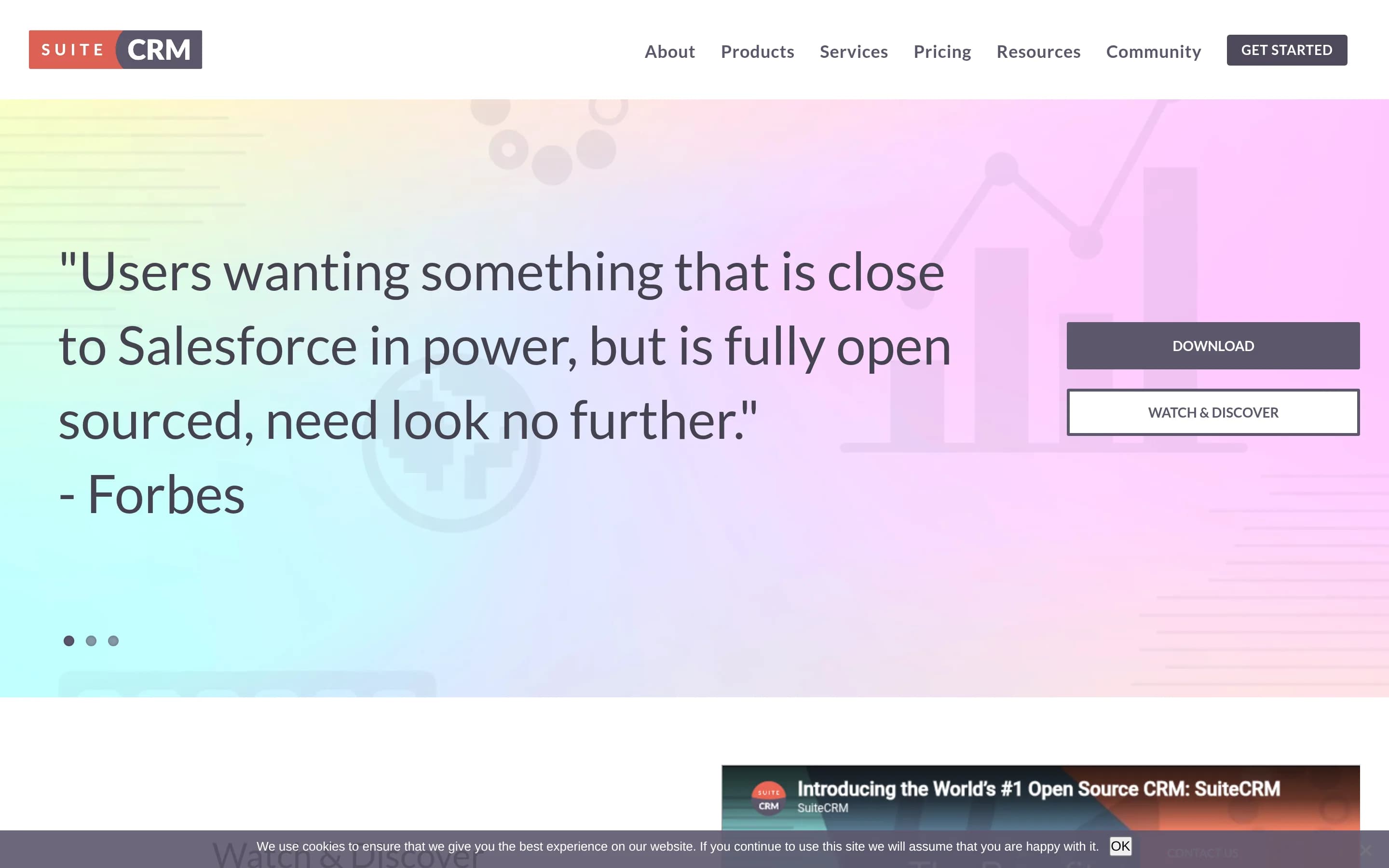
SuiteCRM is the stronger choice when source access, self-hosting, direct control of CRM data, and PHP-based customization outweigh the convenience of a managed SaaS platform. It covers documented fundamentals such as centralized customer data, leads, opportunities, reporting, automation, integrations, and a 360-degree view. Choose Zoho CRM when you require its documented AI assistance, cross-channel engagement, sales
What it does
SuiteCRM is an open-source, enterprise-ready customer relationship management application. Its documented scope includes CRM records and workflows for accounts, contacts, leads, opportunities, cases, contracts, quotes, documents, reporting, and related business data. The repository also identifies multi-currency, multilingual support, portals, and workflow capabilities.
SuiteCRM 7 can be deployed on Linux or Windows servers using Apache or IIS, PHP, and MySQL, MariaDB, or MSSQL. It supports local test and development deployments, self-hosting on an internal network or public cloud, and fully managed hosting. The project is released under the AGPLv3 license.
What it covers
- Centralized customer data
- Lead and opportunity management
- 360-degree customer view
- Workflow or action automation
- Reports and dashboards
- Third-party integrations
- Customizable CRM data model
What’s different
- Documented Zia or ChatGPT assistance
- Documented anomaly detection
- Documented cross-channel engagement parity
- Documented differentiated sales forecasting
- Documented Canvas-style layout generation
- Documented 1,000-plus integration coverage
- Documented Zoho CRM import path
EEspocrm3,262
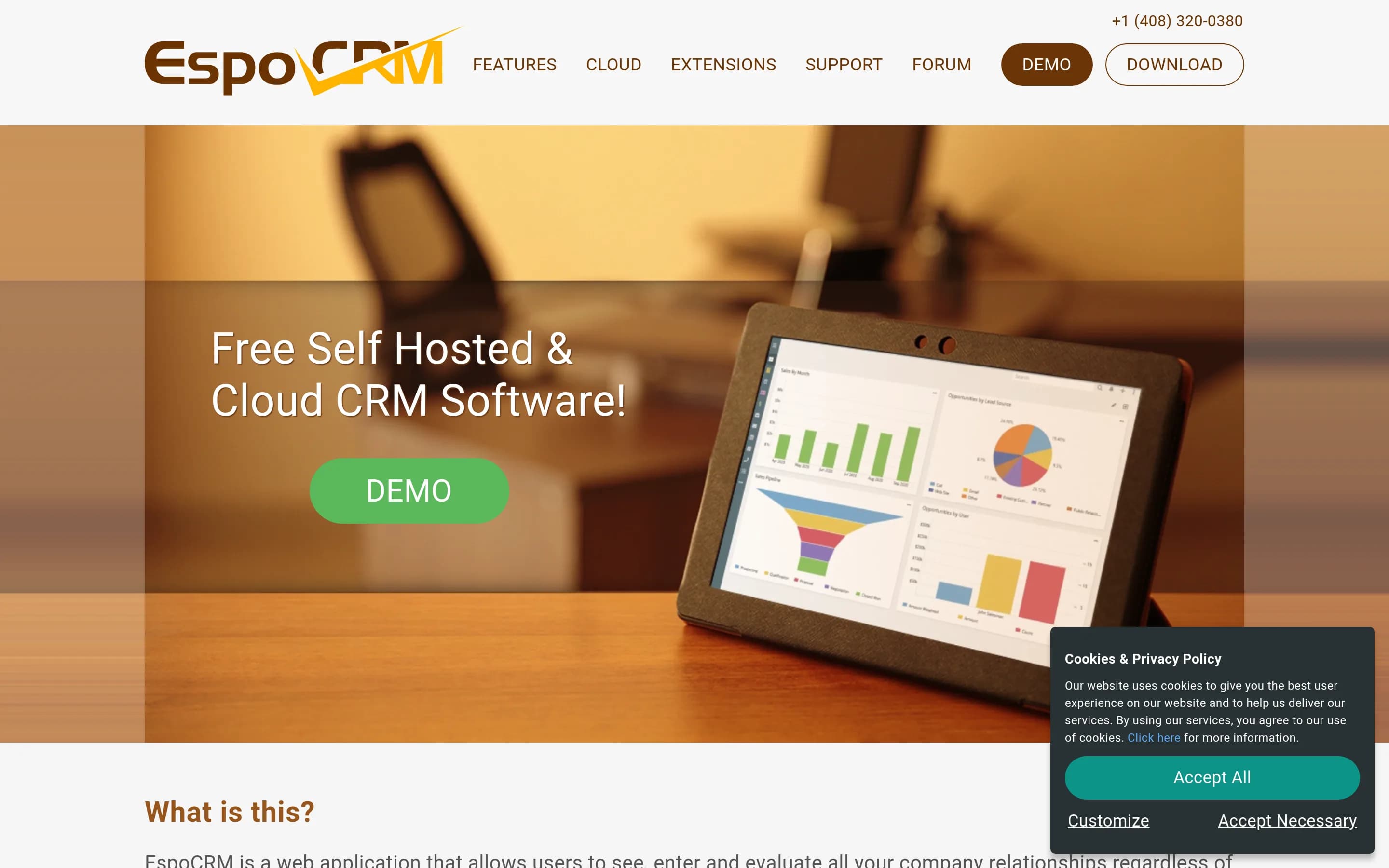
EspoCRM is the stronger choice for organizations prioritizing source access, self-hosting, direct extensibility, and a conventional CRM centered on leads, contacts, accounts, and opportunities. Zoho CRM remains the better fit for teams that need its documented breadth in forecasting, cross-channel engagement, AI agents, Canvas layouts, and a large integration marketplace. Migration is therefore a tradeoff between Esp
What it does
EspoCRM is an open-source customer relationship management web application for storing, organizing, and managing leads, contacts, sales opportunities, marketing campaigns, support cases, and other business information. Its interface is a single-page application backed by a PHP REST API, with an online demo and documentation for administrators, users, and developers.
Organizations can customize entities, fields, relationships, buttons, and extensions, and integrate other applications through the REST API. The project supports manual or scripted installation with PHP and MySQL, MariaDB, or PostgreSQL, as well as Docker and Traefik-based deployment. It is licensed under AGPLv3.
What it covers
- Lead, account, contact, and opportunity records
- Shared customer and company information
- Custom entities, fields, and relationships
- Workflow and business-process automation
- CRM reports and analytics
- Email-linked customer interactions
- Roles and team access controls
- Extension and integration mechanisms
What’s different
- Documented differentiated sales forecasting
- Documented Canvas-style visual layouts
- Documented Zia-style agents and anomaly detection
- Documented 1,000-plus integration catalog
- Documented equivalent cross-channel coverage
DDjango-CRM2,386
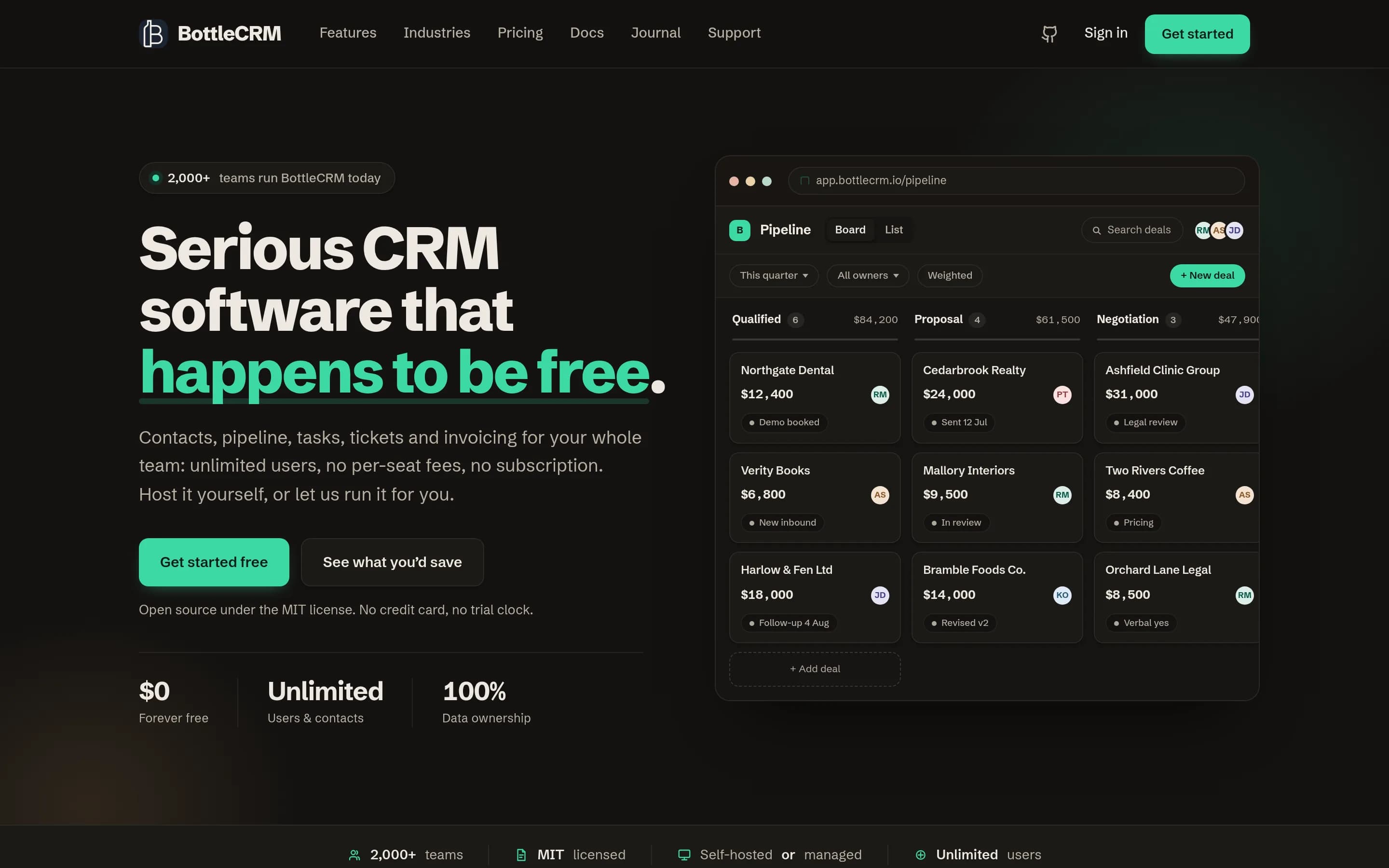
Django-CRM (also presented in the sources as BottleCRM) is the better fit for teams that want an MIT-licensed CRM on infrastructure they control and primarily need customer records, pipelines, tasks, tickets, invoices, mobile access, and an API. Zoho CRM remains the stronger choice for organizations that depend on broad workflow automation, cross-channel engagement, advanced customization, extensive integrations, or—
What it does
BottleCRM is an open-source CRM for startups and enterprises that manages the customer lifecycle across leads, accounts, contacts, opportunities, support tickets, tasks, and invoices. Its Django REST Framework backend supports a SvelteKit web application, a native Flutter mobile application, and a documented REST API.
The product supports single-company or multi-tenant deployments, with PostgreSQL row-level security for organization data isolation. It also documents helpdesk features including SLA timers, approvals, escalations, macros, and a knowledge base, along with agent-ready API access using personal tokens and OpenAPI documentation.
BottleCRM is MIT licensed and designed for self-hosting. The README documents Docker Compose startup, manual setup, production deployment, backups, security hardening, PostgreSQL, and API access, with managed hosting also mentioned as an option.
What it covers
- Lead, contact, and account records
- Sales opportunity pipelines
- Shared customer histories
- Tasks linked to CRM records
- Weighted pipeline forecasting
- Custom fields
- Mobile applications
- REST API access
What’s different
- No lead scoring or nurturing
- No sales workflow automation
- No granular role matrix
- No dashboard builder
- No CRM-composed customer email
- No outbound webhooks
- No calendar feed
- No recurring tasks or reminders
- No accessible CSV import interface
- No documented large integration marketplace
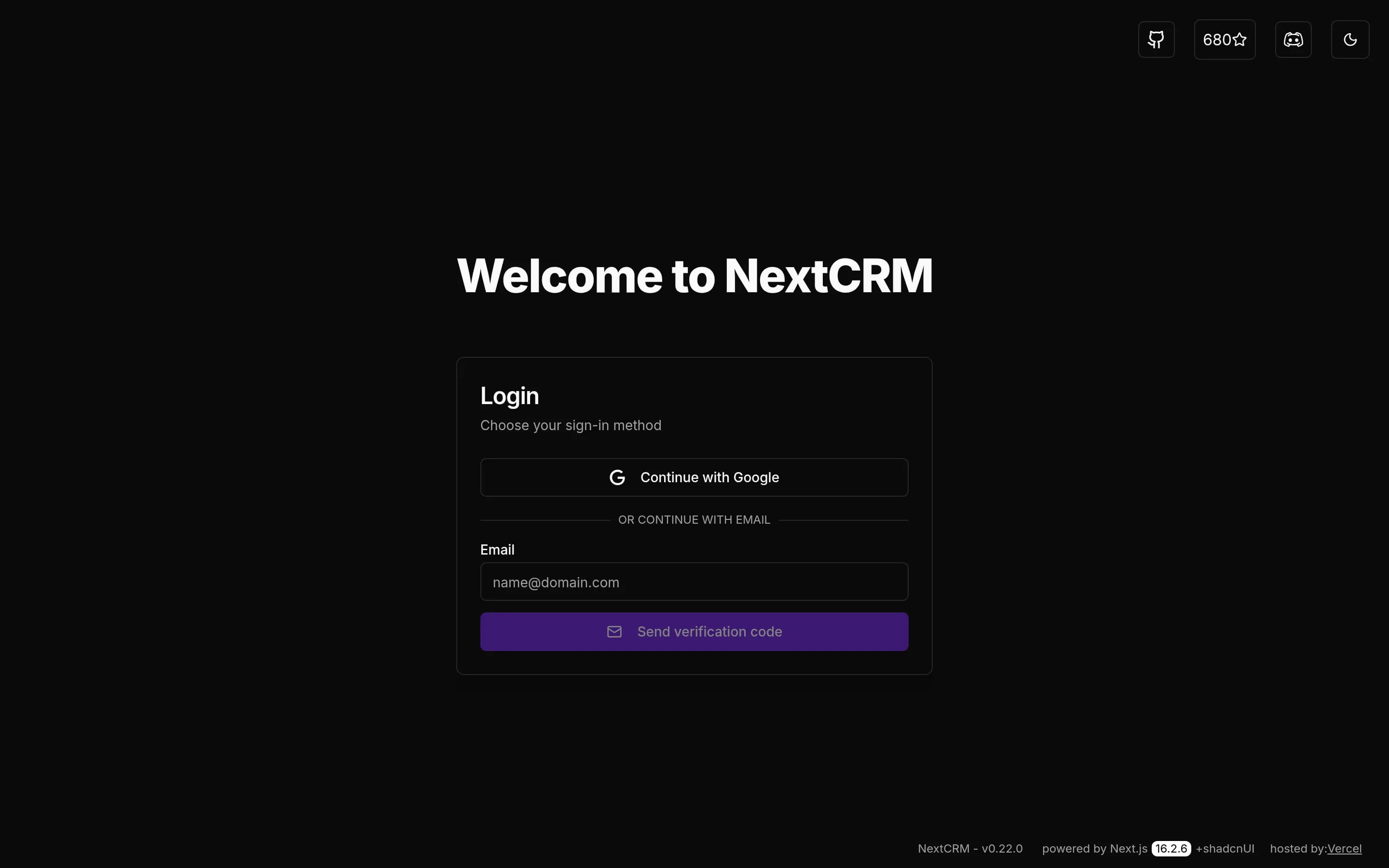
NNextcrm-app681
Choose NextCRM when source access, self-hosting, direct PostgreSQL control, and an integrated CRM/project/invoicing stack justify operating the infrastructure yourself. Choose Zoho CRM when the documented requirements include broader sales automation, cross-channel engagement, forecasting, extensive integrations, or no-code customization that the supplied NextCRM material does not establish.
What it does
NextCRM is an open-source CRM for managing Accounts, Contacts, Leads, Opportunities, Targets, Products, Contracts, Activities, Documents, Campaigns, and Projects. CRM detail pages provide linked notes, calls, emails, meetings, and tasks, while audit history, soft deletion, global search, semantic similarity, reports, and target-list management support ongoing sales operations.
The application also includes invoicing, document storage, an email client, AI enrichment, vector search, and an MCP server with tools for reading and writing CRM data. It can be run locally with Next.js, PostgreSQL, Prisma, and required services, or deployed with Docker Compose bundling the application, PostgreSQL with pgvector, MinIO, and Inngest.
What it covers
- Lead, contact, account, and opportunity records
- Customer interaction and activity history
- Sales reports and charts
- Email and AI-assisted functions
What’s different
- No documented Zoho CRM data importer
- No documented forecasting equivalent
- No documented Canvas-style layout builder
- No documented comparable cross-channel engagement
- No documented 1,000-plus integration marketplace
- No documented journey-orchestration equivalent
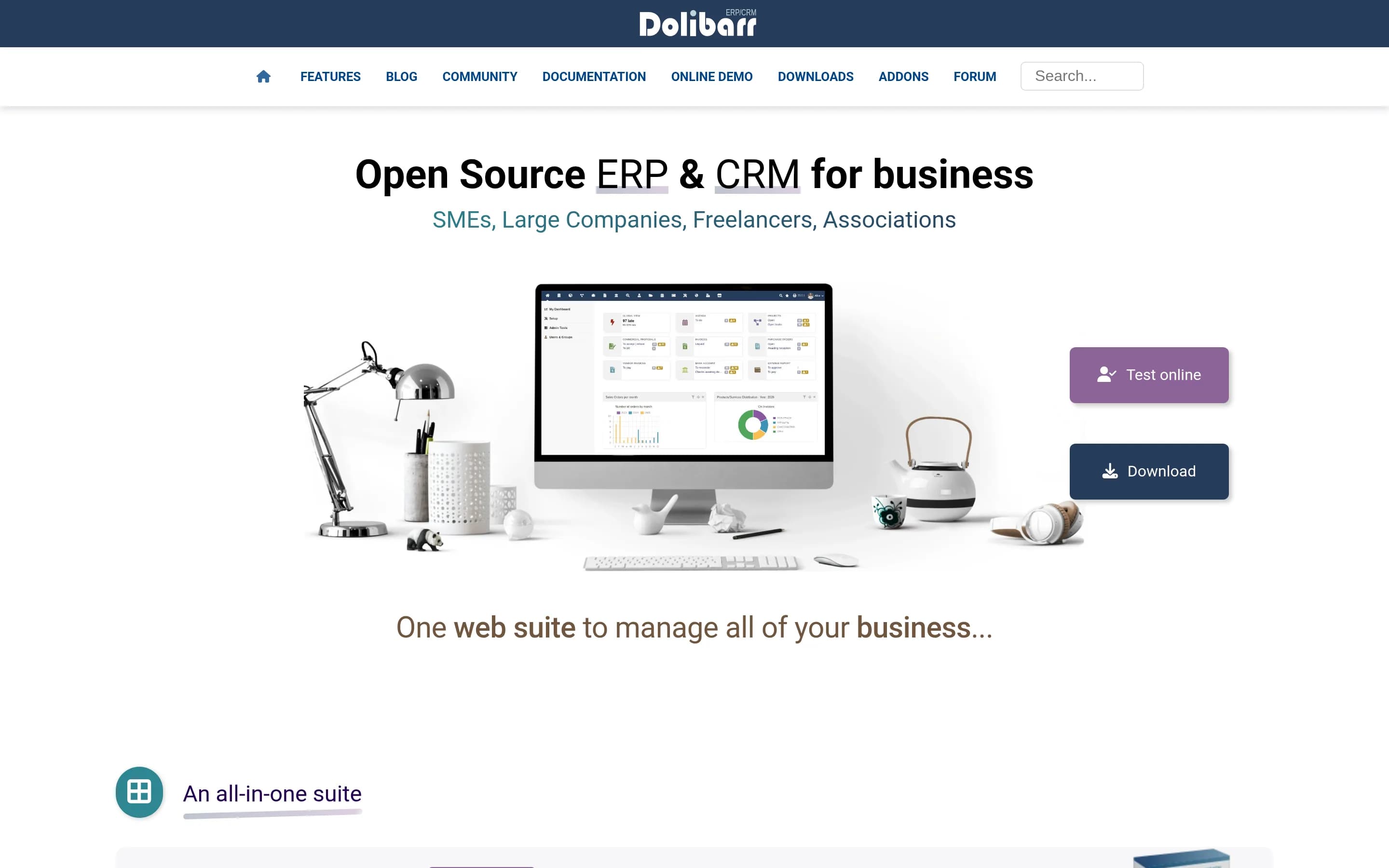
DDolibarr7,523
Dolibarr is the stronger choice for organizations that prioritize GPL-licensed source access, self-hosting, direct infrastructure control, and an integrated CRM/ERP covering contacts, opportunities, quotes, orders, invoices, stock, and accounting. Zoho CRM remains the better fit for sales teams that require documented CRM-specific capabilities such as cross-channel engagement, differentiated forecasting, journey-or …
What it does
Dolibarr is an open-source ERP and CRM suite for companies, foundations, and freelancers. Its documented workflows include third-party, customer, prospect, supplier, and contact management; opportunities and leads; commercial proposals; customer orders; contracts; interventions; tickets; shipping; invoices; payments; purchasing; stock; projects; tasks; agenda; and reporting.
The application supports customizable dashboards, modules, user fields, menus, multi-language operation, multi-currency, multi-user permissions, APIs, mass emailing, data import/export, and integrations including LDAP and payment platforms. It is provided as a standalone or web application and can be deployed on a PHP web server with MariaDB, MySQL, or PostgreSQL, including through Docker or packaged installations.
What it covers
- Customer, prospect, and contact records
- Lead and opportunity management
- Sales reporting
- Configurable fields and dashboards
- User groups and granular rights
- Email and mass-email capabilities
- APIs and application extensions
- General data import and export
What’s different
- No documented Zoho-style Canvas generation
- No documented differentiated sales forecasting
- No documented sales journey orchestration
- No documented sales sequencing
- No documented Zia-equivalent agents or anomaly detection
- No native embedded webmail
- No documented Zoho-specific migration tooling
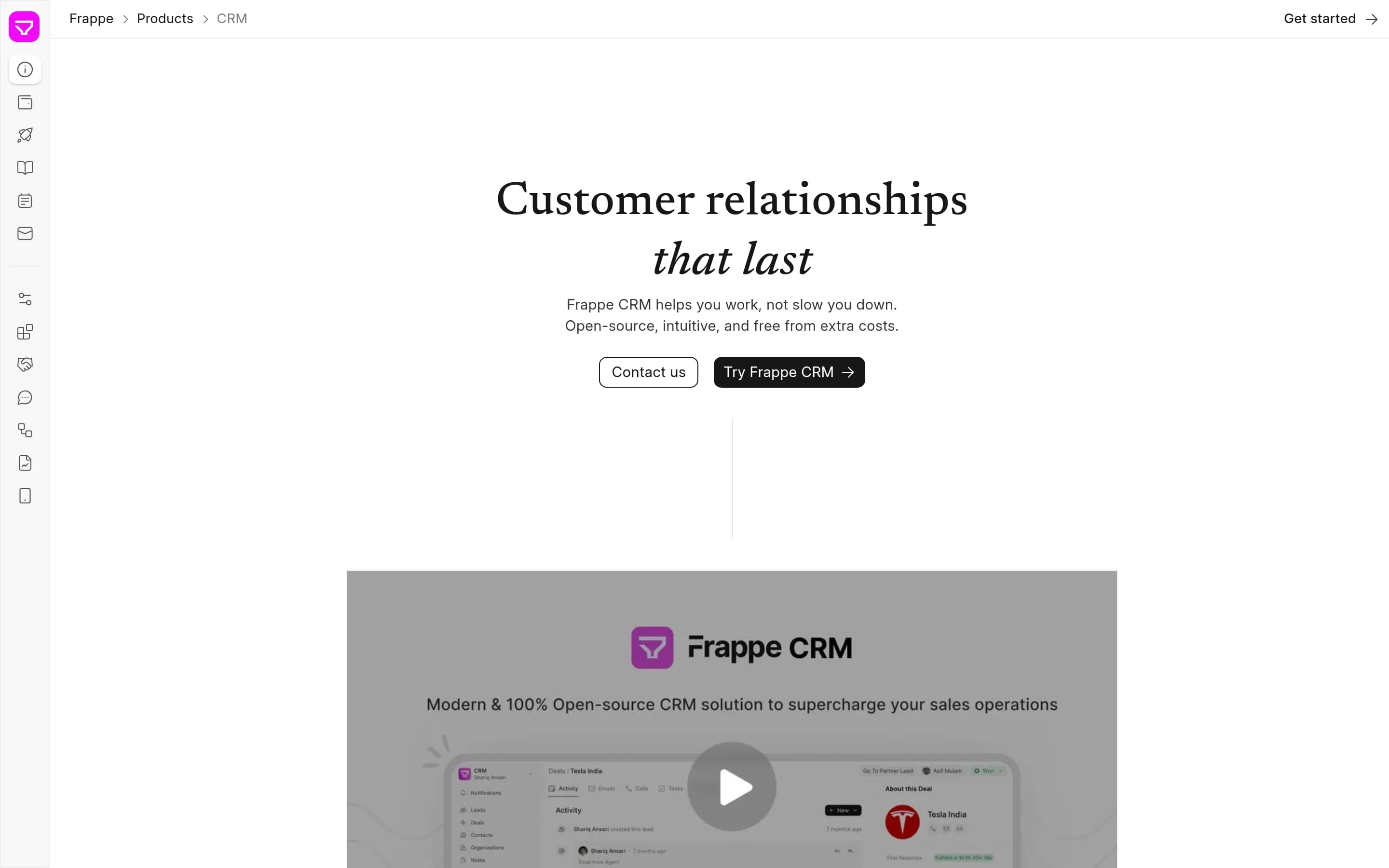
CCrm3,357
Frappe CRM is the stronger fit when source access, self-hosting, direct customization, and a focused lead-and-deal workflow matter most. Zoho CRM remains the safer choice for organizations that depend on documented forecasting, business intelligence, AI assistance, broad application integrations, or advanced journey orchestration. Frappe covers core pipeline work, communications, and basic automation, but the sources
What it does
Frappe CRM is an open-source customer relationship management platform for modern sales teams. It provides lead and deal records, an all-in-one page for activities, comments, notes, and tasks, drag-and-drop Kanban pipeline views, and customizable filters, sorting, columns, and saved views.
The README documents built-in Twilio and Exotel calling integrations, call recording, WhatsApp messaging through Frappe WhatsApp, and ERPNext integration for invoicing and accounting. It includes a graphical web interface with lead, email-template, call, and call-log screens. Users can run it through Frappe Cloud, self-host it with the production deployment script, or deploy it with Docker Compose; local development uses the Frappe framework.
What it covers
- Lead and deal records
- Contact and organization records
- Shared interaction context
- Sales-pipeline stages
- Workflow automation
- Custom fields and views
- Email and call tracking
- WhatsApp engagement
- Reports and filtered views
What’s different
- No documented sales forecasting
- No documented business-intelligence suite
- No documented AI assistance
- No documented Canvas-style layouts
- No documented journey orchestration
- No documented 1,000-app marketplace
- No documented custom team workspaces
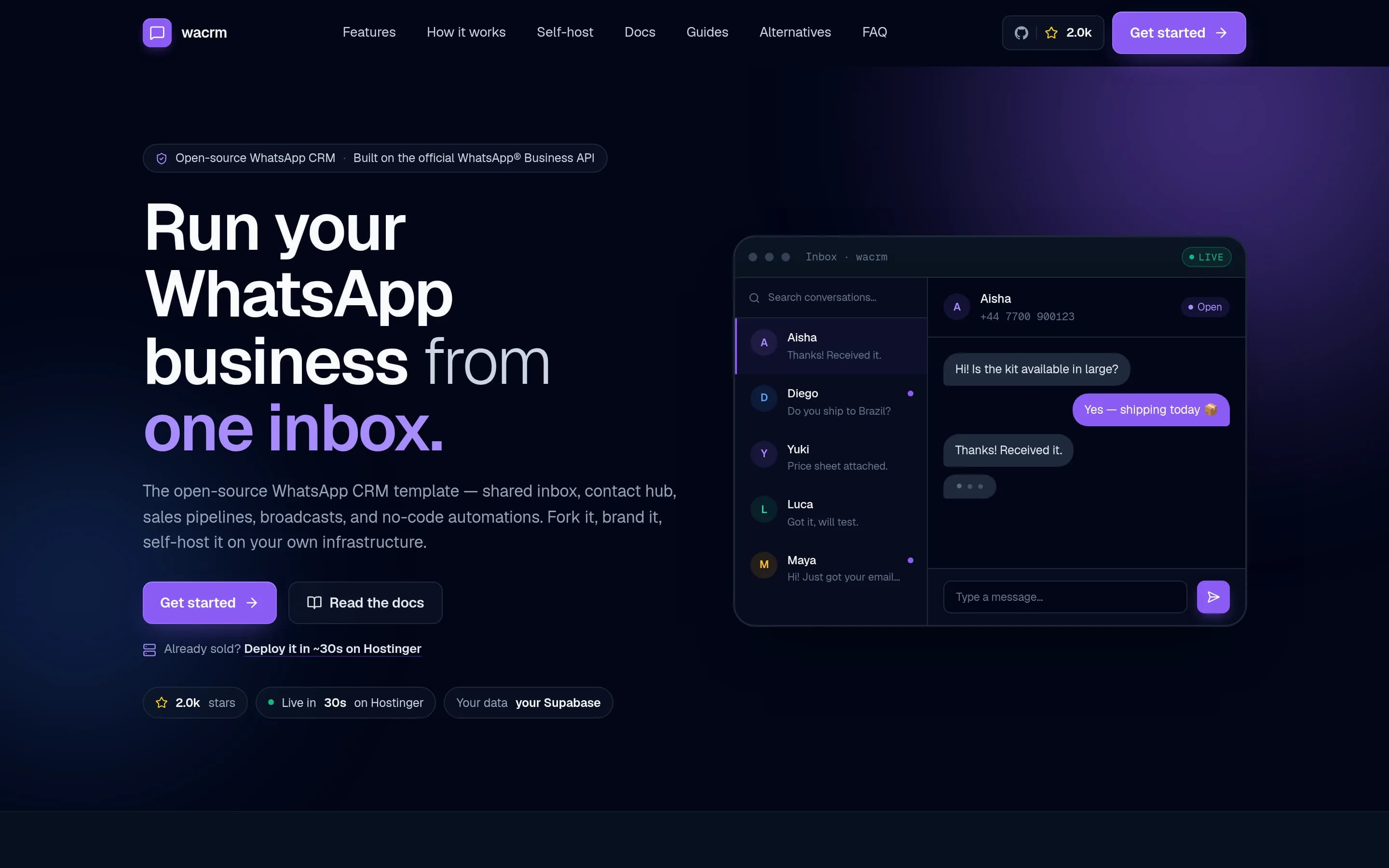
WWacrm1,999
Wacrm is a narrower, self-hosted WhatsApp CRM template, while Zoho CRM is the better fit for organizations needing a broad, managed CRM spanning multiple channels, advanced forecasting, business intelligence, and extensive no-code customization. Choose Wacrm when WhatsApp is the primary channel and source access, infrastructure control, and code-level customization outweigh the work of operating a fork; choose Zoho’s
What it does
wacrm is a self-hostable CRM template centered on the official WhatsApp Business API. Teams can operate a shared inbox, assign conversations, maintain contacts with tags and custom fields, import CSV data, deduplicate records, and manage Kanban sales pipelines with deals linked to conversations. Broadcasts support Meta-approved templates, delivery and read tracking, and recipient variables.
The application also provides visual no-code automations with triggers, conditions, waits, tags, and webhooks; an AI reply assistant with optional auto-replies and knowledge-base retrieval; dashboards for response times, volume, pipeline value, and activity; and role-based team accounts. It runs as a Next.js and Supabase application, with local development, Docker Compose, Hostinger, Vercel, Railway, or VPS deployment documented.
What it covers
- Contact records with custom fields
- Sales pipelines and deal stages
- Workflow automation
- Team access and role controls
- Dashboard and pipeline metrics
- AI-assisted customer replies
What’s different
- No documented omnichannel engagement beyond WhatsApp
- No documented differentiated sales forecasting
- No documented broad business-intelligence suite
- No documented Canvas-style layout builder
- No documented prompt-created team modules
- No documented Zoho Marketplace-scale integration catalog
DDjango-crm613
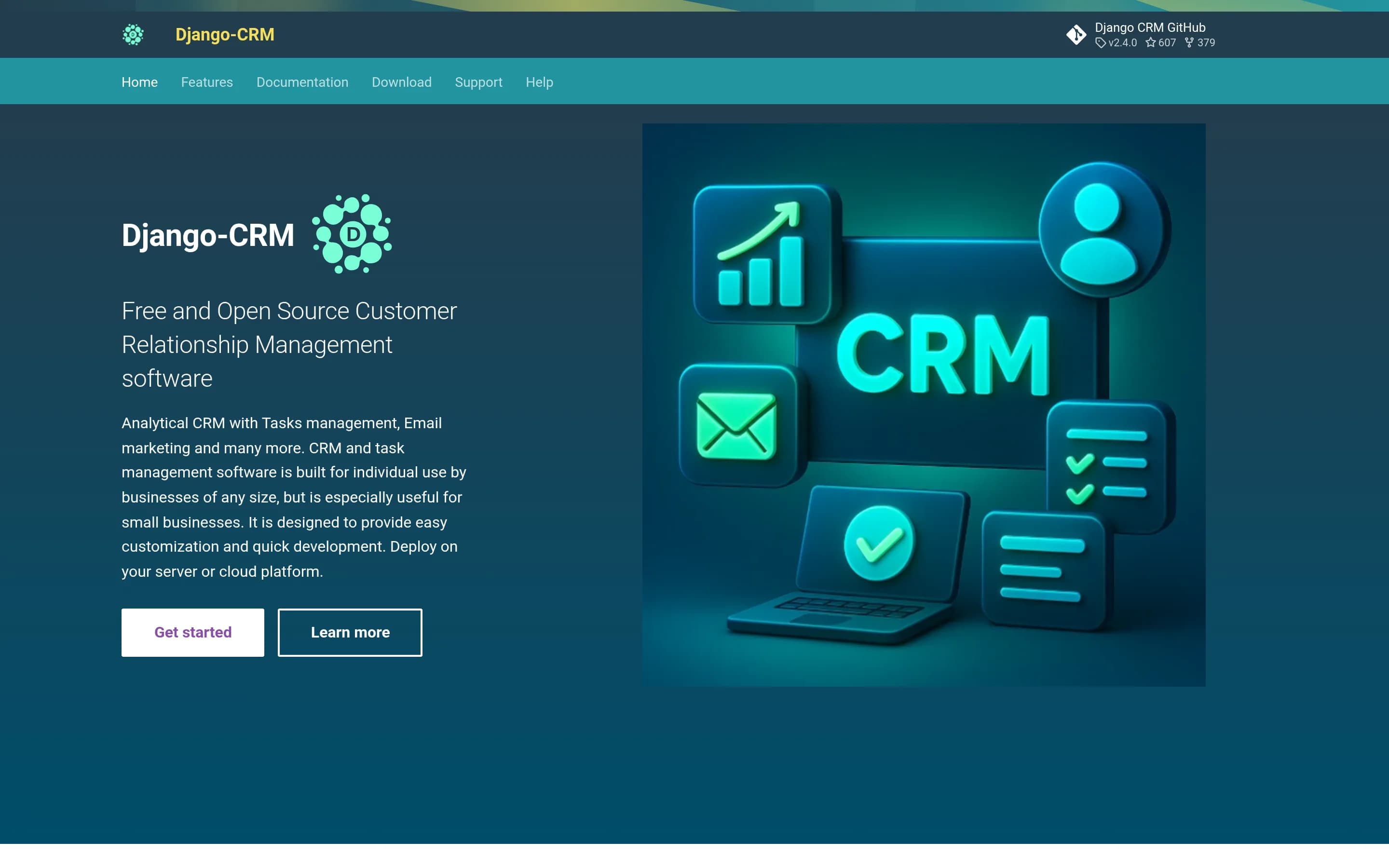
Django-crm is the stronger fit for teams that prioritize source access, self-hosting, direct data control, and Python/Django extensibility while retaining core lead, contact, deal, email, task, and reporting functions. Zoho CRM remains the better choice for organizations that need the documented breadth of a managed SaaS platform—especially advanced workflow orchestration, configurable team modules and layouts, AI, a
What it does
Django-CRM is an open-source customer relationship management system for businesses and freelancers. It manages leads, opportunities, companies, contacts, deals, products, payments, requests, tasks, projects, and email correspondence in interconnected CRM models, with role-based permissions and sales-pipeline tracking.
The platform includes SMTP/IMAP email integration, campaigns, newsletters, templates, segmentation, internal chat, reminders, files, web forms, messenger integrations, and analytics such as sales-funnel, income-summary, lead-source, and request reports. It runs as a standard Django project, supports SQLite for evaluation and MySQL or PostgreSQL for deployment, and is explicitly designed for self-hosted and on-premise use.
What it covers
- Lead and opportunity records
- Company and contact records
- Deal pipeline tracking
- Sales forecasting and reports
- Centralized email history
- Role-based data access
What’s different
- No documented Canvas-style layouts
- No documented AI assistance
- No documented journey orchestration
- No documented custom team modules
- No documented 1,000-app integration catalog
ZaloCRM231
ZaloCRM is a self-hosted, open-source alternative for teams whose CRM work centers on managing multiple personal Zalo accounts, real-time messaging, contacts, appointments, and a simple sales pipeline. Zoho CRM remains the better fit for broader lead-to-close operations requiring explicit account and opportunity records, configurable modules, cross-channel engagement, forecasting, and a large integration catalog. The
What it does
ZaloCRM is an open-source web CRM for centrally managing multiple personal Zalo accounts. It provides real-time conversations, customer and contact records, a lead pipeline, appointments, reminders, tags, notes, duplicate review, lead scoring, customer activity history, search, and team permissions. Dashboard and reporting features cover message activity, KPIs, customer sources, pipeline status, team performance, funnels, and Excel export.
The system also documents workflow automation, AI-assisted replies and summaries, integrations with Telegram, Google Sheets, Facebook, Zapier, and a two-way Zalo–Telegram bridge. It exposes REST APIs and webhooks, supports mobile PWA use, and stores media through MinIO, Amazon S3, or Cloudflare R2. Deployment uses Docker Compose with PostgreSQL, Redis, and object storage on Ubuntu servers.
What it covers
- Contact and customer records
- Sales pipeline stages
- Workflow automation
- Dashboards and reports
- AI-assisted workflows
- Role-based team access
- External integrations and APIs
What’s different
- No documented account and opportunity model
- No documented sales forecasting
- No documented Canvas-style layout builder
- No documented custom team modules
- No documented journey orchestration
- No comparable 1,000-app integration catalog
IIceburgcrm229
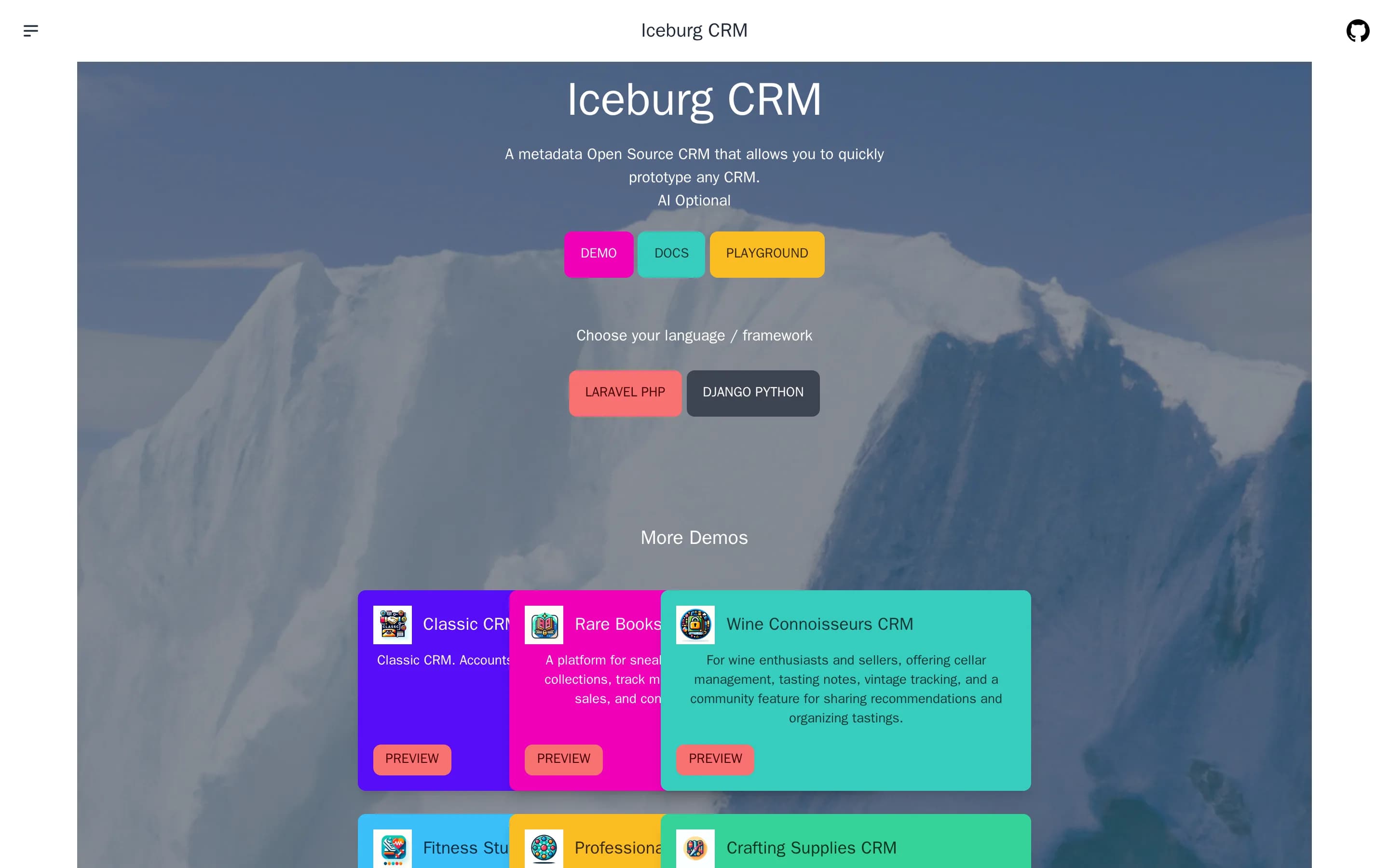
IceburgCRM is the stronger choice for teams that want an AGPL-licensed, self-hosted CRM builder with direct control over modules, relationships, and the database—and that can operate a Laravel/Vue application. Zoho CRM remains the better fit for organizations needing a managed service with documented cross-channel engagement, forecasting, business intelligence, and a large integration ecosystem. The central tradeoffK
What it does
Iceburg CRM is an open-source, metadata-driven customer relationship management system built with Laravel, Vue 3, Inertia, and Tailwind/DaisyUI. Its default configuration includes modules for accounts, contacts, leads, opportunities, contracts, quotes, campaigns, cases, projects, and related business records, with configurable fields, relationships, subpanels, and permissions.
The application supports record workflows, calendars, audit logs, Vue charts, datalets, import and export in six formats, a built-in API, and role-based module permissions. Users can install a default CRM, blank core, custom CRM, or AI-generated CRM through Composer and Artisan commands, configure a database-backed deployment, or use the documented hosted service.
What it covers
- Lead, contact, account, and opportunity records
- Configurable modules and fields
- Role-based record access
- Module workflow support
- Charts and dashboard widgets
- Optional AI-assisted configuration
What’s different
- No documented cross-channel engagement parity
- No documented sales-forecasting parity
- No documented business-intelligence parity
- No documented Canvas-style layout generation
- No documented 1,000-plus application marketplace
- No documented Zoho-specific migration tooling
MMacro3,828
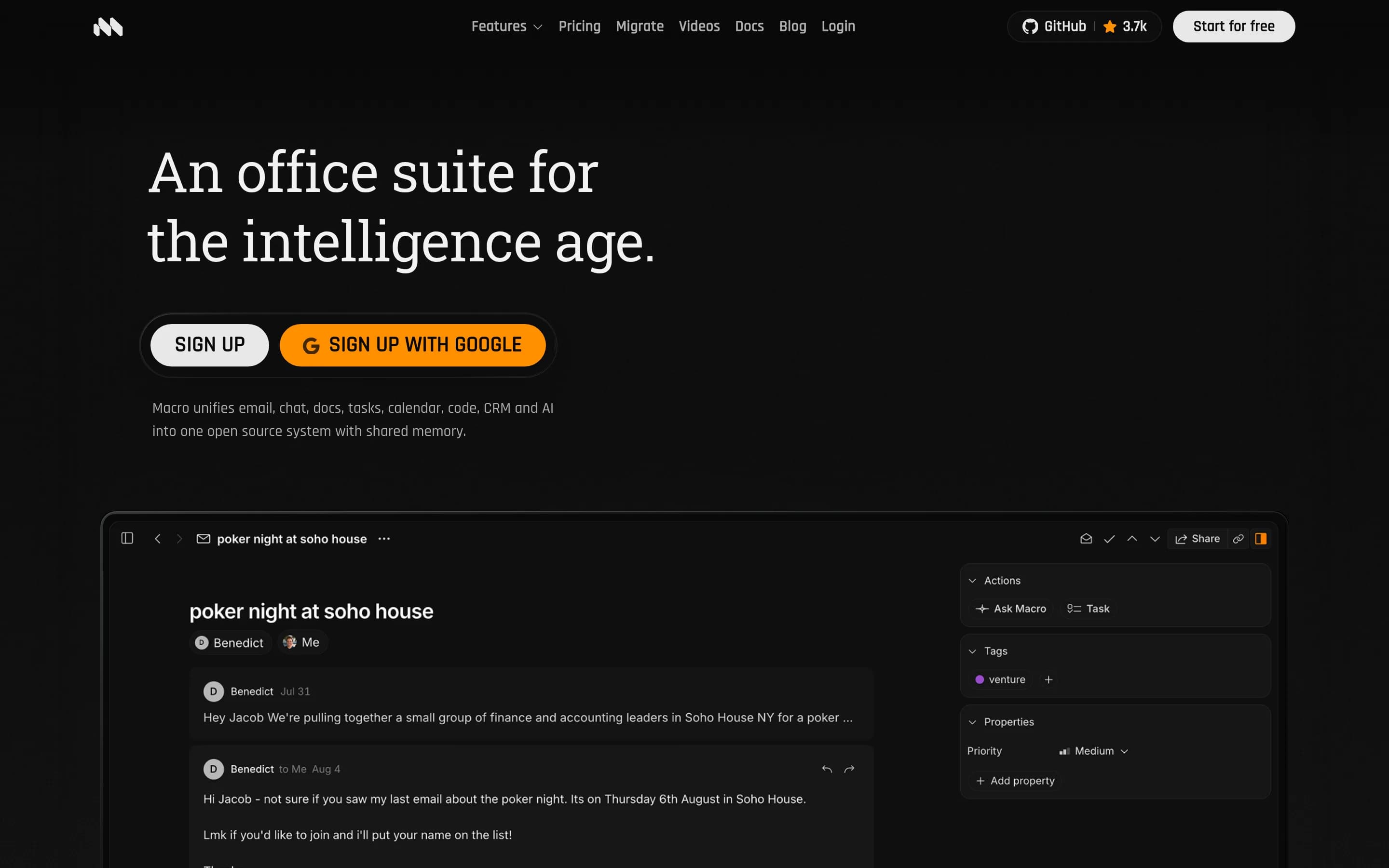
Macro is a plausible replacement for small teams that primarily need contacts, companies, deals, customizable stages, and email-centered collaboration in a unified workspace. Its source is available under AGPLv3 and it can be self-hosted, but its documented CRM scope is narrower than Zoho CRM. Choose Zoho CRM when forecasting, journey/workflow automation, configurable modules, broad integrations, or mature cross‑/om反
What it does
Macro is an all-in-one workspace combining customer and contact objects with email, messaging, documents, tasks, calls, file storage, pull requests, and agents. Its CRM includes a Kanban board, customizable deal stages, list and saved views, shareable views, personal and team views, and notes linked to company or contact records.
The product emphasizes bidirectional links between CRM records and conversations, tasks, emails, documents, and pull requests, allowing teams to trace customer context across their workspace. It is available as a hosted browser application with an iOS app, and the repository documents running the full app locally with a Docker Compose stack and deployment infrastructure.
What it covers
- Lead, contact, company, and deal records
- Custom deal stages and pipeline board
- Shared customer communication context
- Custom CRM properties
- Email-linked customer history
- AI-assisted workspace features
What’s different
- No documented sales forecasting
- No documented journey orchestration
- No documented advanced CRM workflow rules
- No documented custom team modules
- No documented Zoho-scale integration marketplace
- No documented Zoho CRM importer
LLaravel-crm23,694
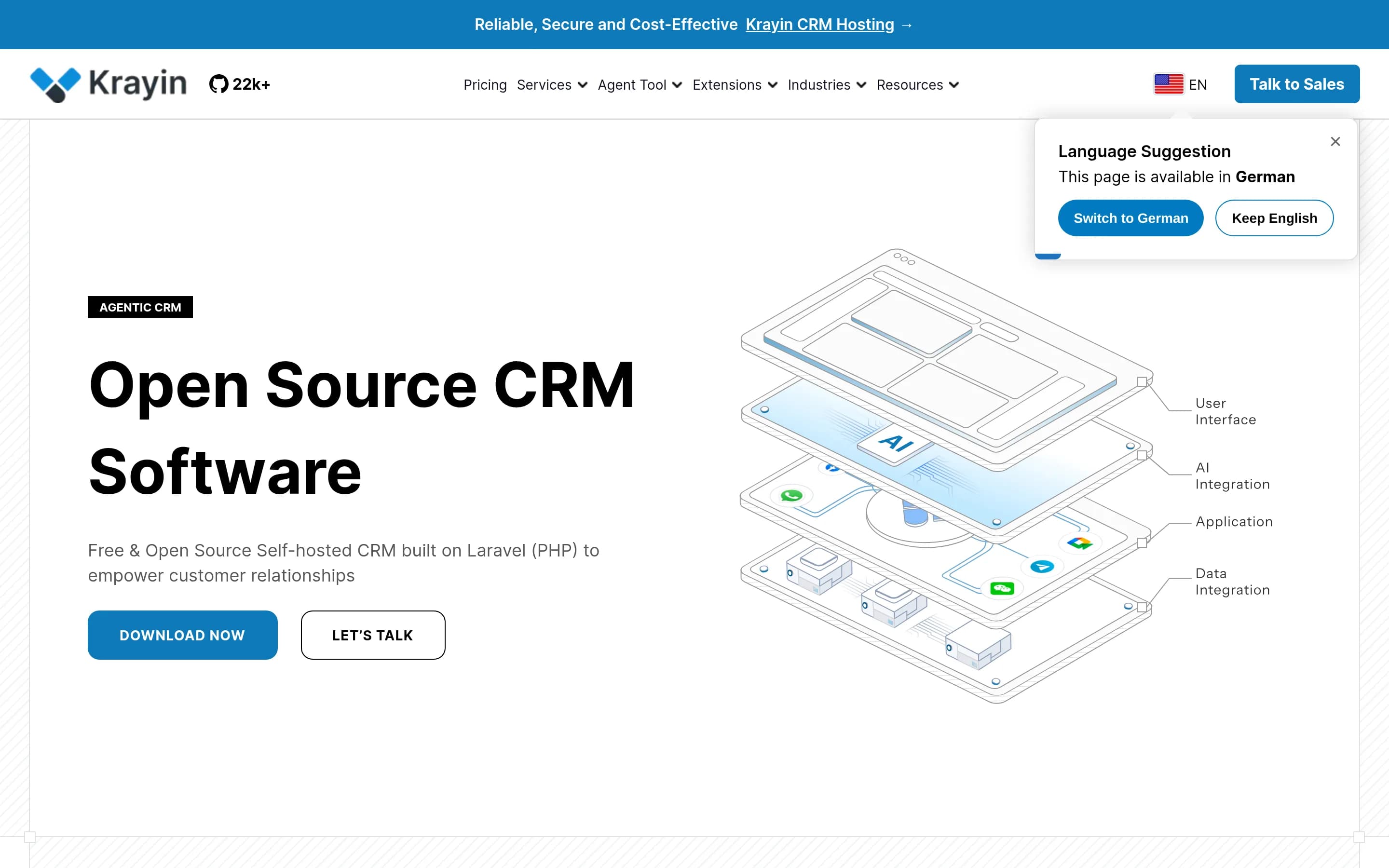
Choose Laravel-crm (Krayin CRM) when source access, self-hosting, and control of a Laravel/PHP deployment matter more than demonstrated breadth. Its documented core covers customer, lead, opportunity, and sales management, but the supplied evidence does not establish equivalents for several Zoho CRM capabilities, including Canvas layouts, journey orchestration, custom team workspaces, or Zoho’s stated integration and
What it does
Krayin CRM is a free, open-source CRM framework for SMEs and enterprises that supports customer lifecycle management, including customer, lead, and sales management. Its documented product includes an admin panel, dashboard, custom attributes, modular architecture, and email parsing through SendGrid. Optional extensions add WhatsApp lead generation and VoIP calling workflows.
The application is built with Laravel, PHP, and Vue.js. It can be installed on an Apache or NGINX server using Composer and Artisan commands, configured with database and mail settings, or run locally with Laravel’s development server. The README also documents Docker installation resources, cloud hosting, and a multi-tenant SaaS extension.
What it covers
- Lead and opportunity management
- Contact and customer records
- Sales workflow support
- Custom fields or attributes
- Sales activity tracking
- Sales forecasting claims
What’s different
- No documented Canvas-layout equivalent
- No documented custom team-workspace equivalent
- No documented journey-orchestration equivalent
- No established Zia or ChatGPT feature parity
- No documented 1,000-application integration catalog
EEver-gauzy4,338
Choose Ever Gauzy when source access, self-hosting, direct database control, and combining CRM with ERP, HR, projects, accounting, or time tracking outweigh the cost of operating a broad platform. Choose Zoho CRM when the priority is a managed, sales-focused system with documented advanced automation, forecasting, cross-channel engagement, AI assistance, and extensive integrations. Ever Gauzy is not a narrower CRM:
What it does
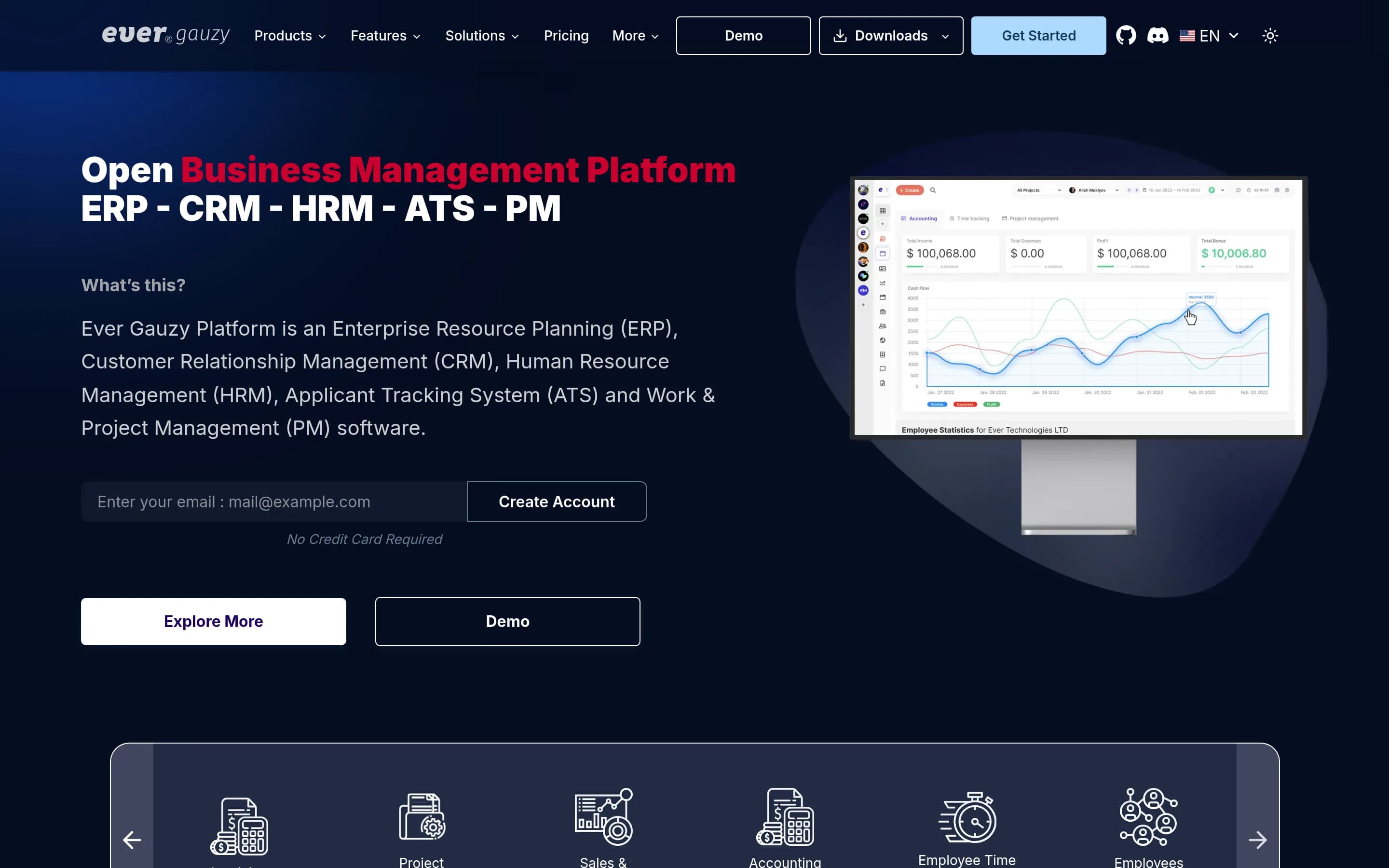
Ever Gauzy is an open business management platform that combines CRM, ERP, HRM, applicant tracking, project management, sales, finance, time tracking, inventory, and production management. Its CRM-related workflows include contacts management for clients, customers, and leads; sales pipelines; proposals; schedules and appointments; email history and templates; organization clients and vendors; reports, insights, and analytics; and data import and export.
The repository documents browser-based Web UI and desktop applications for Windows, macOS, and Linux. Gauzy can run as a local server with a browser interface, as an all-in-one desktop application, or through its SaaS and online demo deployments. It is licensed under AGPL-3.0 and supports local installation through manual setup or Docker Compose, with Kubernetes recommended for production.
What it covers
- Customer and lead records
- Sales pipelines
- Sales management
- Reports and analytics
- Roles and permissions
- Email history and templates
- Third-party integrations
What’s different
- No documented Zoho-specific importer
- No documented journey orchestration
- No documented sales sequencing
- No documented differentiated forecasting
- No documented Canvas-style layouts
- No documented Zia or ChatGPT assistance
- No documented 1,000-plus integration catalog
RRelaticle1,517
Relaticle is a credible alternative for developer-led teams that want a self-hosted, source-available CRM centered on companies, people, opportunities, tasks, custom fields, and AI-agent access. The tradeoff is narrower documented coverage: the supplied Relaticle sources do not establish equivalents for Zoho CRM’s cross-channel engagement, forecasting/business intelligence, advanced workflow orchestration, Canvas UI,
What it does
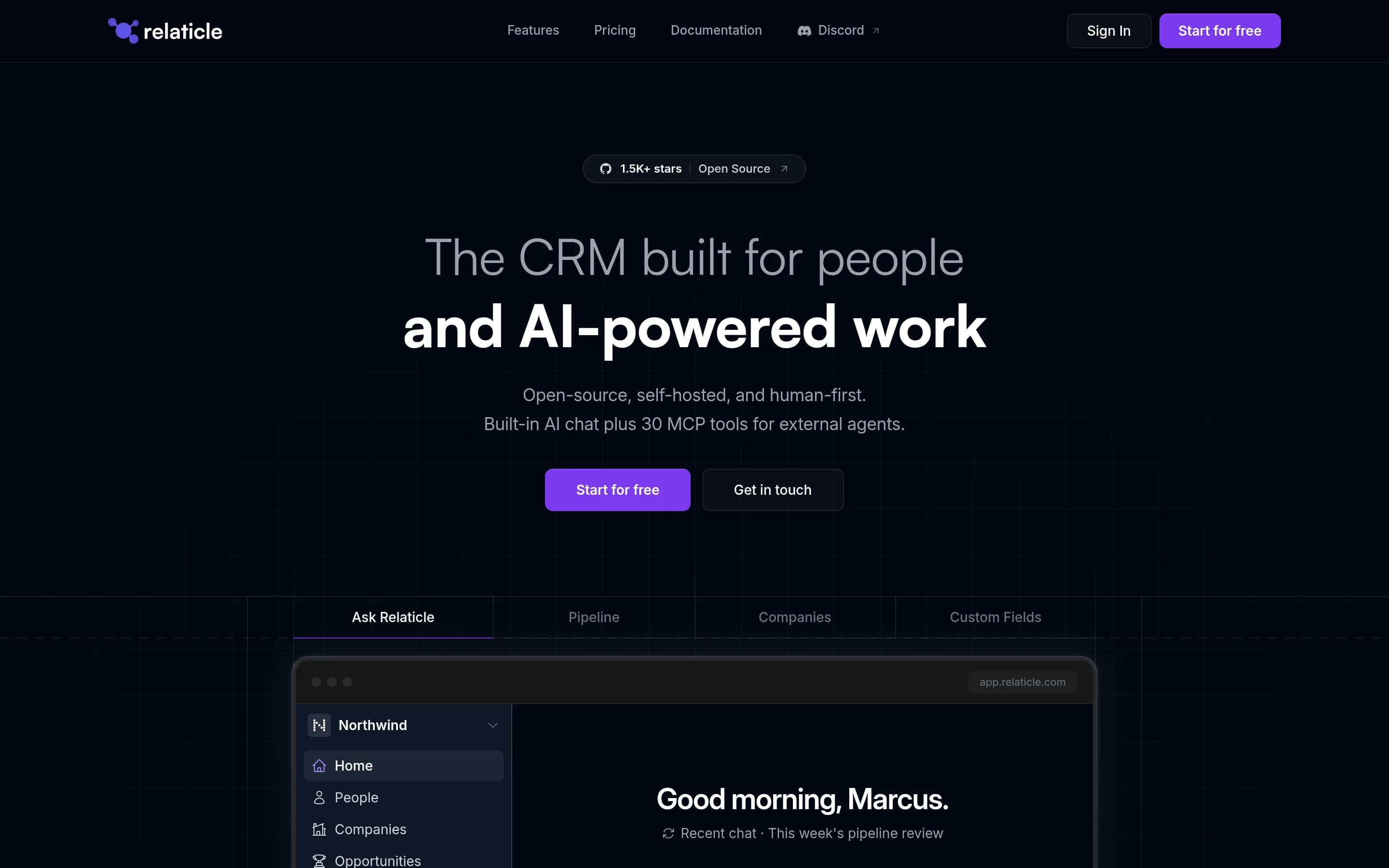
Relaticle is an open-source CRM for developer-led teams, AI-focused startups, and small and midsize businesses. It manages CRM data such as companies, contacts, people, opportunities, notes, tasks, and teams, with a customizable data model containing 22 field types, entity relationships, conditional visibility, and per-field encryption.
The product includes a production-grade MCP server with 32 tools, schema discovery for AI agents, and a REST API with full CRUD access. It provides multi-team isolation through team-scoped data and workspaces, and presents a modern interface built with Filament and Livewire.
Relaticle is distributed under AGPL-3.0 and is designed for self-hosting. The repository documents manual installation with PHP, PostgreSQL, Composer, and Node.js, plus Docker and manual deployment instructions in its self-hosting guide.
What it covers
- Company and contact records
- Sales opportunity pipelines
- Linked interaction history and notes
- Custom fields and data relationships
- Team workspaces and role-based access
- AI-assisted CRM work
What’s different
- No documented cross-channel engagement equivalent
- No documented forecasting or BI equivalent
- No documented advanced workflow orchestration equivalent
- No documented Canvas-style layout builder
- No documented marketplace breadth comparable to 1,000+ integrations