
FFolk
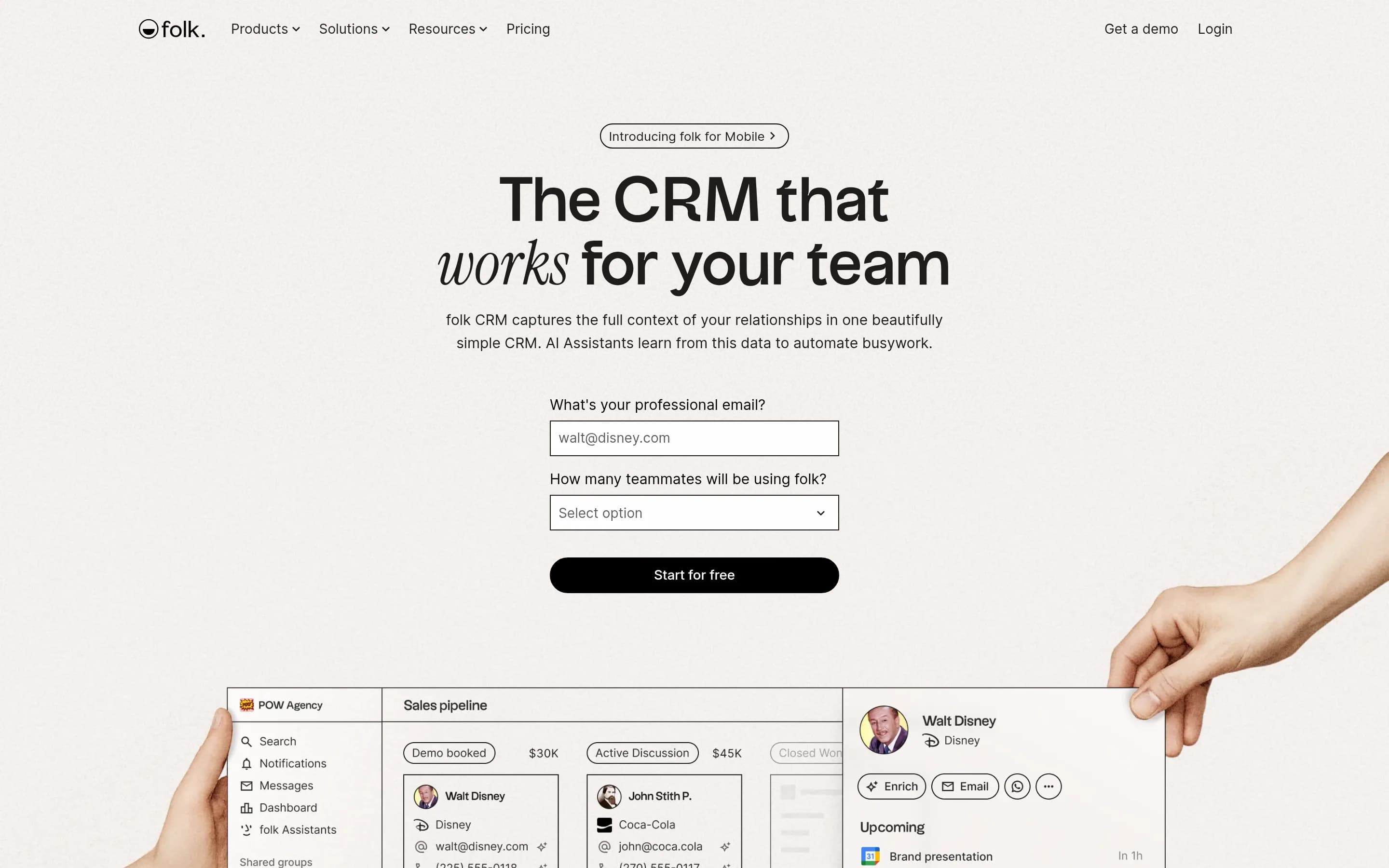
folk is a CRM that centralizes contacts, companies, deals, and interaction history from channels such as email and WhatsApp. It supports customizable relationship workflows, pipeline tracking, enrichment, personalized outreach, and AI-assisted follow-up and recaps.
Why people leave Folk
Someone might look for a folk alternative when their requirements extend beyond its relationship-focused CRM workflow. The supplied material emphasizes flexible contact organization, pipelines, contextual outreach, and AI assistance. A business that needs a broader operational suite—such as deeply integrated finance, service, inventory, or other enterprise processes—may prefer a platform designed around those functions rather than adding integrations around a focused CRM.
The product’s automation model may also be a deciding factor. folk offers trigger-based email workflows, optional filters, AI personalization, campaign tracking, and monthly credit controls. Teams with highly complex automations, extensive branching logic, many non-email actions, or orchestration across numerous applications may want a dedicated automation platform or a CRM with a different workflow model. Conversely, organizations seeking a more minimal contact database may decide that assistants, enrichment, campaigns, and pipeline features add more process than they need.
Communication and data-source requirements can prompt comparison as well. folk highlights email, WhatsApp, meetings, notes, LinkedIn activity, integrations, and an API, but each organization has its own essential systems and governance rules. A team may need a particular connector, synchronization behavior, reporting arrangement, permission structure, or deployment approach that is not established by the supplied page. Before committing, buyers may therefore compare integration coverage, data portability, security controls, and administrative capabilities against their internal requirements.
Finally, teams may prefer different approaches to AI and sales data. folk’s assistants scan relationship context to draft follow-ups, create recaps, enrich company profiles, and personalize emails. Some organizations may not want automated analysis of communications, may require stricter approval or audit processes, or may favor workflows without generative AI. Others may need different enrichment providers, research methods, sales methodologies, or reporting depth. Since the page also mentions campaign credits and a trial, prospective users may wish to compare usage limits, total cost as contact and outreach volume grows, and how well the product’s customizable data model fits their established sales process.
15 Best Open Source Folk Alternatives (Ranked)
Each alternative is evaluated for core feature coverage, deployment options, licensing, project health, and overall fit. The ranking prioritizes how closely a tool matches Folk's primary workflows, using popularity only as a secondary signal.
EEspocrm3,259
Choose EspoCRM when self-hosting, source access, extensibility, and broader CRM operations—such as support cases, inventory, purchases, projects, or invoicing—matter more than Folk’s relationship-focused experience. Choose Folk when WhatsApp and LinkedIn context, company enrichment, inactivity-based follow-up suggestions, and relationship recaps are central; equivalent EspoCRM coverage is not established by the cited
What it does
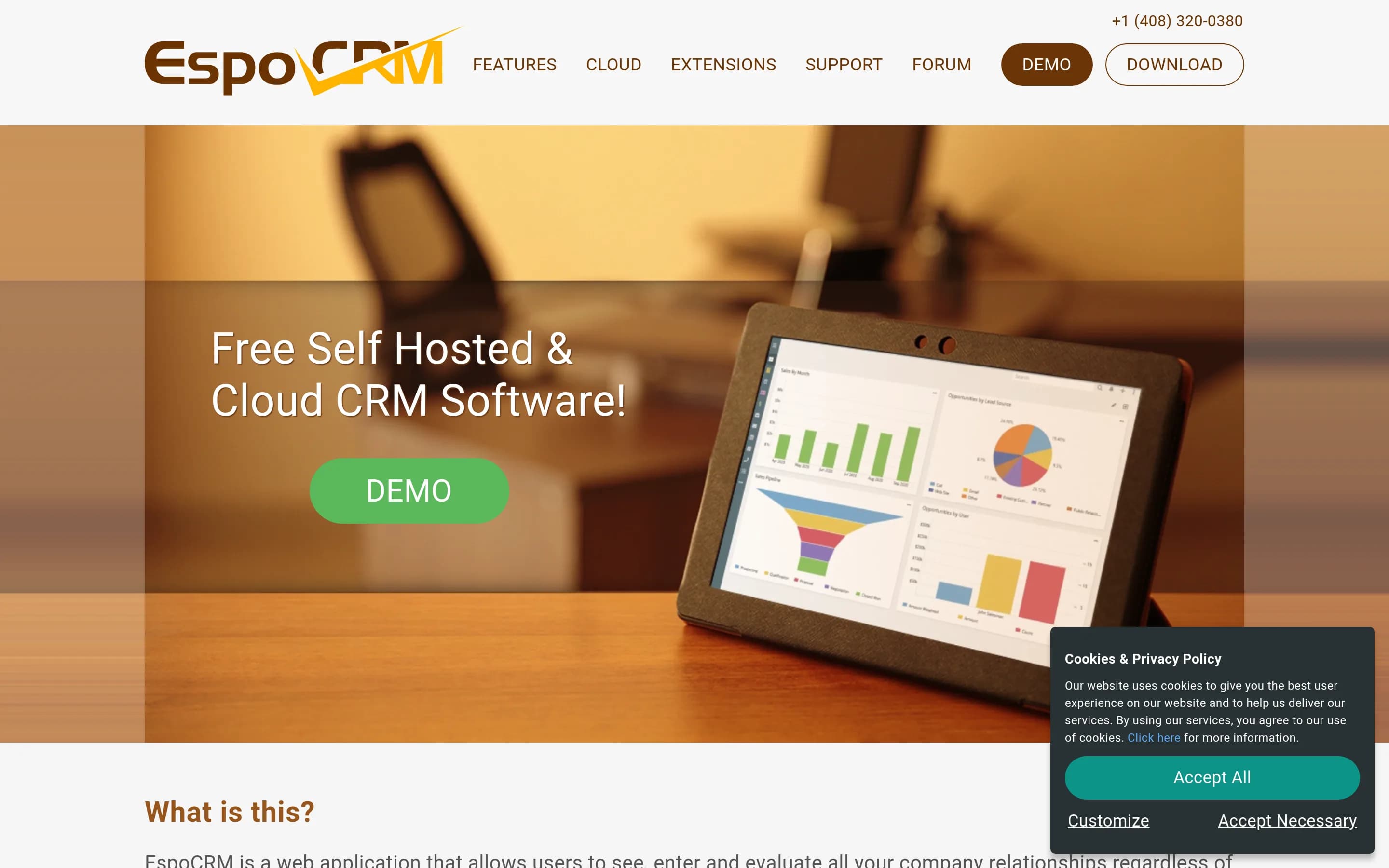
EspoCRM is an open-source customer relationship management web application for storing, organizing, and managing leads, contacts, sales opportunities, marketing campaigns, support cases, and other business information. Its single-page interface is backed by a PHP REST API and includes a documented online demo.
Organizations can customize entities, fields, relationships, and buttons to adapt the system to their processes or build broader business applications. The project supports manual or scripted installation with PHP and MySQL, MariaDB, or PostgreSQL, and documents Docker and Traefik deployment options for user-controlled hosting.
What it covers
- Contact and company records
- Deal and opportunity pipelines
- Email-linked CRM records
- Custom entities, fields, and relationships
- Email campaigns and templates
- Workflow automation
- External integrations through APIs
What’s different
- No documented WhatsApp history
- No documented LinkedIn activity history
- No documented inactivity-based follow-up assistant
- No documented company enrichment
- No documented Folk-specific migration path
WWacrm1,985
Choose Wacrm when WhatsApp is the primary channel and owning, modifying, and self-hosting the CRM outweighs the operational work of maintaining a fork. Choose Folk for a hosted, broader relationship CRM spanning email, WhatsApp, meetings, LinkedIn activity, company research, and contextual follow-up or recap workflows. Wacrm offers deeper documented WhatsApp inbox, broadcast, and automation functions, but it is not a
What it does
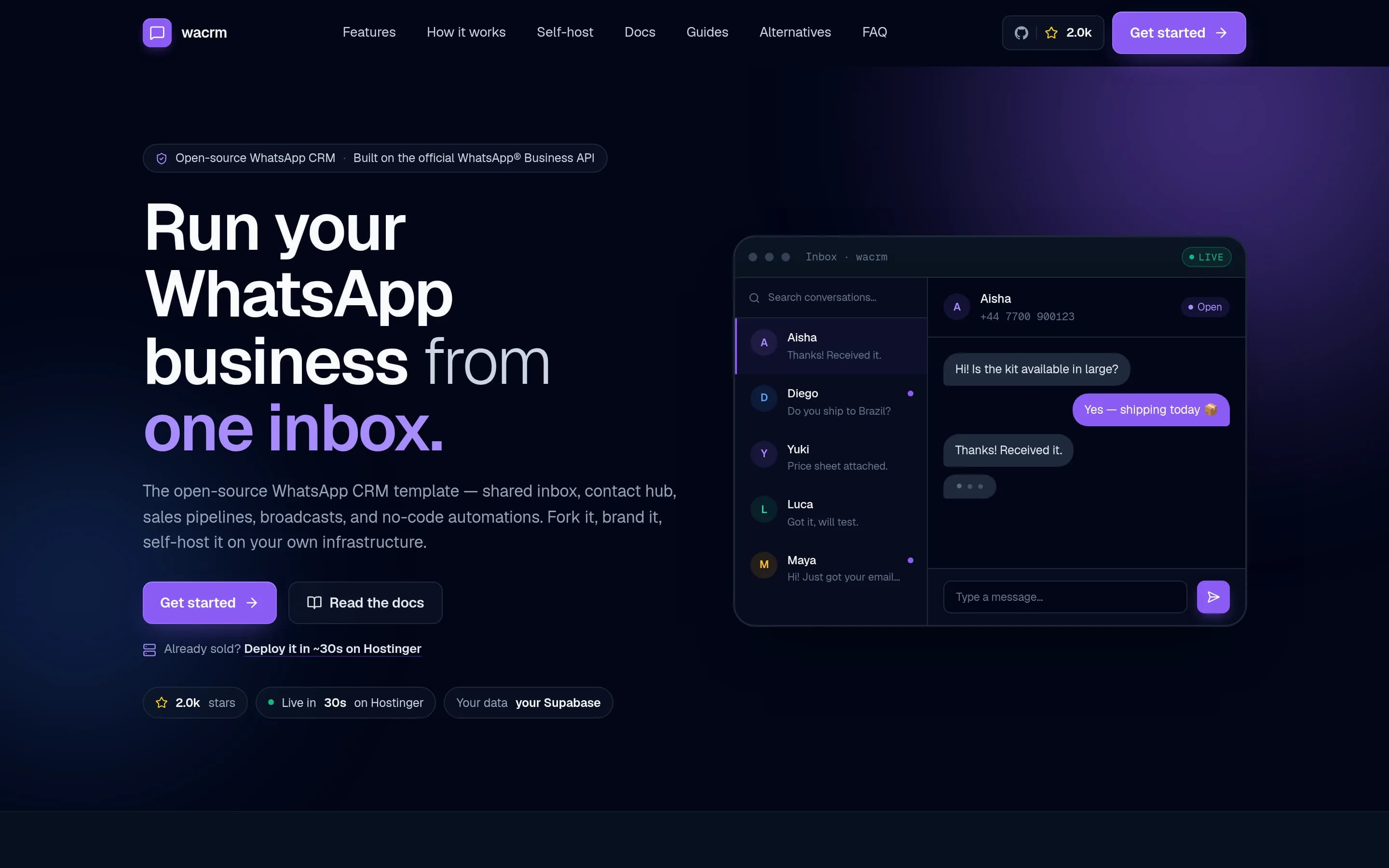
wacrm is a self-hostable CRM template focused on managing customer relationships through the official WhatsApp Business API. It provides a shared inbox with conversation assignment, statuses, notes, team accounts, contacts with tags and custom fields, CSV import, deduplication, and Kanban sales pipelines with deals linked to conversations.
The application also includes broadcasts using Meta-approved templates, delivery and read tracking, no-code automations with triggers, conditions, waits, tags, and webhooks, plus AI-drafted replies and an optional knowledge-base-backed auto-reply bot. A real-time dashboard, public REST API, and MCP server are documented. It runs as a Next.js and Supabase application, with local Node.js setup, Docker Compose, and deployment options including Hostinger, Vercel, Railway, or a user-managed VPS.
What it covers
- Contact records with custom fields
- Customizable sales pipelines
- WhatsApp-linked relationship context
- AI-assisted response drafting
- Trigger-based workflow automation
- Campaign or broadcast delivery tracking
- External access through an API
What’s different
- Documented email and LinkedIn history
- Meeting-centered interaction history
- Inactive-conversation follow-up detection
- On-demand relationship and deal recaps
- Company research and enrichment
- Personalized email workflow campaigns
- Email open, reply, and bounce tracking
DDeskcommCRM573
Choose DeskcommCRM when self-hosting and WhatsApp-led sales operations are the priority: it combines configurable funnels, contacts, automations, AI agents, human handoff, and audit controls, but requires your team to operate a VPS and external services. Choose Folk for a broader relationship-centric workflow spanning email, meetings, LinkedIn activity, companies, deals, enrichment, and email outreach; those areas do
What it does
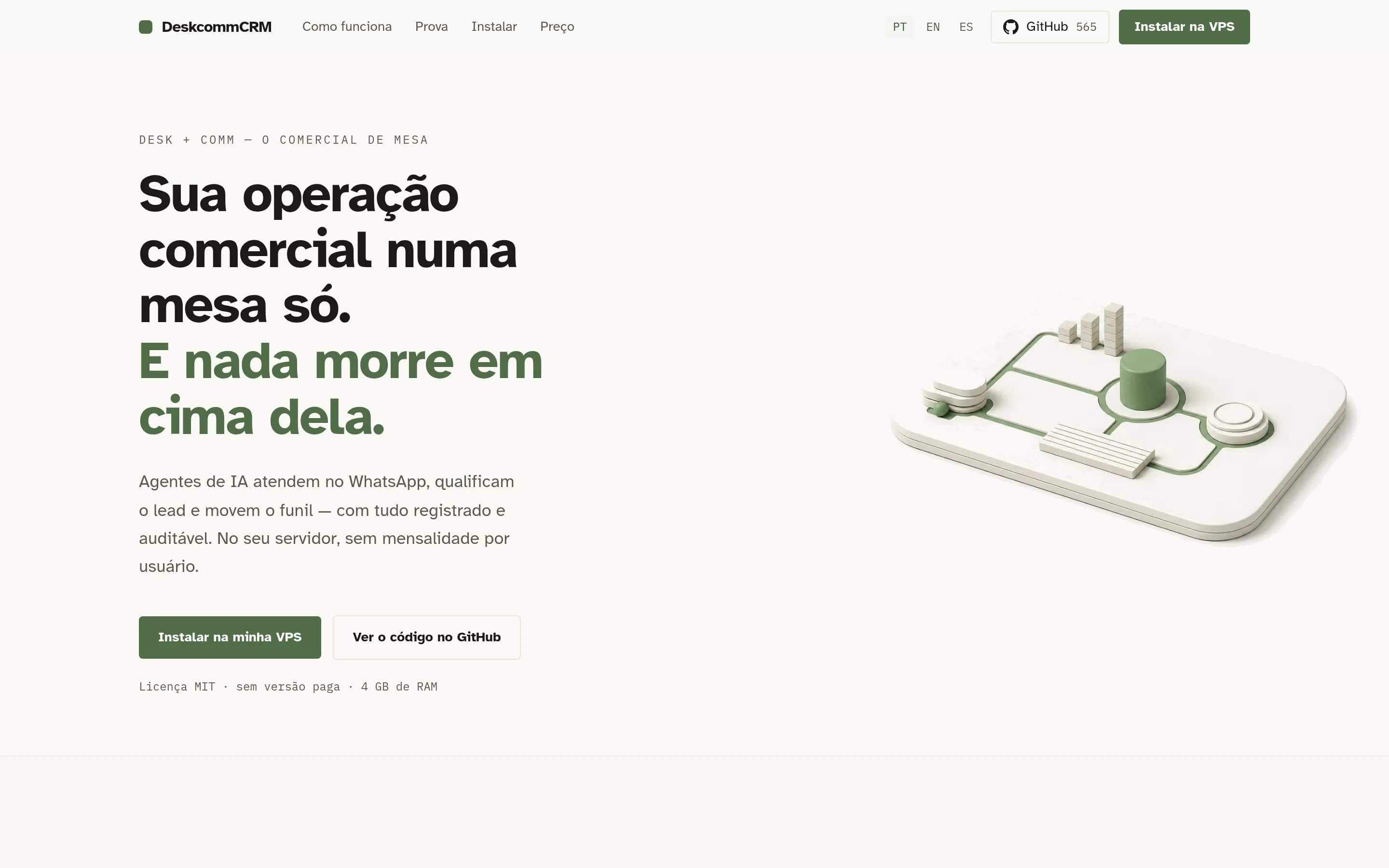
DeskcommCRM is an open-source CRM and sales operating system for businesses that sell through WhatsApp. It provides contact management, Kanban sales pipelines, shared WhatsApp conversations, lead qualification, follow-ups, routing, team assignment, performance views, and audit logs. AI agents can use tenant-specific knowledge, execute skills, move leads through funnels, hand conversations to humans, and support retrieval-augmented responses.
The product supports WhatsApp through WAHA QR-code connections or Meta Cloud API, plus webhooks, event-driven automations, Nuvemshop integration, multi-tenant organizations, role-based access control, and LGPD-oriented data controls. It is deployed on a user-controlled VPS with Docker; the documented installer provisions the app, WhatsApp services, database configuration, HTTPS, scheduled workers, backups, and update tooling.
What it covers
- Contact management
- Configurable sales funnels
- Interaction context
- AI-assisted follow-up
- Workflow automation
- External-system integration
What’s different
- Documented email interaction history
- Documented meeting and LinkedIn history
- Documented company records and enrichment
- Documented email campaign analytics
- Documented Folk data importer
LLaravel-crm23,694
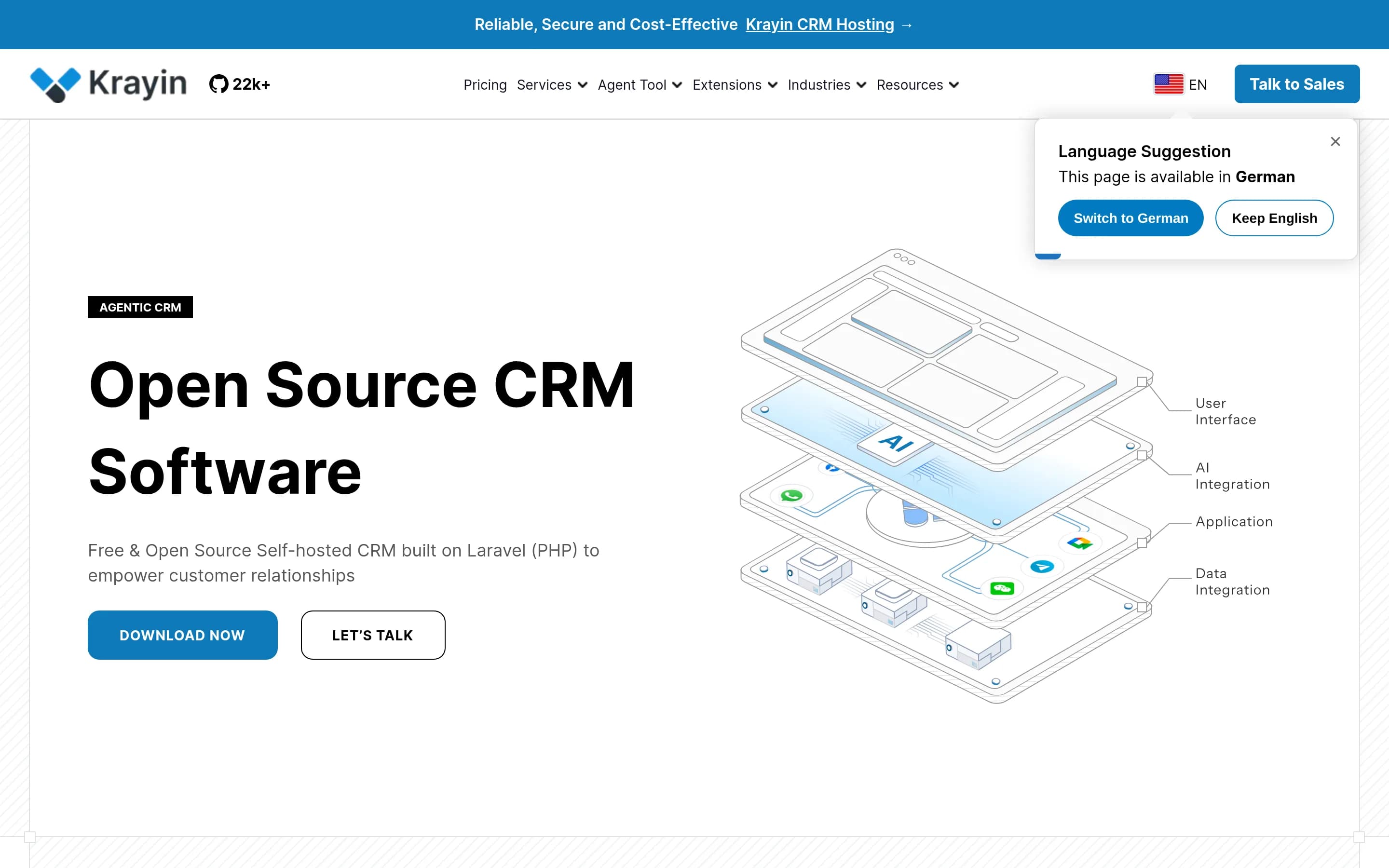
Choose Laravel-crm (Krayin CRM) if you want an open-source, self-hostable Laravel/PHP CRM and can operate or customize its infrastructure. Choose Folk if your priority is its documented relationship-centric workflow, including consolidated multichannel history, enrichment, personalized outreach, and AI-assisted follow-ups and recaps. The central tradeoff is deployment control and source access versus documented out‑/
What it does
Krayin CRM is a free, open-source CRM framework for SMEs and enterprises that supports complete customer lifecycle management, including customer, lead, and sales management. Its documented product features include an admin panel, dashboard, custom attributes, modular architecture, and email parsing through SendGrid.
The application can be installed on a server or run locally with Laravel, PHP, Composer, Apache or NGINX, and MySQL. The repository also documents Docker installation, managed cloud hosting, multi-tenant SaaS deployment, and optional WhatsApp and VoIP CRM extensions. It is licensed under MIT.
What it covers
- Contact and organization records
- Lead and deal management
- Sales activity tracking
- Custom fields or attributes
- Email-related CRM capabilities
- WhatsApp capability, via an extension in Laravel-crm
What’s different
- No documented Folk data importer
- No documented AI follow-up assistant
- No documented AI relationship recaps
- No documented company enrichment workflow
- No documented LinkedIn activity history
- No documented equivalent campaign-event tracking
SSuiteCRM5,670
Choose SuiteCRM when open-source control, self-hosting, customization, and broader sales, marketing, and customer-service workflows matter more than Folk’s relationship-focused experience. Choose Folk when the documented priority is consolidated email, WhatsApp, meeting, note, and LinkedIn context plus AI-generated follow-ups and recaps; the supplied SuiteCRM material does not establish equivalent coverage for those.
What it does
SuiteCRM is an open-source, enterprise-ready customer relationship management application. Its documented scope includes contacts, accounts, leads, opportunities, cases, contracts, quotes, documents, reports, workflows, multi-currency, and multilingual support, providing records and sales-process management for organizations.
The application can be deployed on Linux or Windows servers using Apache or IIS, PHP, and MySQL, MariaDB, or MSSQL. It may be hosted on an internal network, public cloud provider, or managed hosting service. The project provides an online demo, installation and upgrade documentation, regular releases, and an AGPLv3 license.
What it covers
- Centralized customer records
- Customizable CRM data model
- Lead and deal management
- Marketing activity tracking
- External-system integration via API
What’s different
- No documented WhatsApp history parity
- No documented LinkedIn activity parity
- No documented AI follow-up assistant
- No documented AI interaction recaps
- No documented Folk import path
EEver-gauzy4,331
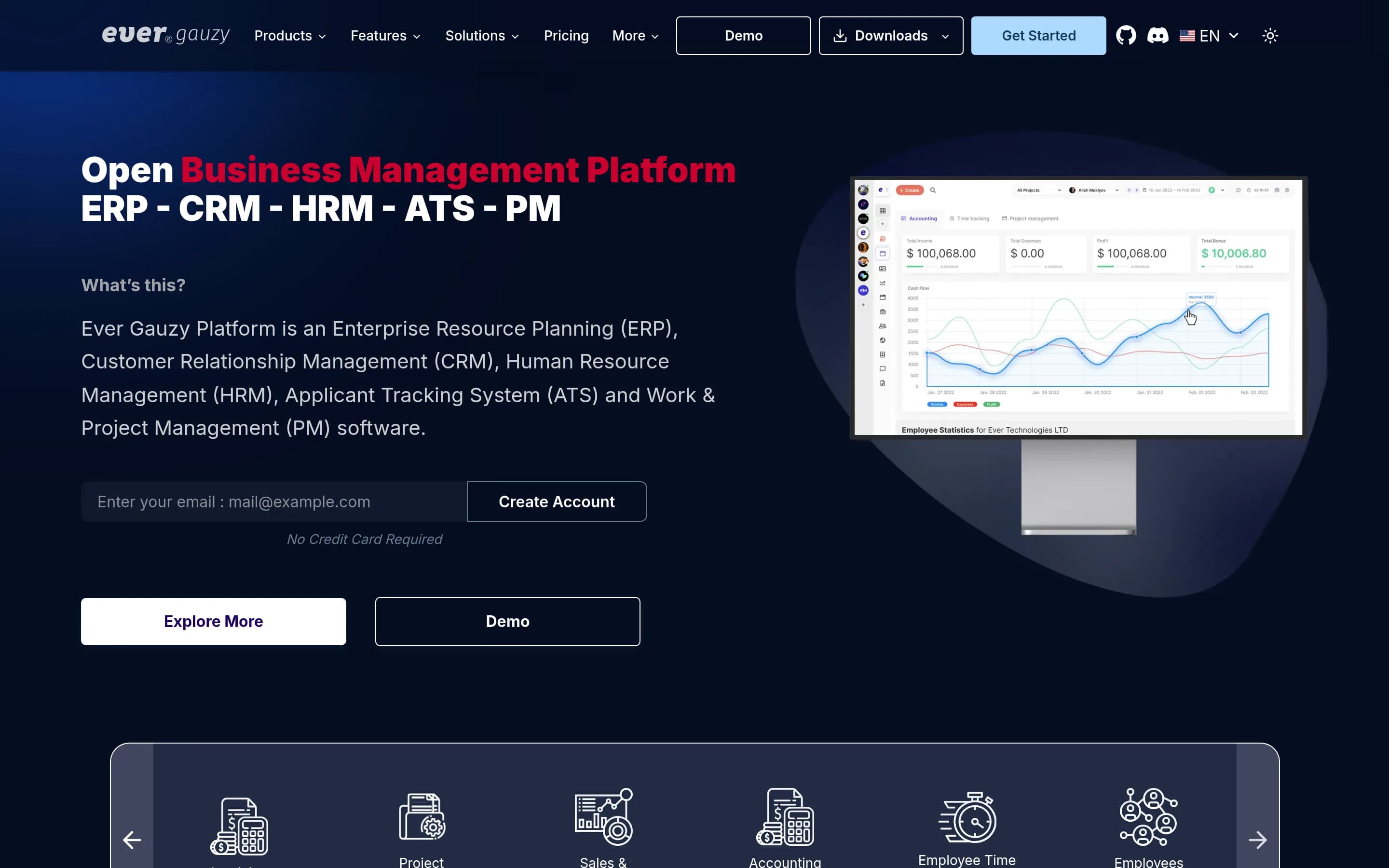
Choose Ever Gauzy when self-hosting and a broader operational suite—CRM plus HR, projects, finance, inventory, and time tracking—matter more than Folk’s relationship-centric experience. Choose Folk when the priority is multichannel relationship context, AI-assisted follow-ups and recaps, enrichment, and personalized email automation; those capabilities are not established for Ever Gauzy by the supplied documentation.
What it does
Ever Gauzy is an open business management platform combining customer relationship management with ERP, HRM, ATS, project management, sales, finance, inventory, and time-tracking functions. Its CRM-related workflows include contacts for clients, customers, and leads, sales pipelines, email history, templates, schedules, tags, reports, and organization records.
The platform provides a browser-based web UI, desktop applications, headless APIs, dashboards, data import and export, integrations, roles, permissions, and multi-organization support. It can run as hosted SaaS or as a locally controlled server and desktop deployment. The README documents Docker Compose, manual Node.js setup, SQLite, PostgreSQL, MySQL, and recommended Kubernetes production deployment.
What it covers
- Contact and client records
- CRM and sales pipelines
- Email history and templates
- External integrations and APIs
- Data import and export
- Roles and permissions
What’s different
- No documented WhatsApp history
- No documented LinkedIn activity history
- No documented AI follow-up assistant
- No documented AI relationship recaps
- No documented company enrichment
- No documented trigger-based email automation
- No documented outreach engagement tracking
MMacro3,704
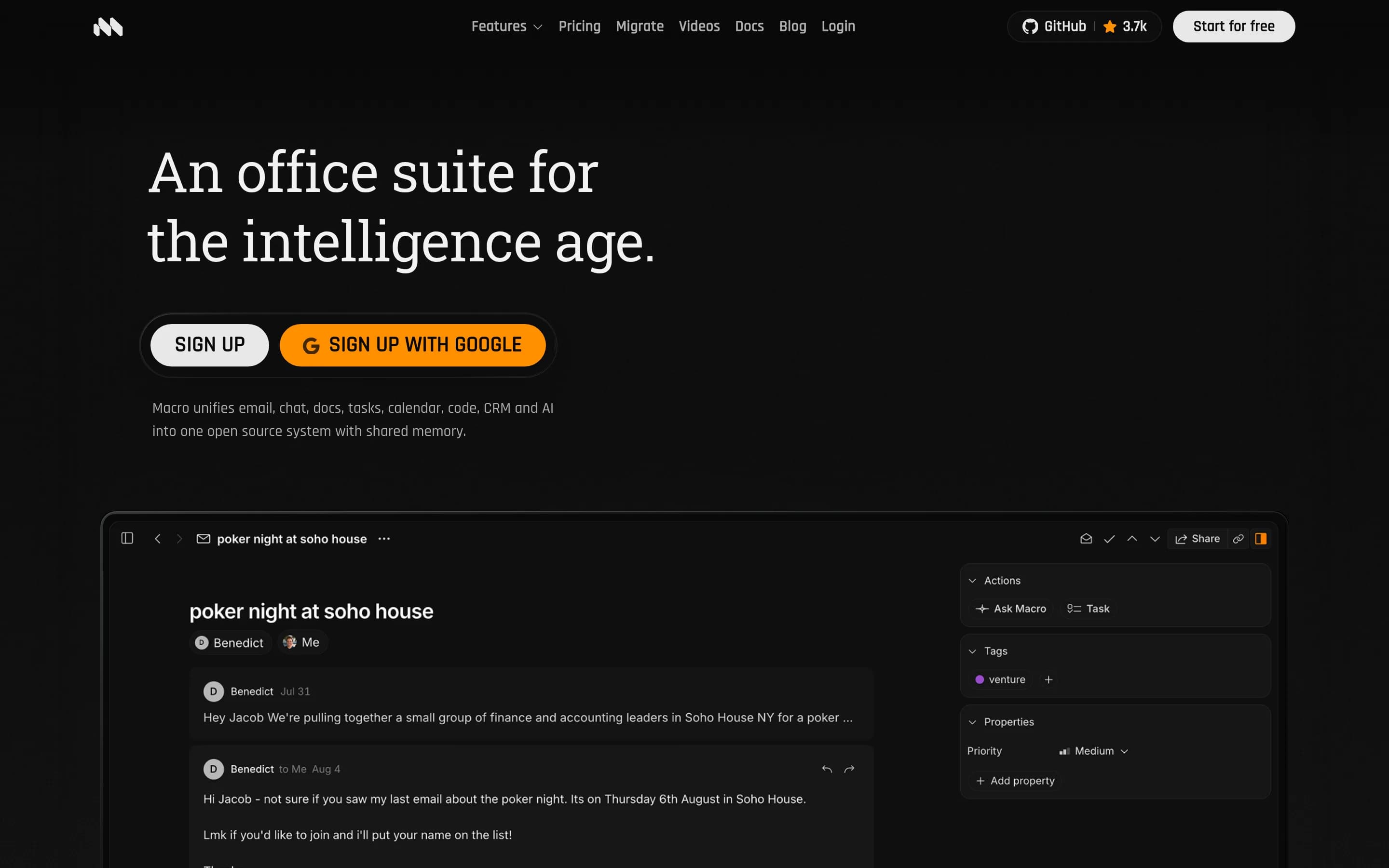
Choose Macro if you want an open-source, self-hostable workspace that combines CRM with email, chat, documents, tasks, calls, and shared AI context. Choose Folk if you want a more focused relationship CRM with documented WhatsApp and LinkedIn context, follow-up and recap assistants, and trigger-based outreach tracking. The main tradeoff is Macro’s broader operational workspace and deployment control versus Folk’s CRM
What it does
Macro is an all-in-one workspace that combines customer and contact objects with email, messaging, documents, tasks, calls, agents, and shared team memory. Its CRM supports customizable properties, kanban boards, deal stages, list and saved views, notes, and shareable views.
CRM records can be linked bidirectionally with messages, emails, tasks, pull requests, and documents. The repository documents email synchronization, aggregation by contact or company, and enrichment. Macro runs as a hosted web application with an iOS app, and the README also documents running the full application locally using the repository's services and Docker Compose stack.
What it covers
- Contact and company records
- Deal pipelines and customizable stages
- Custom CRM properties
- Email synchronization and relationship context
- Company enrichment
- AI-assisted email work
What’s different
- No documented WhatsApp history
- No documented LinkedIn activity history
- No documented trigger-based outreach campaigns
- No documented campaign delivery analytics
- No documented Folk CRM importer
- No documented dedicated follow-up or recap assistants
CCrm3,349
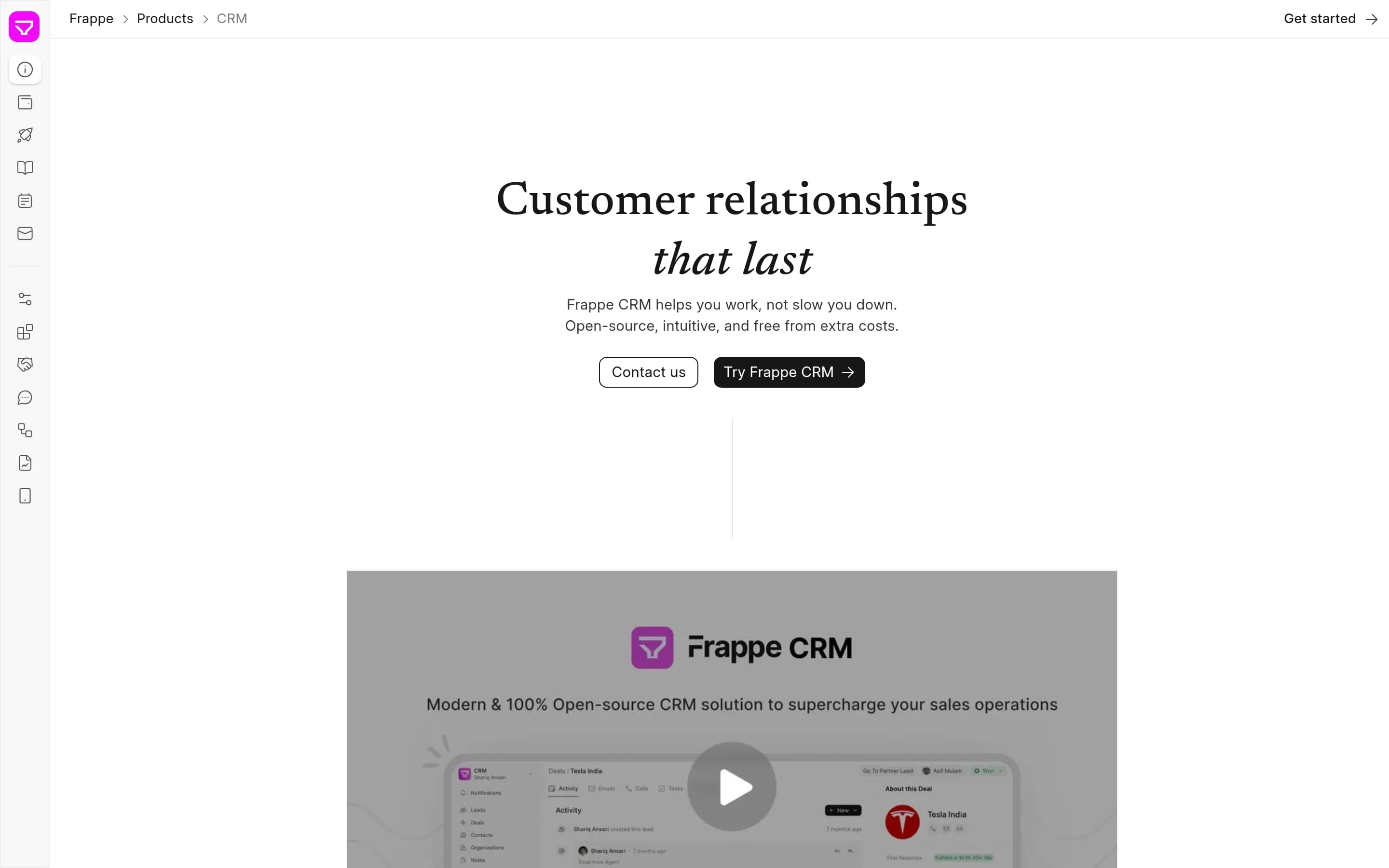
Choose Frappe CRM if source availability, self-hosting, customizable sales pipelines, and optional ERPNext integration outweigh the need for Folk’s documented AI assistants, enrichment, and outreach analytics. Choose Folk if context-aware follow-ups, interaction recaps, company research, AI-personalized email workflows, and campaign delivery tracking are central requirements; those capabilities are not established in
What it does
Frappe CRM is an open-source CRM for modern sales teams. It provides lead and deal pages that consolidate activities, comments, notes, and tasks, along with Kanban boards for visual pipeline tracking and custom views with filters, sorting, and columns.
The README documents email templates, call making and recording through Twilio or Exotel, WhatsApp messaging, and integrations with ERPNext. It is available through Frappe Cloud or can be self-hosted using the production install script, Docker Compose, or a local Frappe development setup. The repository explicitly documents browser access to the CRM interface.
What it covers
- Lead and deal records
- Customizable sales pipelines
- Custom fields and views
- Email communication
- WhatsApp communication
- Follow-up workflow automation
- External integrations and APIs
What’s different
- No documented AI follow-up assistant
- No documented AI interaction recaps
- No documented company enrichment
- No documented AI email personalization
- No documented outreach delivery analytics
- No documented LinkedIn activity capture
DDjango-CRM2,384
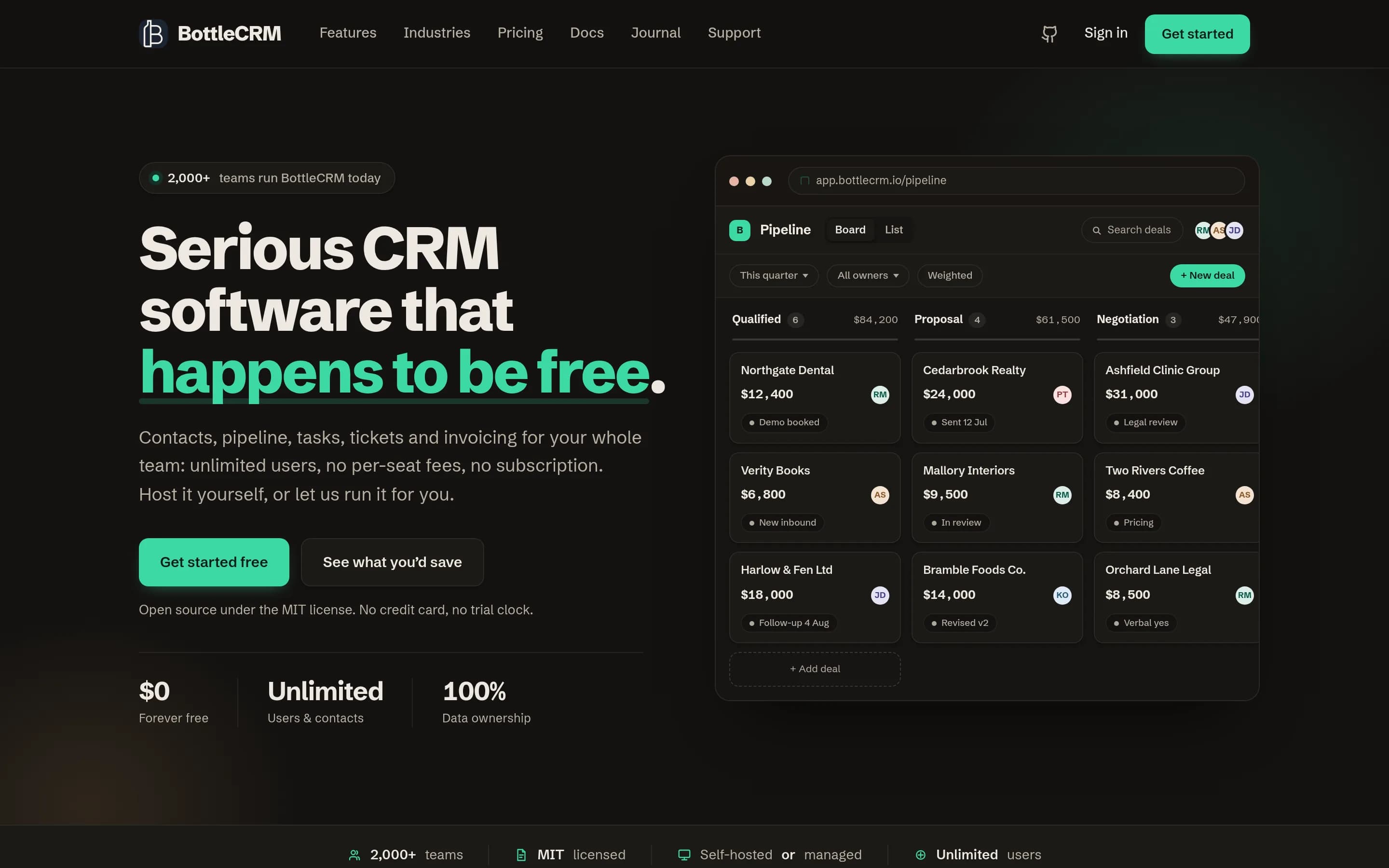
Choose Django-CRM (BottleCRM) when self-hosting, source-code control, multi-tenancy, and integrated support and invoicing matter more than Folk’s communication-centric automation and AI assistance. Choose Folk when the priority is multichannel relationship context, AI-generated follow-ups and recaps, enrichment, or trigger-based outreach; Django-CRM explicitly lacks workflow automation and does not send customer-com.
What it does
BottleCRM is an open-source CRM for startups and enterprises that manages the customer lifecycle across leads, accounts, contacts, opportunities, support tickets, tasks, and invoices. It is designed for multi-tenant deployments and uses PostgreSQL row-level security to isolate organizational data.
The product provides a SvelteKit web application, native Flutter mobile applications for iOS and Android, and a Django REST API with an OpenAPI schema. Users can run it locally or on their own infrastructure with Docker Compose, and the documentation covers production self-hosting, backups, security hardening, and API usage. It is MIT licensed and supports unlimited users and records.
What it covers
- Contact and company/account records
- Deal pipeline tracking
- Custom fields
- Interaction timelines, with different channel coverage
- REST API access
What’s different
- No workflow automation
- No customer-outbound email composer
- No documented Folk-style follow-up assistant
- No documented Folk-style recap assistant
- No documented company enrichment
- No documented WhatsApp or LinkedIn timeline support
- No web or mobile CSV import access
RRelaticle1,517
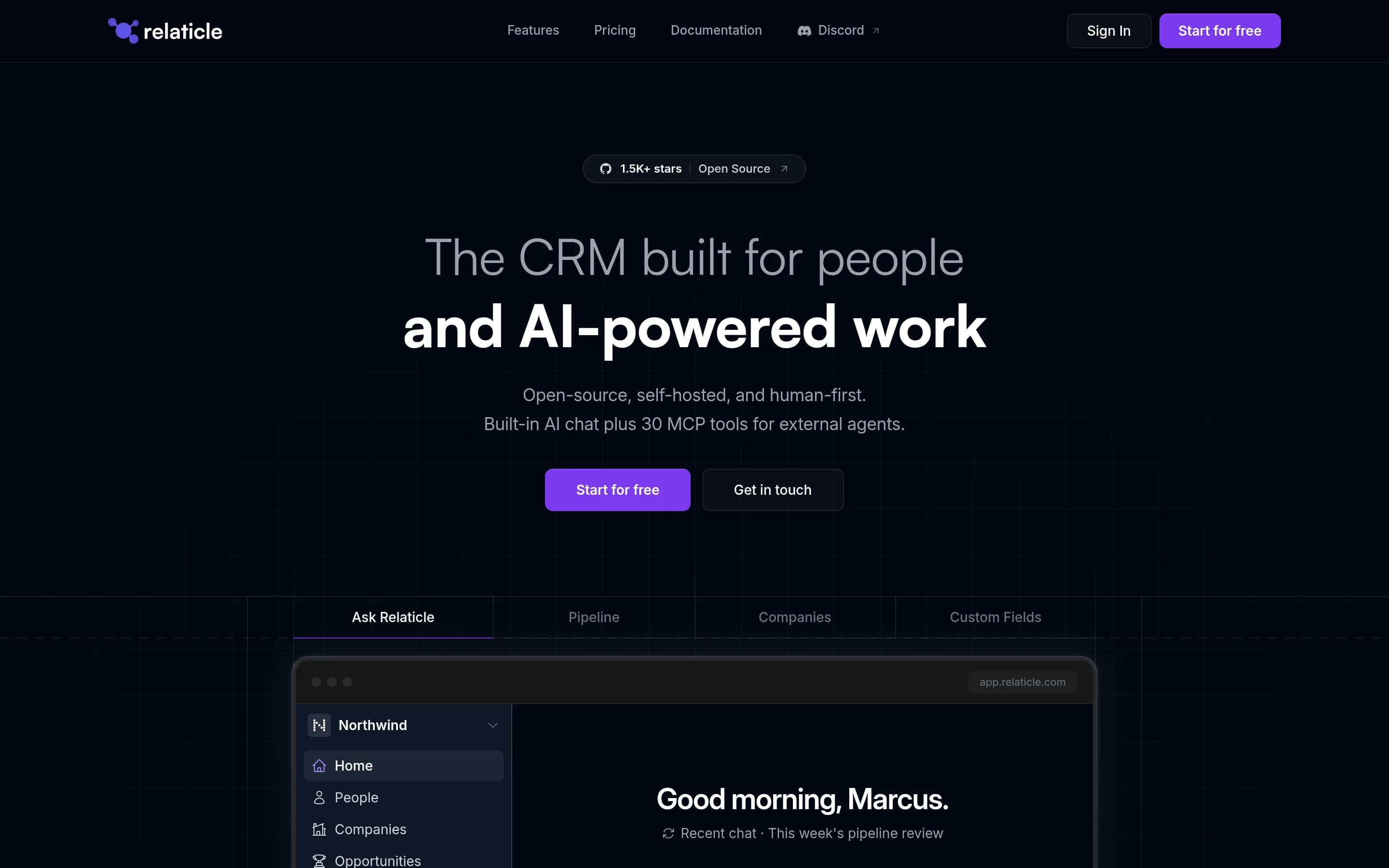
Choose Relaticle when self-hosting, source access, granular custom fields, and CRM access through external AI agents are more important than Folk’s documented communication and outreach workflows. Choose Folk when the CRM must center on email/WhatsApp/LinkedIn context, enrichment, automated personalized email, and campaign tracking; equivalent Relaticle coverage for those areas is not established by the supplied docs
What it does
Relaticle is an open-source CRM designed for developer-led teams, AI-focused startups, and SMBs. Its documented CRM scope includes contacts, companies, opportunities, tasks, notes, tracking, team workspaces, and a customizable data model with 22 field types, entity relationships, conditional visibility, and per-field encryption.
The product includes a graphical interface built with Filament and Livewire, a REST API with full CRUD, and a production-grade MCP server exposing 32 tools for AI-agent CRM operations. It supports multi-team isolation and self-hosted deployment through Docker or manual installation, using Laravel, PHP, PostgreSQL, Composer, Node.js, and optionally Redis.
What it covers
- People and company records
- Deal or opportunity pipelines
- Custom fields and record structures
- Interaction history and notes
- AI-assisted CRM work
- REST API access
What’s different
- No documented WhatsApp integration
- No documented LinkedIn activity capture
- No documented company enrichment
- No documented trigger-based email campaigns
- No documented email campaign metrics
- No documented Folk-specific importer
NNextcrm-app681
Choose Nextcrm-app if self-hosting and a broader operational suite—including CRM, projects, invoicing, documents, email, audit history, and AI-agent access—matter more than matching Folk’s relationship-centric experience. Choose Folk if your priority is documented WhatsApp and LinkedIn context, tailored follow-up and recap assistants, or trigger-based personalized email workflows; equivalent coverage is not described
What it does
NextCRM is an open-source CRM that centralizes accounts, contacts, leads, opportunities, contracts, targets, and related activities. Users can create, update, search, and review records, link notes, calls, emails, meetings, and tasks to entities, and inspect audit history. It also includes projects, documents, invoices, campaigns, an email client, reports, and unified keyword and semantic search.
Documented AI capabilities include contact and target enrichment, browser-based company research, C-level contact discovery, vector similarity search, and a project-management assistant. The application provides an MCP server for AI-agent access to CRM data, campaigns, projects, documents, enrichment, and reports. It runs as a Next.js application with PostgreSQL and can be installed locally or deployed with Docker Compose, which bundles the app, database, storage, and background-job services.
What it covers
- Contact and company/account records
- Deal or opportunity records
- Email and meeting activity records
- AI-assisted contact or company enrichment
- Customizable CRM data structures
- External integration interfaces
What’s different
- No documented WhatsApp history
- No documented LinkedIn activity capture
- No documented stalled-conversation assistant
- No documented on-demand relationship recap assistant
- No documented field-triggered email workflows
SSuiteCRM-Core279
Choose SuiteCRM-Core when self-hosting, data control, source customization, and broader sales, marketing, and customer-service workflows matter more than Folk’s relationship-centric experience. Choose Folk when the priority is consolidated multichannel relationship context, AI-assisted follow-ups and recaps, enrichment, and trigger-based email outreach; equivalent SuiteCRM coverage for those specific capabilities is未
What it does
SuiteCRM is an open-source, enterprise-ready customer relationship management application designed to give organizations control over their data and the ability to customize their business solution. SuiteCRM 8 uses an Angular frontend, Symfony backend, and API-first architecture.
The repository documents CRM software intended for deployment on Linux servers, with local test and development support and compatibility with Apache, PHP, and MySQL. Organizations can host it on an internal network or public cloud, use managed hosting, and access an online demo. The project is released under the AGPLv3 license.
What it covers
- Centralized customer records
- Customizable CRM data model
- Lead and opportunity management
- Personalized customer outreach
- Workflow automation
- API-based integrations
What’s different
- No documented WhatsApp history
- No documented LinkedIn activity history
- No documented AI follow-up assistant
- No documented AI recap assistant
- No documented company enrichment
- No documented email open, reply, or bounce tracking
DDolibarr7,521
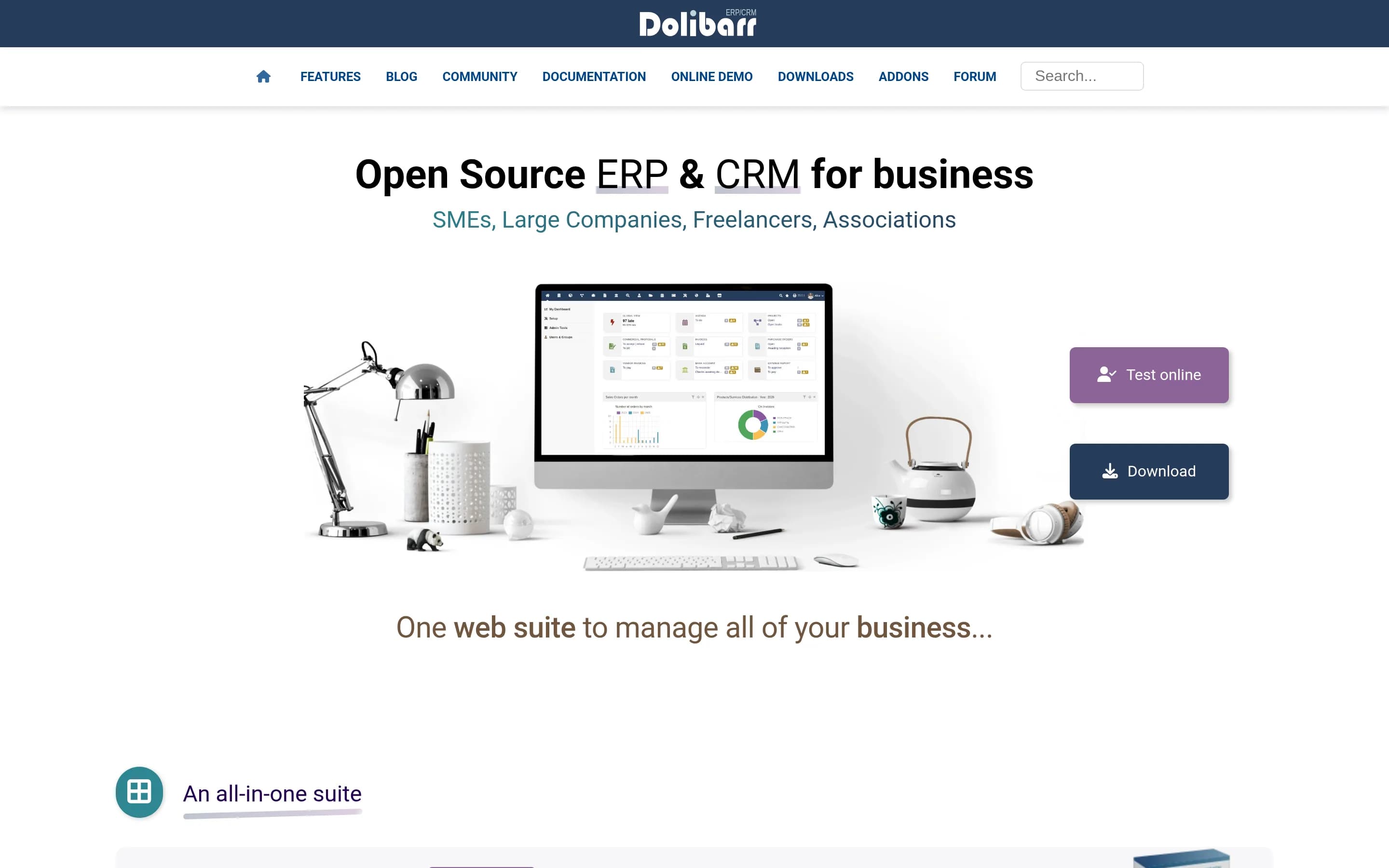
Dolibarr is the stronger choice for organizations that want a self-hostable, open-source CRM embedded in a broader ERP covering sales, invoicing, accounting, stock, purchasing, projects, and HR. Folk remains the better fit for teams centered on relationship context, multichannel interaction history, and AI-assisted follow-ups and recaps; those capabilities are not established for Dolibarr by the supplied sources.
What it does
Dolibarr is an open-source ERP and CRM suite for companies, foundations, and freelancers. Its documented modules cover customers, prospects, leads, contacts, opportunities, commercial proposals, orders, contracts, interventions, tickets, suppliers, products, inventory, invoicing, accounting, projects, tasks, agenda, and human resources.
The platform supports customizable user fields, dashboards, permissions, multi-language and multi-currency operation, data import and export, mass emailing, REST and SOAP APIs, and integrations such as LDAP and payment platforms. It can run as a standalone or web application, with installation through PHP and MariaDB, MySQL, or PostgreSQL, packaged distributions, or Docker; hosted cloud offers are also available.
What it covers
- Contact and prospect records
- Lead and opportunity management
- Custom user fields
- Mass email capability
- APIs for integrations
- Data import and export
What’s different
- No documented Folk-specific migration path
- No documented WhatsApp history capture
- No documented LinkedIn activity capture
- No documented context-aware follow-up assistant
- No documented relationship recap assistant
- No native embedded webmail
- No fully supported project-task dependencies
- No payroll module
OOpen-mercato1,646
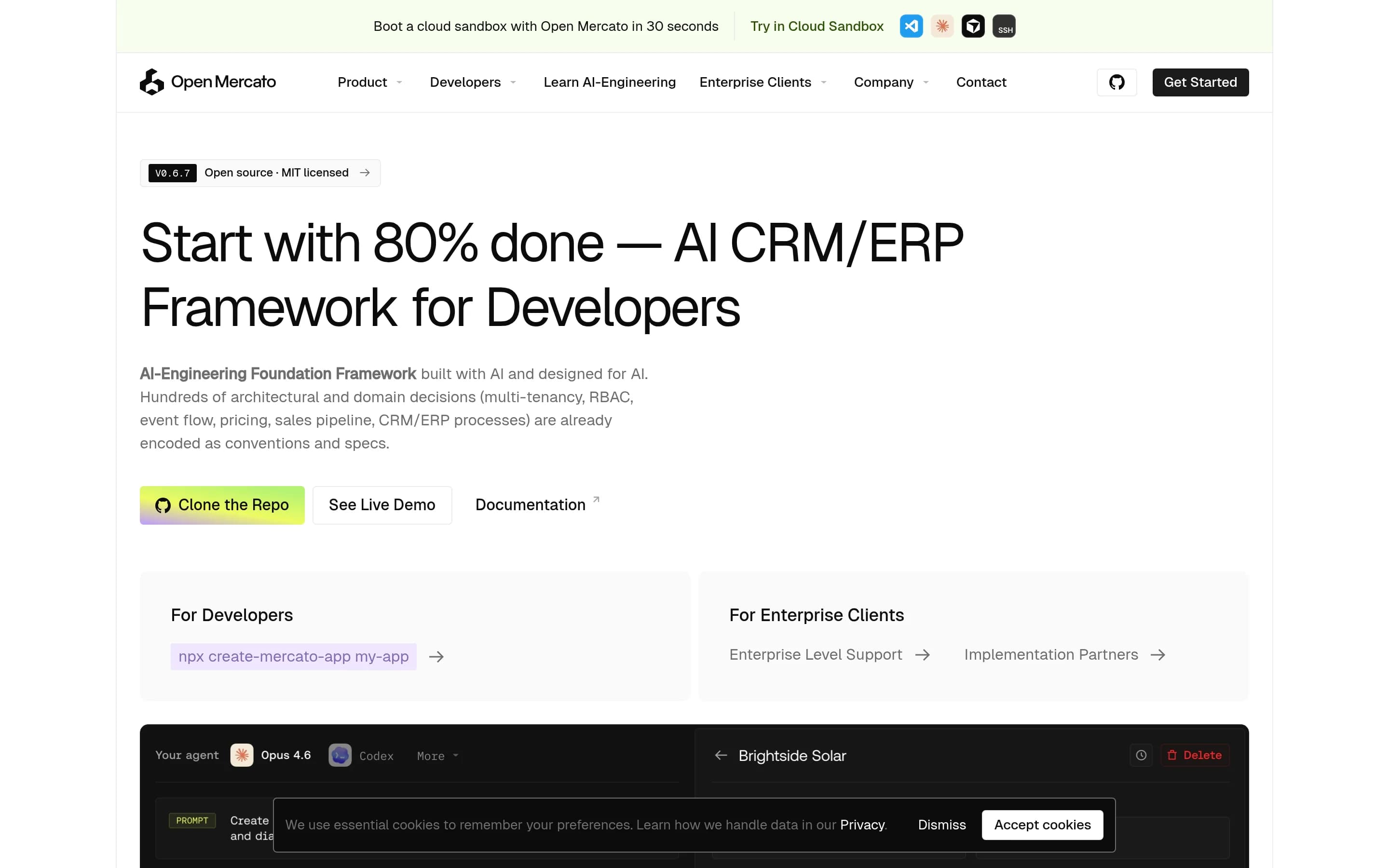
Open Mercato is better suited to engineering-led organizations that want to self-host and extend a CRM into commerce, ERP, portals, or bespoke operational workflows. Folk is the safer choice for teams wanting a ready-made relationship CRM with documented multichannel history, outreach, enrichment, and follow-up assistance; the supplied Open Mercato material establishes a customizable CRM/ERP framework, but not direct
What it does
Open Mercato is an open-source TypeScript foundation for building CRM, ERP, commerce, and custom business applications. Its documented CRM use case models customers and opportunities, while custom entities, dynamic forms, flexible data definitions, and modular workflows support tailored relationship and sales processes.
The repository includes a Next.js admin interface, generated APIs, multi-tenancy, organization hierarchies, feature-based RBAC, event subscribers, indexing, caching, and AI-supportive workflows. Users can run the complete application locally with Node.js, PostgreSQL, Redis, and Docker, or deploy it to a Linux server, Railway, or other supported environment.
What it covers
- Customer and company records
- Sales opportunities and pipelines
- Custom fields and data models
- Interaction timelines
- Custom workflows
- APIs and external frontends
- AI-supportive workflows
What’s different
- No documented WhatsApp history parity
- No documented LinkedIn activity parity
- No documented follow-up drafting parity
- No documented relationship recap parity
- No documented company-enrichment parity
- No documented email-campaign metrics parity
IIdurar-erp-crm8,673
Idurar-erp-crm is a plausible self-hosted alternative when invoicing, quotes, payments, and accounting-oriented customer management matter more than Folk’s relationship-centric workflows. Choose Idurar for operational ERP/CRM functions and infrastructure control; choose Folk when multichannel interaction history, customizable relationship pipelines, AI follow-ups and recaps, enrichment, or automated email outreach is
What it does
IDURAR is an open-source ERP and CRM application built with Node.js, Express.js, MongoDB, React, Ant Design, and Redux. Its documented workflows include customer management, quote management, invoice management, payment management, accounting, inventory, and broader ERP operations.
The repository documents a self-hosted deployment path: users clone the repository, configure MongoDB and environment settings, install backend and frontend dependencies, run setup, and start the backend and frontend servers. It is released under the GNU Affero General Public License v3.0 and can be used for personal or commercial purposes.
What it covers
- Customer or contact records
- CRM-oriented customer management
- Self-customizable source code
What’s different
- Documented multichannel interaction history
- Documented customizable deal pipelines
- Documented AI follow-up suggestions
- Documented AI relationship recaps
- Documented company enrichment and research
- Documented trigger-based email workflows
- Documented outreach campaign tracking
- Documented packaged integrations or public API