
TTodoist
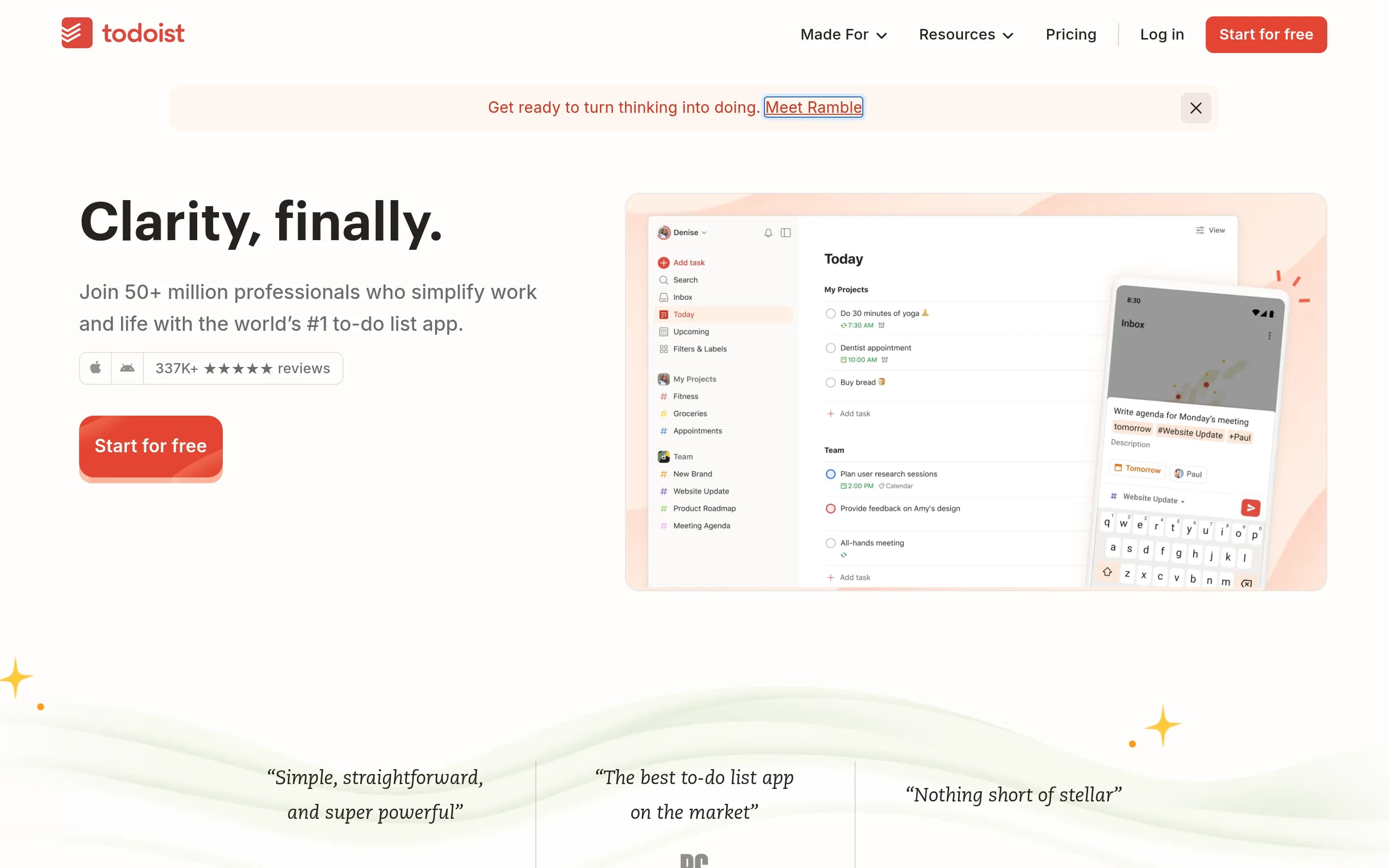
Todoist is a task manager and to-do list application for capturing, organizing, scheduling, and completing personal or team tasks. It supports natural-language entry, recurring due dates, filtered views, shared task spaces, templates, and calendar-based weekly planning.
Why people leave Todoist
Someone might seek a Todoist alternative when their needs extend beyond task and to-do tracking into more comprehensive project planning. Todoist can organize work into projects and provides list or board templates, but the supplied product page emphasizes capturing, sorting, scheduling, and completing tasks. Teams that need deeper milestone planning, resource allocation, roadmaps, or other delivery controls may prefer a system designed primarily around project management rather than a task manager that also accommodates projects.
Another reason could be a preference for a different approach to organizing work. Todoist centers on quickly capturing tasks, assigning due dates, using recurring tasks, and reviewing Today, Upcoming, calendar, or custom-filter views. This structure may not suit people who want their work to revolve around documents, notes, a visual canvas, or another planning model. Users may also want a tool with a narrower, simpler workflow if they do not need projects, filters, teamwork, templates, and multiple planning views.
Scheduling requirements may also lead someone to compare alternatives. Todoist provides due dates, recurring tasks, an Upcoming view, and a calendar view for visualizing the week. However, the crawled page does not present it as a full appointment-booking or availability-management platform. People whose primary need is managing meetings, external bookings, reservations, or shared availability may therefore look for dedicated scheduling software rather than adapting a to-do list to that job.
Finally, organizations may evaluate whether Todoist’s collaboration model matches how their teams operate. The product offers shared spaces for team tasks while keeping personal tasks and projects separate, along with integrations, templates, and SOC 2 Type II–described security. Even so, a team might prefer an alternative that consolidates communication, documentation, and work tracking differently, or one that better fits its required integrations and operating processes. Individuals or organizations specifically seeking an open-source option may also prioritize source-code access, self-hosting, customization, or greater control over deployment and data; none of those capabilities are established by the supplied Todoist page.
5 Best Open Source Todoist Alternatives (Ranked)
Each alternative is evaluated for core feature coverage, deployment options, licensing, project health, and overall fit. The ranking prioritizes how closely a tool matches Todoist's primary workflows, using popularity only as a secondary signal.
MMindwtr1,677
Choose Mindwtr for a local-first, open-source GTD workflow with optional self-hosting and user-selected sync. Keep Todoist when shared team spaces and task collaboration are central: Mindwtr explicitly positions itself for individual use and not for shared workspaces, assignments, or team discussion.
What it does
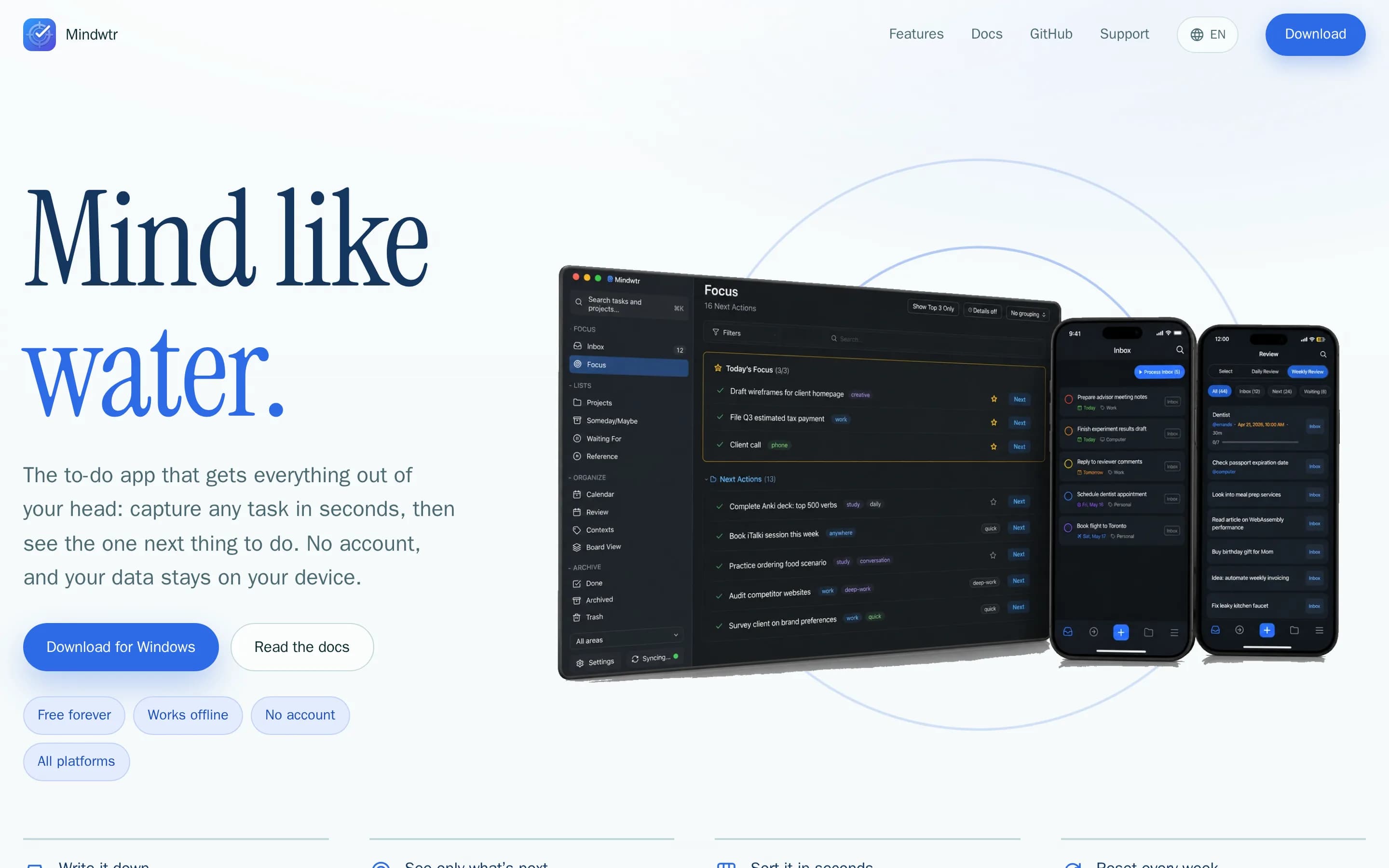
Mindwtr is a free, open-source to-do application built around the Getting Things Done method. It captures tasks and ideas into an inbox, guides clarification and organization, presents next actions in Focus, and supports projects, sections, contexts, waiting-for items, someday/maybe lists, reviews, checklists, recurrence, search, attachments, and Markdown notes.
The application provides calendar planning, Kanban boards, notifications with snooze, Pomodoro focus sessions, daily digests, weekly reviews, optional AI assistance, and imports from TickTick, Todoist, OmniFocus, Apple Reminders, Obsidian, and CSV. It runs on Windows, macOS, Linux, iOS, Android, and offline-capable web, with optional iCloud, Dropbox, folder, WebDAV, or user-controlled server synchronization. Docker deployment is documented.
What it covers
- Task and idea capture
- Projects and sections
- Dated task planning
- Recurring tasks
- Calendar views
- Board views
- Search and filtering
- Desktop and mobile apps
What’s different
- Shared team workspaces
- Task assignments
- Team discussions
- Documented natural-language entry
- Documented template library
- Documented Todoist integration parity
TTududi3,252
Choose Tududi if source access, self-hosting, deployment control, and a broader hierarchy of tasks, projects, areas, and notes outweigh the operational work of running it. Choose Todoist if your workflow depends on documented natural-language capture, weekly calendar planning, templates, or an established Todoist setup: those capabilities and a Todoist importer are not established for Tududi in the supplied material.
What it does
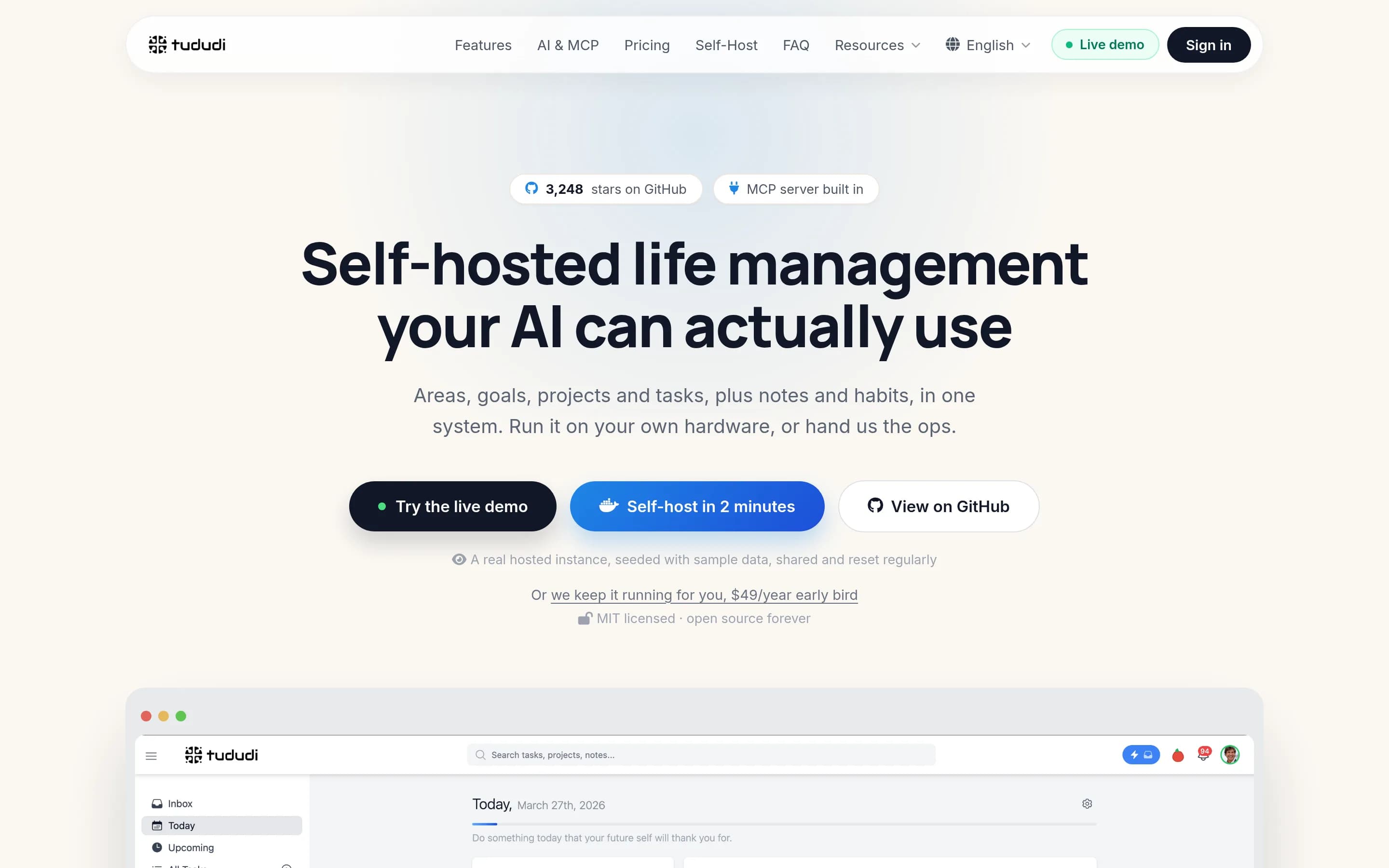
Tududi is a productivity application for organizing personal and shared work. Users can create tasks, subtasks, projects, areas, notes, and tags; assign tasks to projects; track due dates and priorities; filter work by views such as Today, Upcoming, and Someday; and share projects with team members.
The README documents recurring tasks with flexible schedules, completion-based recurrence, subtasks with progress tracking, a responsive interface, an installable PWA with offline queuing, Telegram capture and digests, a REST API, OIDC/SSO, and bidirectional CalDAV synchronization. It can be run locally with Docker or Docker Compose, with persistent database and upload volumes, or used through a hosted subscription.
What it covers
- Task creation and completion
- Project-based task organization
- Due dates and recurring tasks
- Today and Upcoming views
- Task filtering and prioritization
- Shared project collaboration
What’s different
- No documented natural-language task entry
- No documented weekly calendar view
- No documented template library
- No documented Todoist importer
- No documented Kubernetes deployment
TTasks.md2,180
Tasks.md is a narrower, self-hosted alternative centered on kanban-style boards and Markdown files, while Todoist is the better-documented choice for natural-language capture, recurring schedules, calendar planning, filters, templates, integrations, and shared team spaces. Choose Tasks.md when deployment control and filesystem-readable tasks matter more than broad workflow coverage; choose Todoist when its scheduling
What it does
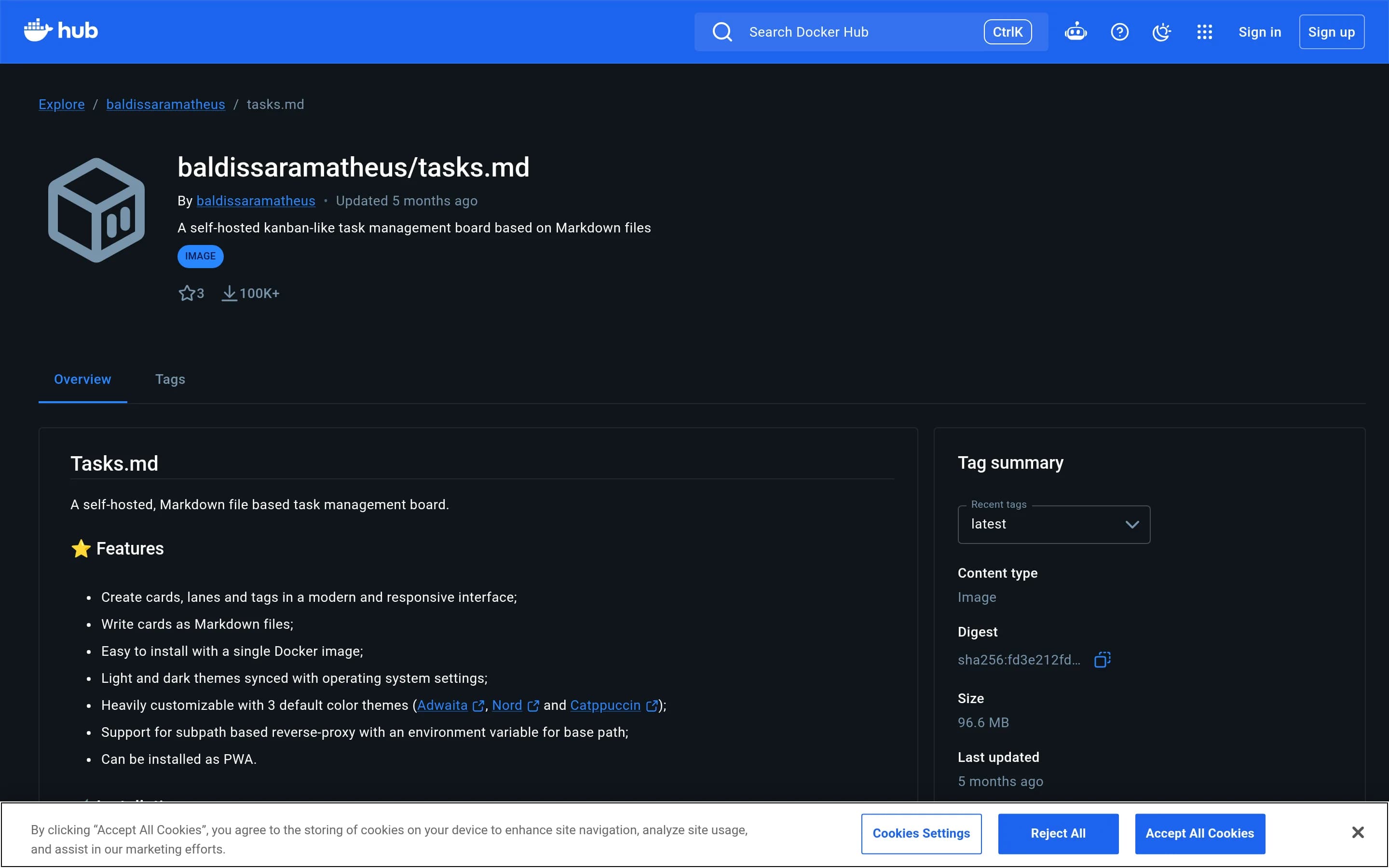
Tasks.md is a self-hosted task-management board for organizing work as cards, lanes, and tags. Cards are stored as Markdown files, while lanes correspond to directories and tasks to files in the underlying filesystem. Subdirectories can be opened as separate projects with their own lanes and tasks.
The application provides a modern responsive web interface, light and dark themes, customizable color themes, multilingual support, reverse-proxy subpaths, and PWA installation. It is deployable with Docker or Docker Compose using mounted task and configuration directories, or it can be run from source with separate frontend and backend processes.
What it covers
- Task creation and completion
- Project-level task grouping
- Board-style work organization
- Due-date handling
What’s different
- Natural-language task capture
- Recurring task schedules
- Today and Upcoming views
- Calendar-based weekly planning
- Custom task filters
- Shared team task spaces
- Task and project templates
- Documented service integrations
TTaskBoard1,401
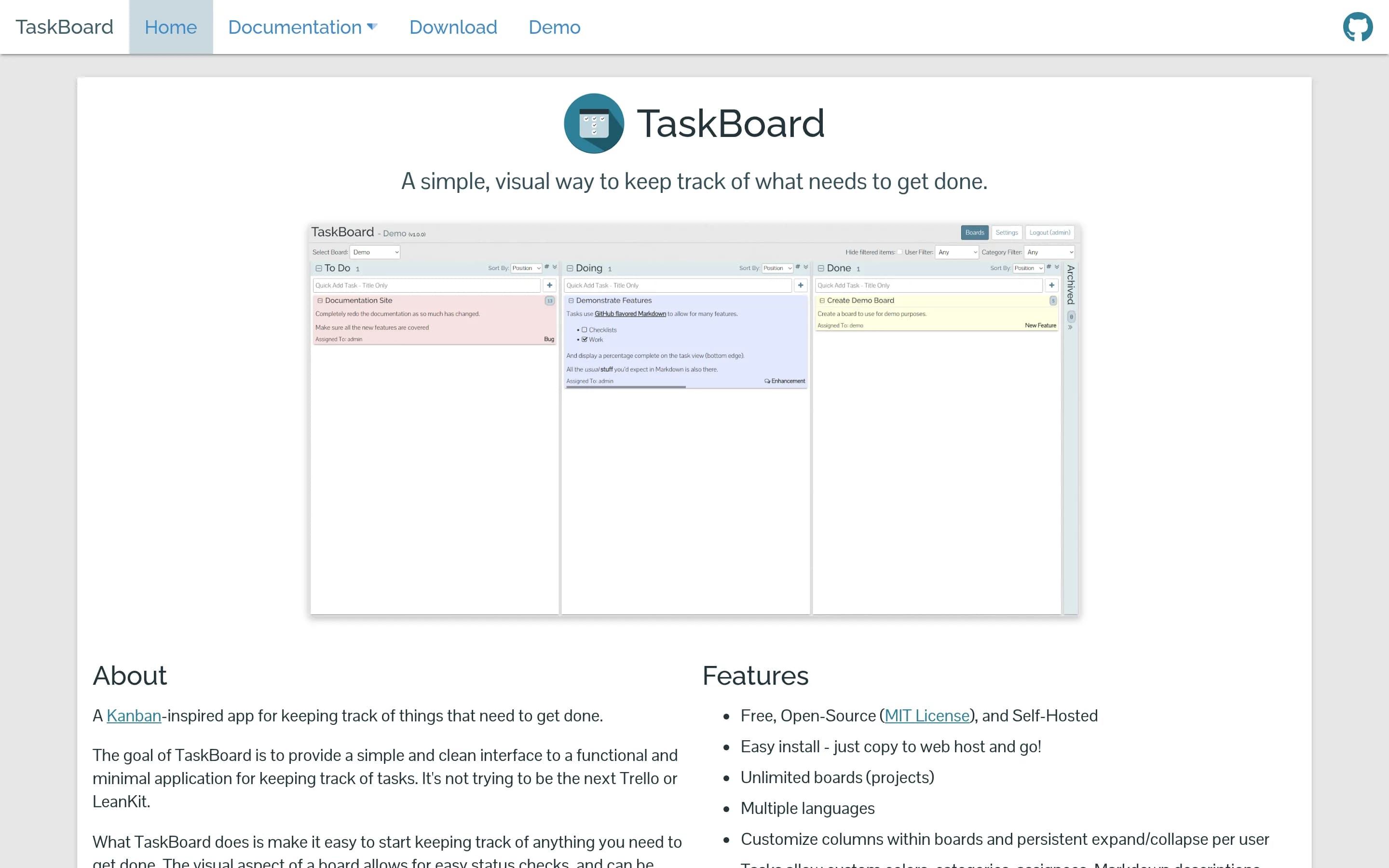
TaskBoard is a self-hostable, MIT-licensed Kanban task tracker, but it is explicitly unmaintained and depends on obsolete PHP 7.x-era infrastructure. Choose it only for a simple board workflow when source access and deployment control outweigh maintenance risk. Choose Todoist for natural-language capture, recurring scheduling, filtered and calendar views, templates, integrations, or a maintained task-management scope
What it does
TaskBoard is a Kanban-inspired task-management application for tracking work on customizable boards. Users can create columns such as Todo, Doing, and Done, add tasks, drag them between stages, and organize work with categories.
Tasks support titles, descriptions with Markdown, assignees, due dates, colors, points, comments, attachments, and activity history. Multiple user roles, shared boards, and board administration support team workflows.
The application is an open-source Angular and PHP web app using a REST API and SQLite by default. It can be deployed to a user-controlled web server with PHP 7.x, SQLite, and Apache configuration; the README marks the project unmaintained.
What it covers
- Task creation and completion tracking
- Due dates on tasks
- Board-based task organization
- Multi-user task assignment
What’s different
- No documented natural-language capture
- No documented recurring tasks
- No documented Today or Upcoming views
- No documented custom filters
- No documented calendar planning view
- No documented workflow templates
- No documented external integrations
LLotti1,162
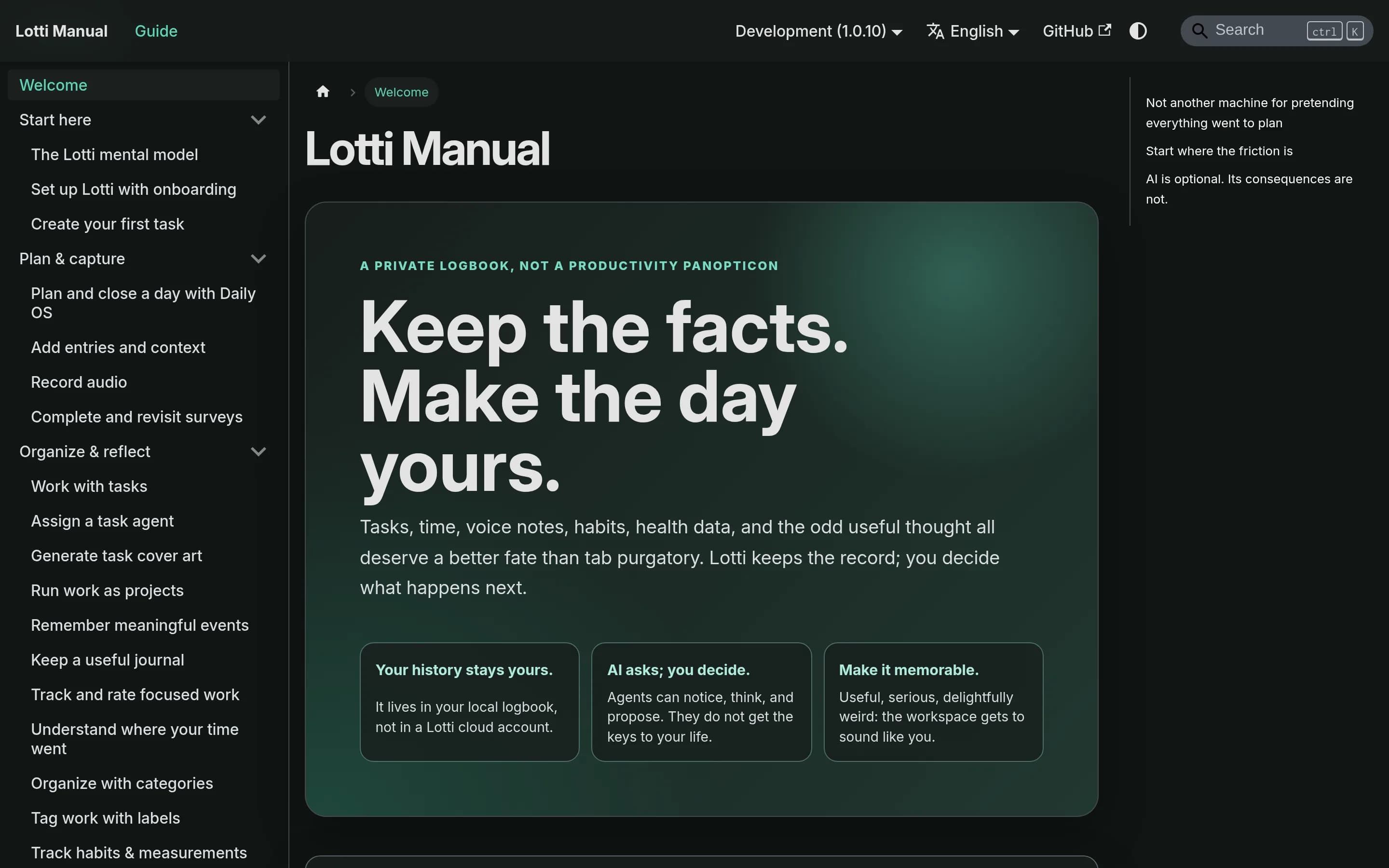
Choose Lotti if you want an open-source, local-first personal logbook that combines tasks with time tracking, notes, habits, optional AI assistants, and encrypted synchronization under your control. Keep Todoist if your priority is a mature task-list workflow centered on natural-language capture, recurring schedules, filtered and calendar views, templates, integrations, or shared team spaces. Lotti covers task basics
What it does
Lotti is a local-first personal logbook that separates planned tasks from records of completed work. Users can create tasks with checklists, priorities, estimates, due dates, labels, statuses, and linked context; record time, notes, images, audio, measurements, and journal entries; and organize information with categories and labels.
The application includes habit tracking, time analysis, speech transcription, dashboards, search, and optional task-specific AI agents that summarize records and propose changes for approval. It runs across macOS, Linux, Windows, iOS, and Android. Data is stored in local SQLite with filesystem attachments, while synchronization uses end-to-end encryption through a Synapse homeserver operated by the user or a trusted party.
What it covers
- Tasks with priorities and due dates
- Task grouping into projects, with Lotti projects behind an advanced flag
- Labels for organizing work
- Task checklists and lifecycle states
- Multi-device access across desktop and mobile platforms
What’s different
- No documented recurring tasks
- No documented natural-language typed entry
- No documented Today or Upcoming views
- No documented weekly calendar view
- No documented custom task filters
- No documented shared team task spaces
- No documented task or project templates
- No documented integration catalog
- No established polished project mode