
HHubSpot
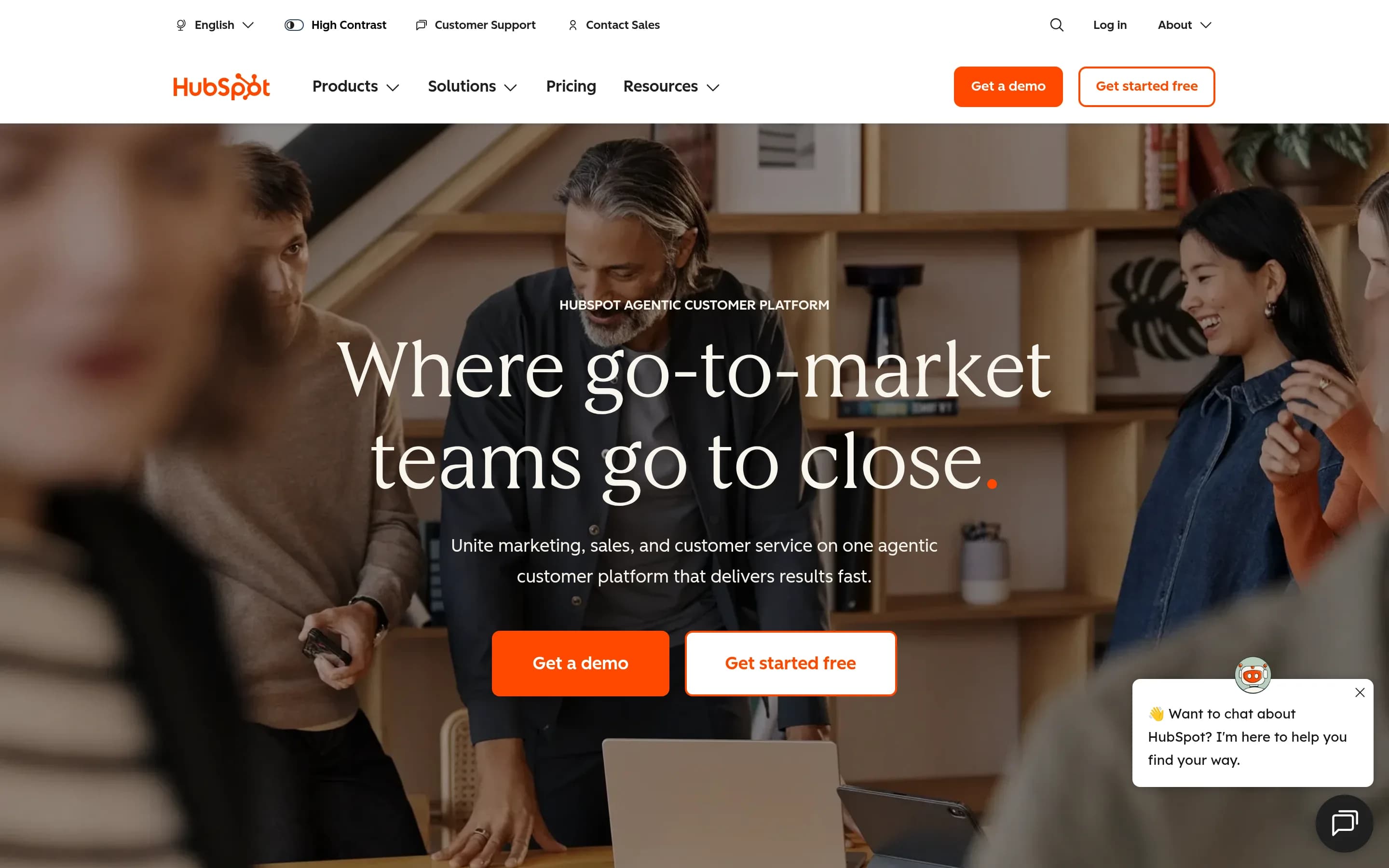
HubSpot is an integrated customer platform that combines CRM records with marketing automation, sales pipelines, customer service, content, data, and revenue tools. It provides shared customer data and workflows for marketing, sales, and support teams.
Why people leave HubSpot
Organizations may seek an alternative when they do not need HubSpot’s broad, integrated customer-platform approach. The product combines CRM, marketing, sales, service, content, data, revenue, and AI capabilities in one environment. A business focused on only one of those jobs may prefer a narrower tool with fewer modules, a workflow tailored more closely to one department, or less overlap with systems it already uses. Teams that have established tools for content, support, payments, or marketing may also decide that replacing them with a unified suite is unnecessary.
HubSpot’s emphasis on connected data can create a meaningful platform commitment. Customer records, campaigns, sales pipelines, support activity, content, automation, and AI agents can all become tied to the same system. Some organizations may instead want a modular architecture in which individual components can be changed independently. Others may prioritize direct control over deployment, data storage, customization, or integration behavior and therefore investigate open-source or self-hosted alternatives.
The breadth of the platform can also affect implementation and administration. Bringing several teams into one shared CRM may require data migration, process design, permissions, integration work, and training. HubSpot advertises more than 2,000 integrations as well as onboarding, migration, premium support, and partner services, but organizations may still prefer a product that better matches their existing processes without a larger platform rollout. Smaller teams could seek a simpler contact-and-pipeline system, while enterprises with specialized requirements might compare more configurable or domain-specific products.
Finally, product packaging may influence an evaluation. The crawled page presents separate Marketing, Sales, Service, Content, Data, Revenue, Smart CRM, and Agent products, with free and premium plans and a bundled Starter platform. Buyers may want to compare which workflows are available in the edition or combination they need, particularly when their requirements span multiple departments. Teams may also prefer alternatives that place less emphasis on built-in AI agents, offer different automation models, or provide a clearer fit for a single use case such as help-desk ticketing, campaign automation, or content publishing.
4 Best Open Source HubSpot Alternatives (Ranked)
Each alternative is evaluated for core feature coverage, deployment options, licensing, project health, and overall fit. The ranking prioritizes how closely a tool matches HubSpot's primary workflows, using popularity only as a secondary signal.
EEver-gauzy4,331
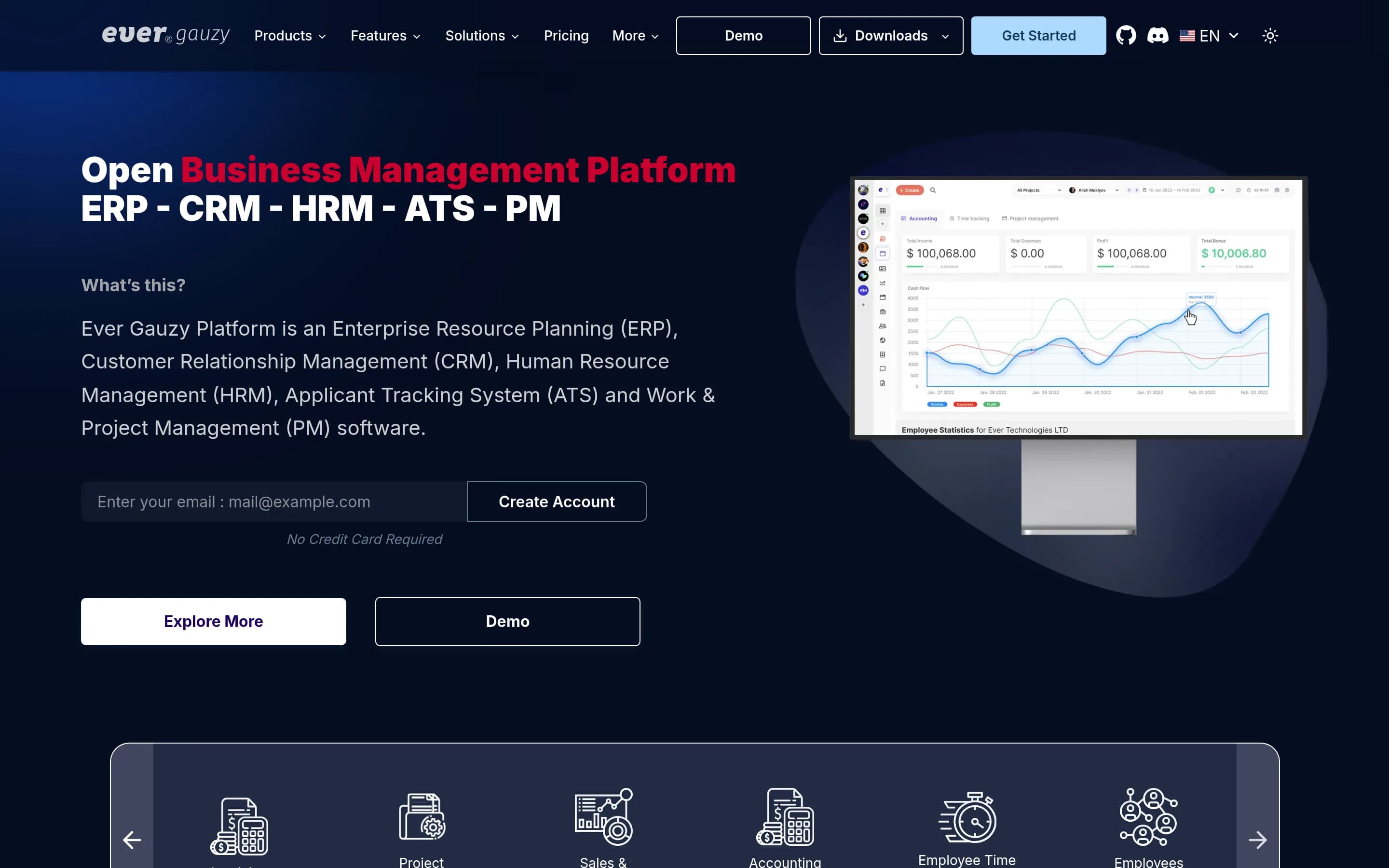
Ever Gauzy is not a feature-for-feature HubSpot replacement: it overlaps in CRM, sales pipelines, billing, payments, and integrations, but its documented scope centers on ERP, HRM, project management, and workforce operations rather than HubSpot’s integrated marketing, service, content, and AI workflows. Choose Ever Gauzy when self-hosting and combining customer records with internal business operations are primary;
What it does
Ever Gauzy is an open business-management platform combining CRM, ERP, HRM, applicant tracking, project management, time tracking, sales, and financial workflows. Its documented CRM capabilities include managing clients, customers, leads, contacts, sales pipelines, proposals, schedules, email history, reports, and analytics. It also includes invoicing, estimates, billing, payments, accounting, expenses, inventory, and integrations.
The product is available as a browser-based platform, server deployment, SaaS instance, and Windows, macOS, and Linux desktop applications. Users can run it locally with Node.js and Yarn or deploy it with Docker Compose; Kubernetes is recommended for production. It uses SQLite by default for demos and can connect to PostgreSQL, MySQL, and other documented databases.
What it covers
- CRM and contact management
- Sales pipelines
- Billing and payments
- Email history and templates
- External integrations
- Roles and permissions
What’s different
- Documented marketing automation
- Documented help-desk workflows
- Documented content publishing
- Documented AI agents
- Documented 2,000-plus app marketplace
- Documented HubSpot-specific migration
WWacrm1,956
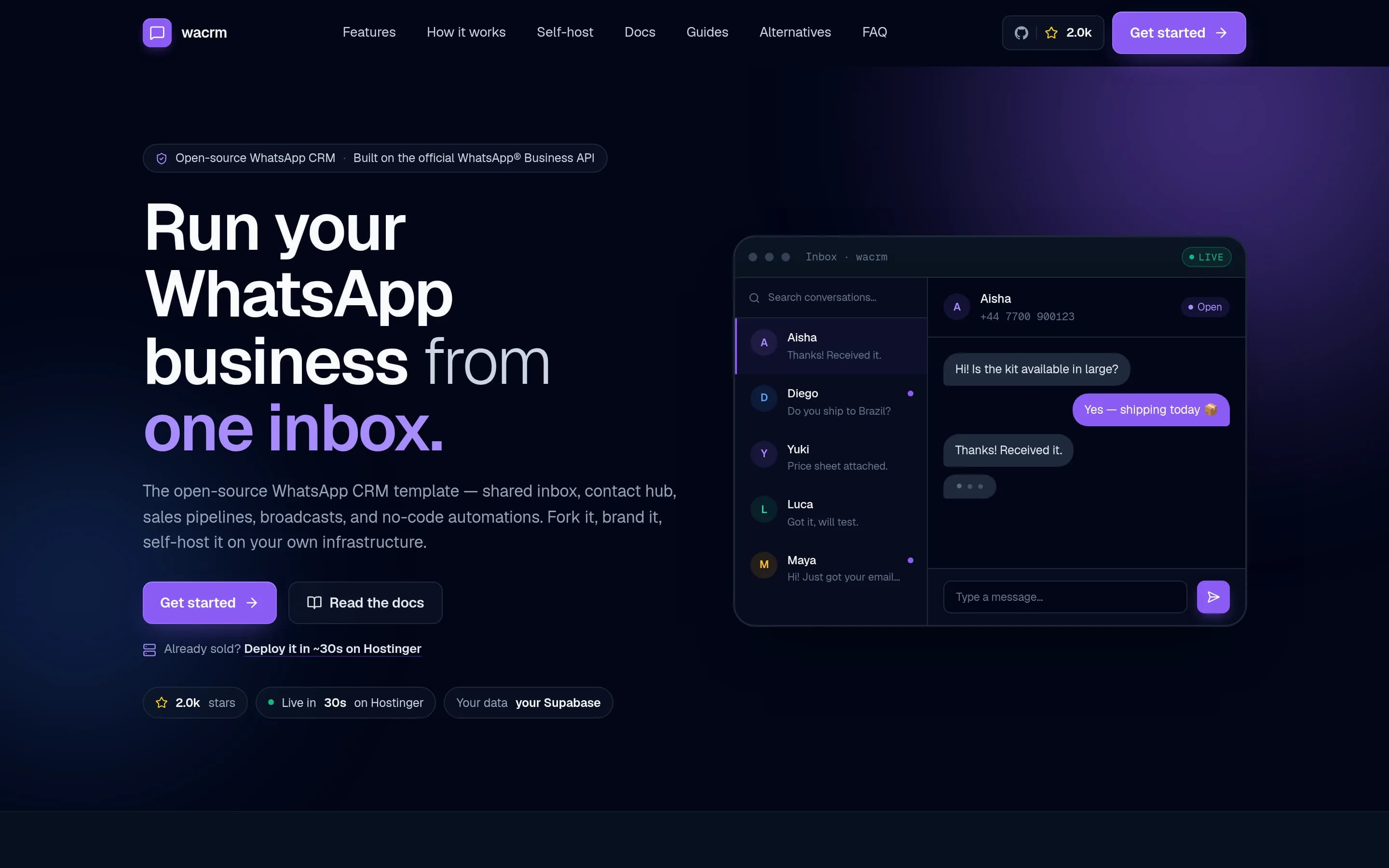
Wacrm is a narrower, self-hosted WhatsApp CRM template, not a full replacement for HubSpot’s integrated customer platform. Choose Wacrm when WhatsApp is the primary channel and code/data control, customization, and self-hosting outweigh suite breadth. Choose HubSpot when marketing, sales, service, content, customer data, revenue tools, and integrations need to operate as one managed platform.
What it does
wacrm is a self-hostable CRM template centered on the official WhatsApp Business API. Teams can share one inbox, assign conversations, add notes, manage contacts with tags and custom fields, import CSV data, deduplicate records, and link deals to Kanban sales pipelines. Broadcasts support Meta-approved templates, delivery and read tracking, and per-recipient variables.
The application also provides visual no-code automations, a real-time dashboard, role-based team accounts, a public REST API, and an MCP server. Its AI reply assistant supports provider-owned OpenAI or Anthropic keys, optional auto-replies, human handoff, and a knowledge base. It runs as a Next.js and Supabase application locally or on Node.js hosting, with Docker Compose documented; Hostinger is recommended.
What it covers
- Contact records with tags and custom fields
- Sales pipelines and deal stages
- Campaign-like broadcasts and automations
- Team customer-conversation workflows
- AI-assisted customer replies
- APIs and outbound webhooks
What’s different
- Broad integrated customer-platform scope
- Omnichannel shared inbox
- Formal SLA and CSAT help-desk tooling
- General content creation and publishing
- CPQ, billing, and payment tooling
- Large packaged app marketplace
AAtomic-crm1,199
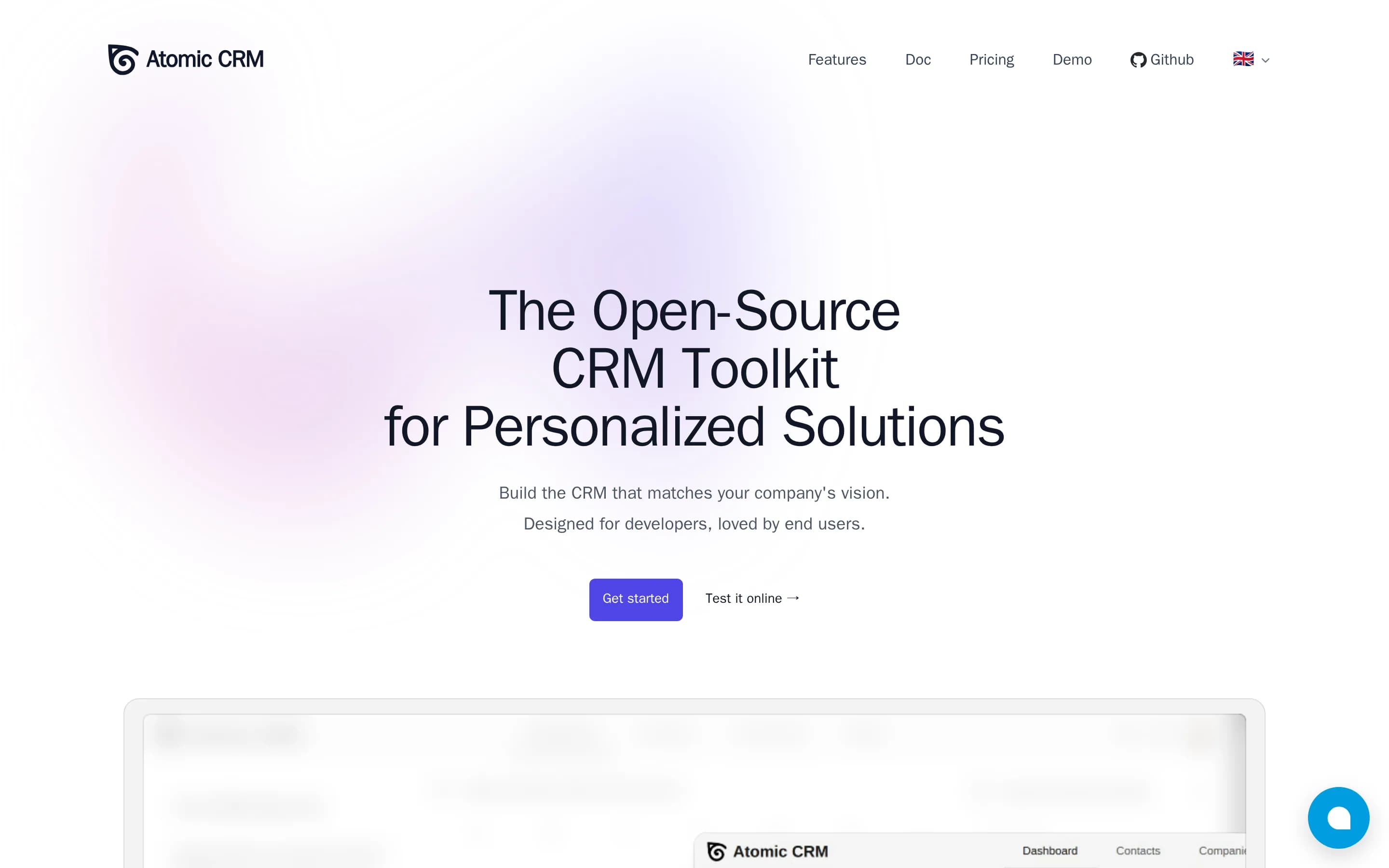
Atomic CRM is a focused, open-source CRM covering persistent contact records, activity histories, tasks, notes, email capture, and sales deal pipelines, but it does not document HubSpot's marketing automation, help desk, content, or broader customer-data platform capabilities.
What it does
Atomic CRM is a full-featured CRM built with React, shadcn-admin-kit, and Supabase. It provides contact organization, tasks and reminders, notes, email capture as notes, aggregated activity histories, data import and export, custom fields, access control, and an API for integrations.
The application includes a Kanban view for visualizing and tracking sales deals. It is free and open source under the MIT license, with an online demo and a documented local setup. Users can clone the repository, install dependencies, and run the Vite frontend with a local Supabase instance and Postgres database through Docker.
What it covers
- Contact and customer record management
- Aggregated activity and relationship history
- Sales deal and pipeline tracking
- Tasks, reminders, and follow-up coordination
- Notes and captured email communications
- Custom fields and data import/export
- API-based integrations
What’s different
- Automated marketing campaigns and lead nurturing
- Help-desk workflows and scalable customer support
- Content creation and distribution
- Broad shared customer-data workflows across marketing, sales, and support
- AI customer, prospecting, and data agents
- CPQ, billing, and payments
- App marketplace integrations
DDjango-crm611
Django-crm is a plausible HubSpot alternative for teams that primarily need self-hosted contact, lead, deal, task, email-campaign, and CRM analytics workflows—and can operate and customize a Python/Django application. HubSpot remains the better fit when the CRM must be part of a broader managed platform spanning marketing, support, content, data, revenue, AI agents, and a large integration marketplace. The central IT
What it does
Django-CRM is an open-source customer relationship management system for businesses, teams, agencies, and freelancers. It manages companies, contacts, leads, opportunities, deals, requests, products, payments, tasks, projects, email messages, and related CRM records, with role-based permissions and collaborative task features.
The platform includes sales pipeline tracking and forecasting, funnel and income reports, lead-source analytics, contact segmentation, newsletters, email campaigns, dynamic templates, and SMTP/IMAP integration with Gmail and other providers. Correspondence can be synchronized and linked to CRM objects, while web forms, messenger integrations, VoIP callbacks, and Excel import/export are also documented.
Django-CRM runs as a standard Django project and is designed for self-hosted or on-premise deployment. It uses Django Admin for its web interface, supports desktop
What it covers
- Contact and company records
- Lead and opportunity management
- Deal and pipeline tracking
- Email campaigns and segmentation
- CRM-linked email correspondence
- Role-based access controls
- Sales analytics and funnel reports
- Products and payment tracking
What’s different
- No documented content publishing suite
- No documented AI agents
- No documented CPQ or automated billing
- No documented large app marketplace
- No documented HubSpot-specific migration path
- No documented Docker or Kubernetes packaging